

NIST 800-53
NIST Special Publication 800-53 is the US federal catalog of security and privacy controls for information systems and organizations, referenced widely beyond federal use as a comprehensive control library.
What NIST 800-53 Contains
800-53 provides a large catalog of controls organized into families: access control, awareness and training, audit and accountability, assessment and authorization, configuration management, contingency planning, identification and authentication, incident response, maintenance, media protection, physical protection, planning, personnel security, risk assessment, system and services acquisition, system and communications protection, system and information integrity, and program management.
Controls have baseline profiles for different impact levels (low, moderate, high), with organizations tailoring selection based on system risk profile.
Where NIST 800-53 Fits
800-53 is the required control catalog for US federal systems under the Federal Information Security Modernization Act (FISMA). Contractors and vendors serving federal customers typically inherit 800-53 obligations.
Outside federal contexts, 800-53 is often referenced as a comprehensive control library. Organizations may not adopt it wholesale but frequently draw specific controls from it, particularly for gaps not covered well by other frameworks.
NIST 800-53 vs. Other Frameworks
800-53 is a control catalog, comparable in scope to ISO 27002. It is broader and more prescriptive than NIST CSF, which describes outcomes rather than specific controls. Programs typically use CSF for outcome-level structure and 800-53 for implementation detail when federal alignment is required.
Related Terms


Turn Cyber Risk Into Financial Exposure the Board Can Act On
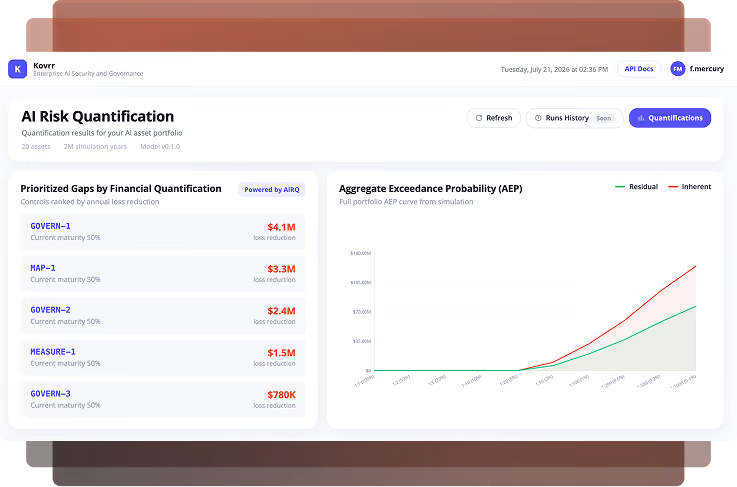
Security leaders are being asked to defend budgets, prioritize controls, and report cyber risk in the same terms as every other enterprise risk. Kovrr's CRQ Platform models loss scenarios, benchmarks control performance, and gives the C-suite a defensible view of where cyber sits on the balance sheet.