Blog Post
CRQ Platform Comparison for Financial Services Organizations
August 1, 2026
Cyber risk quantification (CRQ) has moved from optional to operational in financial services. The average cost of a data breach in the sector reaches $5.56 million, and regulatory mandates including DORA, NYDFS Part 500, and SEC cyber disclosure rules demand quantified, defensible loss exposure figures the finance function can act on.
Financial institutions evaluating CRQ platforms in the upcoming years face a maturing but genuinely differentiated vendor landscape, with meaningful methodology differences between the actuarial-grade platforms, the scenario-and-workshop platforms, and the multi-model control-crosswalk platforms. The right choice depends on whether the institution's primary driver is cyber insurance optimization, board-level reporting, cross-regulation compliance, or operational risk management at scale.
This article covers what makes financial services CRQ requirements distinct, the three categories of CRQ platforms competing for financial institution buyers, the specific requirements every FS evaluation should test against, how CRQ platforms scale for large enterprises, how they integrate with existing GRC platforms, and what Kovrr's approach brings to financial services CRQ specifically.
Why Financial Services Has Unique CRQ Requirements
Financial services CRQ is a different problem from CRQ in most other industries. Regulatory pressure is denser, insurance markets are more mature, systemic risk considerations matter more, and the audience for the outputs includes not just the board but also regulators, rating agencies, and reinsurance underwriters.
The Regulatory Pressure Driving Quantification
DORA came into force in January 2025 for financial entities operating in the EU, requiring ICT risk management frameworks, incident reporting, and third-party ICT risk management supported by quantified analysis. NYDFS Part 500 amendments now require covered entities to conduct annual risk assessments and demonstrate risk-based control decisions.
SEC cyber disclosure rules require material cyber incidents to be reported on Form 8-K, and the definition of "material" is inherently a quantified financial threshold analysis. Financial institutions face more regulatory demand for quantified cyber output than any other industry, which raises the stakes on both platform accuracy and platform defensibility. The ongoing CRQ trends that will define 2026 reflect exactly this regulatory acceleration.
The Insurance and Systemic Risk Dimensions
Financial institutions carry larger cyber insurance policies than any other sector, and the sophistication of the underwriting conversation has grown substantially. Insurers now expect quantified loss distributions, tail exposure figures, and control maturity data from applicants, and the cyber insurance coverage optimization conversation is materially different when the applicant walks in with defensible quantification.
Systemic and concentration risk add another dimension. When a large percentage of an institution's third-party dependencies rely on the same critical cloud provider or software supplier, the platform needs to surface that concentration and quantify what a systemic failure would mean, as documented in Kovrr's S&P 500 research on market resilience.
The Three Categories of CRQ Platforms for Financial Services
Financial services buyers typically evaluate between three distinct categories of CRQ vendor, each with different methodology, data ingestion approaches, and use case fit.
Category by Methodology
- Actuarial and loss modeling platforms (Kovrr): Combine internal telemetry with global insurance claims databases to produce financial loss distributions calibrated against real-world claims outcomes.
- Scenario-based workshop platforms (Axio, KPMG): Rely on user-guided scenario definition and structured workshops using approaches like OCTAVE Allegro, producing tailored risk-transfer analysis.
- Multi-model control-crosswalk platforms (CyberSaint): Layer NIST 800-30, FAIR, and other frameworks on top of continuous control monitoring, producing compliance-focused quantification.
Category by Use Case Fit
- Cyber insurance optimization and systemic risk analysis: Actuarial and loss modeling platforms are the strongest fit, since insurance-grade calibration is what the underwriter conversation runs on.
- Board stress testing and risk-transfer decisions: Scenario-based workshop platforms fit institutions that prioritize structured scenario development over continuous automated quantification.
- Cross-regulation compliance auditing: Multi-model control-crosswalk platforms fit institutions whose primary CRQ driver is mapping quantified risks across DORA, SEC, PCI-DSS, and internal frameworks simultaneously.
The best CRQ tools of 2026 buyer's guide covers cross-category evaluation criteria that apply regardless of which category best fits the institution.
Key Financial Services Requirements to Evaluate Against
Financial services buyers should test CRQ platforms against specific requirements the industry demands, rather than evaluating on generic feature lists.
Data and Modeling Requirements
- Actuarial-grade claims data: Insurance industry claims history and multi-source loss data anchor the model to real financial outcomes rather than analyst estimates alone.
- Sufficient Monte Carlo trials: The engine should run tens of thousands of trials per quantification for stable outputs, as detailed in the 25,000-trial statistical significance update.
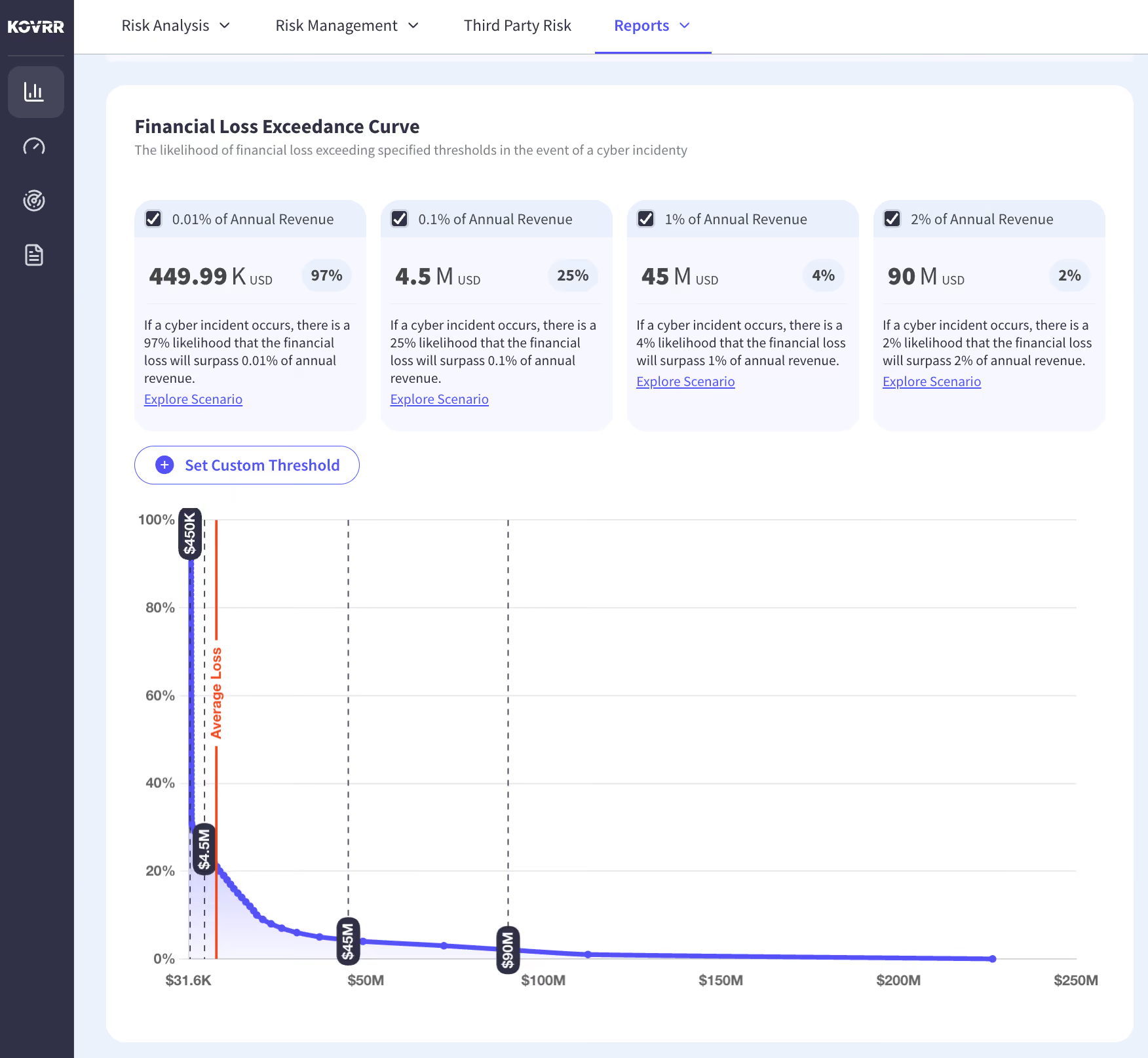
- Full loss distribution reporting: AAL, tail exposure, and the Loss Exceedance Curve should all be available, not just a single dollar figure.
Regulatory and Reporting Requirements
- DORA-aligned reporting outputs: The platform should produce the ICT risk management, incident reporting, and third-party analysis DORA requires without downstream analytical work.
- SEC materiality analysis: Native support for materiality thresholds and disclosure-ready loss figures, matching the materiality analysis discipline SEC rules require.
- Multi-framework crosswalking: The ability to map a single quantified risk to DORA, NYDFS, SEC, PCI-DSS, and NIST CSF 2.0 without duplicated effort.
How CRQ Platforms Scale for Large Enterprises
Large enterprise CRQ is different from mid-market CRQ. The volume of scenarios, the complexity of the asset environment, and the reporting demands from multiple audiences all compound. Platforms that work well for a mid-sized institution can hit hard scaling walls at the enterprise scale.
Volume of Scenarios and Asset Coverage
Large financial institutions typically run dozens of quantified scenarios across hundreds or thousands of asset groupings. Platforms that require manual scenario configuration per asset become prohibitively expensive at scale, while platforms with pre-built scenario libraries and asset-mapping automation stay tractable. The scenario library depth is a strong indicator of enterprise readiness, since manually building the library is where mid-market platforms lose enterprise deals.
Multi-Entity and Multi-BU Support
Global financial institutions operate multiple legal entities across jurisdictions, each with its own regulatory obligations, board reporting cadence, and materiality thresholds. The platform needs to support hierarchical entity structures where subsidiaries roll up into parent-level views, business units aggregate across geographies, and materiality analysis runs at the appropriate legal entity level. This is where portfolio risk management capabilities become essential for enterprise CRQ programs.
Continuous vs. Periodic Quantification at Scale
Large institutions cannot rely on annual or quarterly manual quantification cycles. The threat landscape and control posture change faster than any manual process can capture, and the audience for the outputs expects current-state numbers rather than snapshots. Enterprise-grade platforms integrate continuously with the security tooling stack, updating quantifications as controls and telemetry change, which is the pattern the continuous control monitoring integration with CRQ uses.
How CRQ Tools Integrate With Existing GRC Platforms
Every financial institution operates one or more existing GRC platforms, and the CRQ evaluation is often as much about integration as it is about the standalone CRQ product. Two patterns cover the fundamentals.
Native GRC Integrations to Look For
- Bidirectional data flow: The CRQ platform should send quantified risk data to the GRC system and pull control and asset context back, keeping both systems synchronized.
- API-first architecture: Documented APIs that let internal teams build custom integrations rather than depending on vendor development cycles.
- Pre-built connectors for major GRC vendors: Out-of-the-box integrations with the GRC platforms most FS institutions run, reducing time-to-value materially.
Data Flow Patterns That Work at Scale
- Register-level integration: Quantified risks flow into the enterprise cyber risk register with dollar-denominated exposure per entry.
- Control-level integration: Control maturity data flows from the GRC platform into the CRQ model, so quantified outputs reflect current control state without manual updates.
- Reporting-level integration: Board and regulatory reports draw from both platforms without duplicated data entry, so the cybersecurity board report reflects a single source of truth.
What Kovrr Brings to Financial Services CRQ
Kovrr's approach to FS CRQ combines three capabilities that map directly to the requirements the industry demands.
Actuarial-Grade Claims Data as the Modeling Foundation
The model draws on proprietary insurance claims data and multi-source threat intelligence to calibrate frequency and severity distributions against real financial outcomes. As Yakir Golan documented in how accurate CRQ models are, data provenance is the primary determinant of accuracy, and actuarial-grade inputs produce materially more defensible outputs than public breach data alone.
Connected Telemetry From Multiple Signal Sources
The platform ingests data continuously from security tools, cloud environments, identity providers, and third-party sources into a single analytical layer. That connected telemetry approach means the CRQ output reflects the current control posture rather than an annual snapshot, and the same underlying data feeds the cyber risk register, board reporting, and third-party risk views without duplicated integration work.
Cyber Insurance Optimization Built In
Because the model is calibrated against insurance claims data, the outputs are directly usable in cyber insurance renewal conversations. Institutions can model coverage adequacy, evaluate different limit and retention structures, and demonstrate defensible loss estimates to underwriters in the same language reinsurance markets already use. This is what the PE firm CFO CRQ approach is built around, and it extends naturally to portfolio-level cyber management at scale.
Choosing the Right CRQ Platform for Your Financial Institution
CRQ platform selection in financial services is a genuinely differentiated decision. Institutions whose primary driver is cyber insurance optimization or systemic risk analysis benefit most from actuarial and loss modeling platforms. Institutions focused on structured board stress testing may find scenario workshop platforms fit better. Institutions with cross-regulation compliance as the dominant driver may lean toward multi-model control-crosswalk platforms.
The strongest evaluations start with a clear articulation of the institution's primary CRQ driver, test each candidate platform against the FS-specific data, modeling, and reporting requirements, and evaluate GRC integration and scale characteristics before signing.
Book a demo of Kovrr's financial services CRQ approach tuned to your regulatory posture and insurance profile.

CRQ for Financial Services FAQs
Speak to an ExpertHow do CRQ platforms compare for financial services organizations?

Which cyber risk quantification tools scale for large enterprises?
Which CRQ tools integrate best with existing GRC platforms?
What regulatory requirements should FS CRQ platforms support?
How does cyber insurance optimization factor into FS CRQ platform selection?
How does CRQ support DORA compliance for financial institutions?