.jpg)
Blog Post
The Best Cyber Risk Quantification Tools in 2026: A Buyer's Guide
July 14, 2026
Cyber risk quantification tools translate technical exposure into the same financial language a CFO uses for market, credit, and operational risk. The best of them run probabilistic models on real telemetry, produce defensible loss distributions in dollar terms, and connect quantified exposure to the day-to-day workflows security teams already run: risk registers, board reporting, budget prioritization, and cyber insurance decisions. The wrong tool produces a static number no one trusts. The right tool becomes the reporting backbone of the entire cyber risk program.
Buyers evaluating cyber risk quantification tools in 2026 face a maturing market with meaningful differences in methodology, data inputs, and integration depth. This guide covers what separates a serious CRQ platform from a compliance dashboard with a dollar sign attached, walks through the vendors most commonly shortlisted for enterprise deals, and lays out an evaluation checklist buyers can use before signing a contract.
What Separates a Real CRQ Tool From a Dashboard
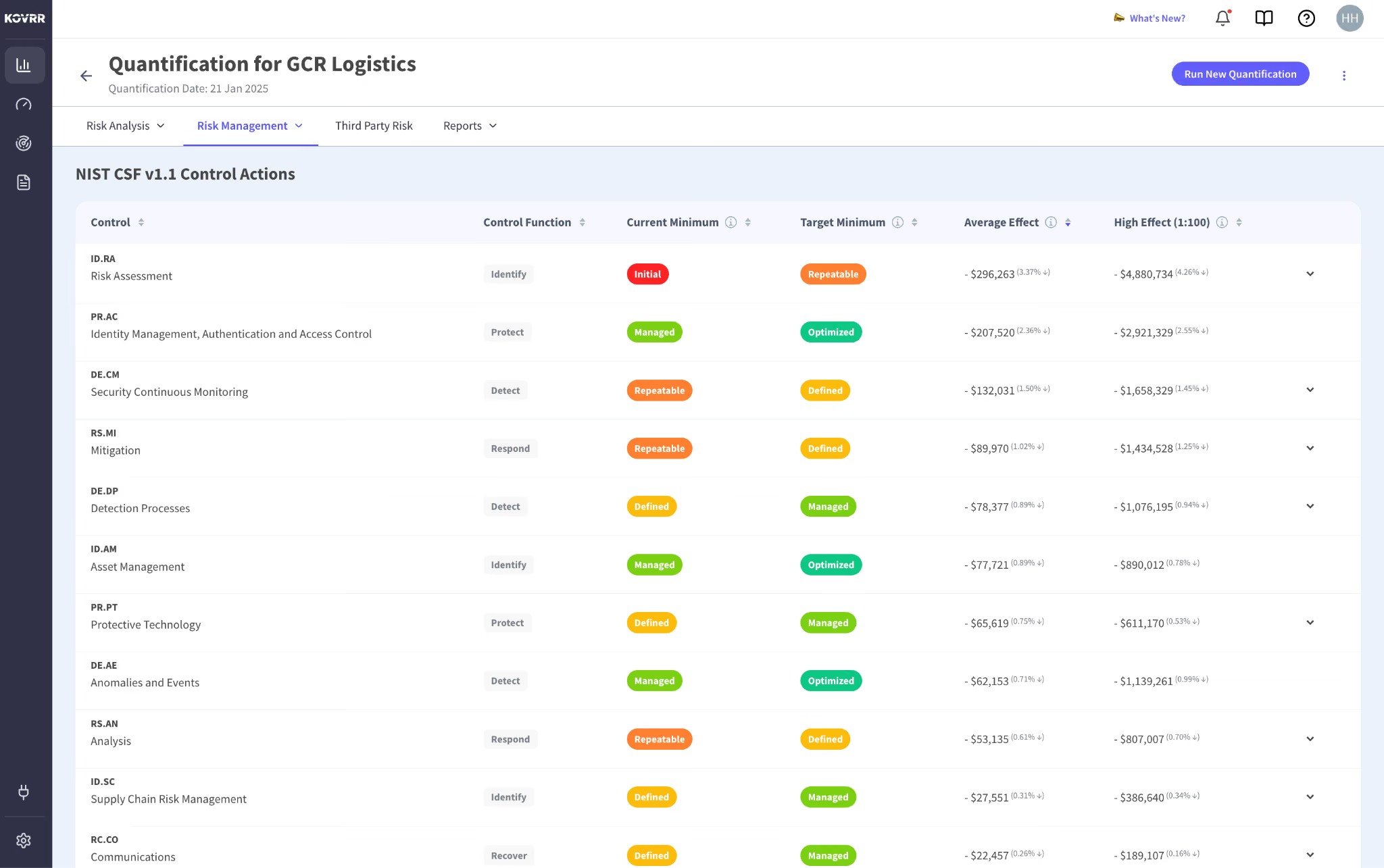
Every vendor in this category claims to quantify cyber risk. Fewer actually produce outputs a CFO or board risk committee will trust under scrutiny. Five capabilities separate the real platforms from the marketing:
- Probabilistic modeling backed by real loss data. A defensible model runs thousands of Monte Carlo simulations against calibrated frequency and severity inputs drawn from historical incidents, insurance claims data, and control maturity signals. Point estimates are not quantification. Kovrr's engine runs 25,000 trials per quantification, which is what gives the loss distribution statistical significance rather than the appearance of it.
- Automated data ingestion rather than questionnaire-driven inputs. Manual questionnaires bias the model toward what respondents believe, not what controls actually do. Platforms that ingest telemetry from security tools, cloud environments, and identity providers produce quantifications that track reality between assessment cycles.
- Financial outputs a CFO recognizes. Average Annual Loss, 1:100 tail exposure, and a Loss Exceedance Curve that finance leaders can compare to any other line on the enterprise risk register. If the tool only produces control scores or maturity ratings, it is not quantifying financial risk.
- Framework mapping without framework dependency. NIST CSF, ISO 27001, and DORA mappings should exist without forcing the buyer into a single methodology. The choice of model matters, and the buyer should not be locked into one theoretical framework as a condition of using the tool.
- Operational integration. The quantification has to feed the cyber risk register, board reporting, insurance decisions, and budget prioritization. A CRQ platform that produces beautiful reports but does not integrate with day-to-day operations gets abandoned within a year.
The CRQ Vendor Landscape
Most enterprise shortlists in 2026 include some subset of the following platforms. Each takes a different approach to the same underlying problem, and the right choice depends on the buyer's primary use case.
- Kovrr. Cyber risk quantification built on catastrophe modeling techniques from the insurance industry, with continuous data ingestion, 25,000-trial Monte Carlo simulation per quantification, and native integration into board reporting, insurance optimization, and third-party risk workflows. Strongest fit for organizations where cyber risk needs to be operationalized across security, finance, GRC, and insurance simultaneously.
- Safe Security (which acquired RiskLens). FAIR-aligned modeling with a large integration library. Buyers already committed to running an internal FAIR practice tend to shortlist it.
- CyberSaint (CyberStrong). Emphasis on mapping technical telemetry to compliance frameworks. Fits organizations whose primary CRQ use case is proving compliance ROI to auditors and executives.
- Axio. Scenario-based modeling with historical industry loss library. Positioned around cyber insurance premium alignment.
- Cymulate. Attack simulation platform that feeds simulation results into financial risk views. Fits organizations that want CRQ tied to red-team-style validation.
The methodological differences matter. Some tools are wrappers around a single risk framework, others are proprietary platforms with their own model architecture, and the distinction between a model and a framework determines how flexible the tool is when the buyer's environment or reporting needs change.
How to Evaluate a CRQ Tool Before Buying
A structured evaluation cuts through vendor pitch decks and gets to the questions that actually predict long-term value. Use this checklist across the shortlist.
1. Model and methodology
- What quantification model does the platform use, and is the buyer forced into a single methodology?
- How many Monte Carlo trials run per quantification, and how does the vendor demonstrate statistical significance?
- Where does the frequency and severity data come from, and how often is it refreshed?
- Can the model be calibrated to industry benchmarks specific to the buyer's sector?
2. Data inputs
- Does the platform integrate directly with existing security tools, cloud environments, and identity providers?
- Is control maturity assessed continuously or through point-in-time questionnaires?
- How is control maturity mapped to financial impact, and is the mapping transparent?
3. Outputs and reporting
- Does the tool produce AAL, 1:100, and a Loss Exceedance Curve, or only aggregate scores?
- Are outputs board-ready without additional formatting work?
- Can the model drill down to specific event types, business units, or scenarios?
3. Operational integration
- Does the platform populate a live risk register?
- Does it support cyber insurance decisions directly?
- Does it produce third-party and portfolio views for holding companies and PE firms?
- Are there top-down scenario capabilities for enterprise-wide stress testing?
4. Vendor and program fit
- Does the vendor offer a managed CRQ program for teams that need modeling expertise?
- What is the time-to-value from contract to first defensible quantification?
- How is model transparency handled, and can the buyer audit the assumptions?
Matching the Tool to Your Primary Use Case
Buyers rarely need a CRQ platform for one narrow reason. The strongest platforms serve multiple use cases from the same underlying data model. That said, primary drivers shape the shortlist:
- Board and executive reporting. Prioritize platforms with native AAL, 1:100, LEC, and quarter-over-quarter movement views. See the playbook of board-level cyber metrics for what the report should contain.
- Cyber insurance optimization. Prioritize platforms with insurance-industry data heritage and native coverage optimization workflows. Tools built on carrier-adjacent data produce numbers underwriters recognize.
- Third-party and vendor risk. Prioritize platforms that quantify third-party financial exposure rather than producing a security score. A score does not tell the CFO how much money is at stake.
- Portfolio views for holding companies and PE firms. Prioritize platforms with portfolio risk aggregation and PE-specific workflows that let boards compare exposure across companies in a portfolio.
- Regulatory disclosure and materiality analysis. Prioritize platforms with materiality analysis built in for SEC Item 106 disclosures and comparable regimes.
- Continuous control monitoring. Prioritize platforms with continuous control monitoring so the quantification tracks the environment rather than the last assessment.
Common Mistakes When Selecting a CRQ Tool
Failed CRQ deployments follow patterns. The mistakes below are the ones that show up repeatedly in post-mortems.
- Buying a compliance dashboard and calling it CRQ. Framework maturity scoring is not financial quantification. If the outputs are ratings and not dollar distributions, the tool will not answer the CFO's questions.
- Overweighting integrations without checking data quality. A platform with 200 integrations that pull noise produces a noisy model. Fewer high-quality data sources beat a long integration list of low-signal feeds.
- Ignoring model transparency. If the vendor cannot show how frequency inputs, severity inputs, and control effects translate into the final loss distribution, the buyer will lose the model transparency argument the first time a board member asks how the numbers were built.
- Underestimating the operational integration work. A CRQ platform that does not feed the risk register, board deck, and insurance renewal within six months will be replaced within twenty-four.
- Treating CRQ as a one-time project. Quantification is a continuous discipline. Static outputs decay fast, and buyers who treat CRQ as an annual exercise get the accuracy they pay for.
Choosing the CRQ Tool That Actually Gets Used
The CRQ market has enough serious platforms in it that buyers can find a good technical fit. The harder question is which tool gets adopted across security, finance, GRC, and insurance workflows and stays in use two years later. Platforms that produce defensible dollar outputs, integrate with the systems risk leaders already run, and provide transparent methodology tend to win the second-year renewal. The platforms that produce beautiful dashboards but sit on the shelf do not.
The strongest way to evaluate a CRQ tool is to see what it produces against your own data. Book a demo to see a full quantification, including AAL, 1:100 tail exposure, Loss Exceedance Curve, and control-level financial impact, run against a scenario tuned to your industry and control posture.

Best CRQ Tools 2026 FAQs
Speak to an ExpertWhat is a cyber risk quantification tool?

How is a CRQ tool different from a GRC or risk register platform?
Do I need to be committed to a specific risk framework to use a CRQ tool?
How long does it take to see value from a CRQ platform?
Can a CRQ tool support cyber insurance renewal conversations?
How does CRQ integrate with third-party and portfolio risk management?