
Blog Post
Cyber Risk Quantification Methodologies: A Practical Comparison
July 18, 2026
Cyber risk quantification methodologies translate technical exposure into structured financial estimates using mathematical, statistical, and actuarial techniques instead of ordinal ratings like high, medium, or low. The methodological landscape has matured enough that buyers now face real choices between frameworks that describe how to reason about risk, models that produce the numbers, and automated platforms that combine both. Understanding the differences between these approaches is the difference between a defensible cyber risk quantification program and one that produces numbers no one on the executive team trusts.
Every serious CRQ methodology answers the same underlying equation: cyber risk exposure equals breach likelihood multiplied by breach financial impact. What separates methodologies is how each one estimates likelihood, how it measures impact, how it handles uncertainty, and how transparently it exposes its assumptions.
This guide covers the primary methodologies in use today, the distinction between models and frameworks, how to choose the right approach for a given program, and the pitfalls that show up in every failed CRQ deployment.
The Two Categories of CRQ Methodology
Most confusion in this space comes from conflating two very different things. A CRQ program uses both, but they play different roles.
- Frameworks describe how to think about cyber risk. They organize concepts, define taxonomies, and standardize vocabulary. A framework tells you what factors matter. It does not produce numbers on its own.
- Models produce the actual quantified outputs. They ingest data, apply statistical techniques, and generate financial loss distributions. A model tells you what the numbers are.
Buyers who understand the model-versus-framework distinction avoid the most common architectural mistake in CRQ, which is committing to a single framework as if it were a model, or purchasing a model without checking which framework it operates under. The strongest programs use frameworks to structure thinking and dedicated models to produce the numbers.
Framework-Based Methodologies
Two frameworks dominate structured cyber risk thinking. Both organize how risk gets identified and described. Neither, on its own, produces the quantified financial outputs a CFO needs to make decisions.
1. FAIR (Factor Analysis of Information Risk): FAIR breaks risk into Loss Event Frequency and Loss Magnitude, then decomposes each further into contributing factors. It provides a taxonomy for reasoning about risk in probabilistic terms and gets used widely by internal risk teams who want a shared vocabulary. FAIR is an open standard maintained by The Open Group, and its main contribution to the field is definitional structure rather than a specific computational engine.
2. NIST SP 800-30: Published as part of the NIST Risk Management Framework, NIST SP 800-30 provides a systematic approach to identifying threats, vulnerabilities, and impacts. It is widely used to structure enterprise risk assessments, particularly in regulated industries and government contexts. Like FAIR, it defines a way of thinking about risk rather than a specific quantitative model.
Both frameworks are useful. Neither is sufficient on its own for financial quantification, which is why organizations pair them with statistical models that produce the actual dollar outputs.
Statistical and Mathematical Models
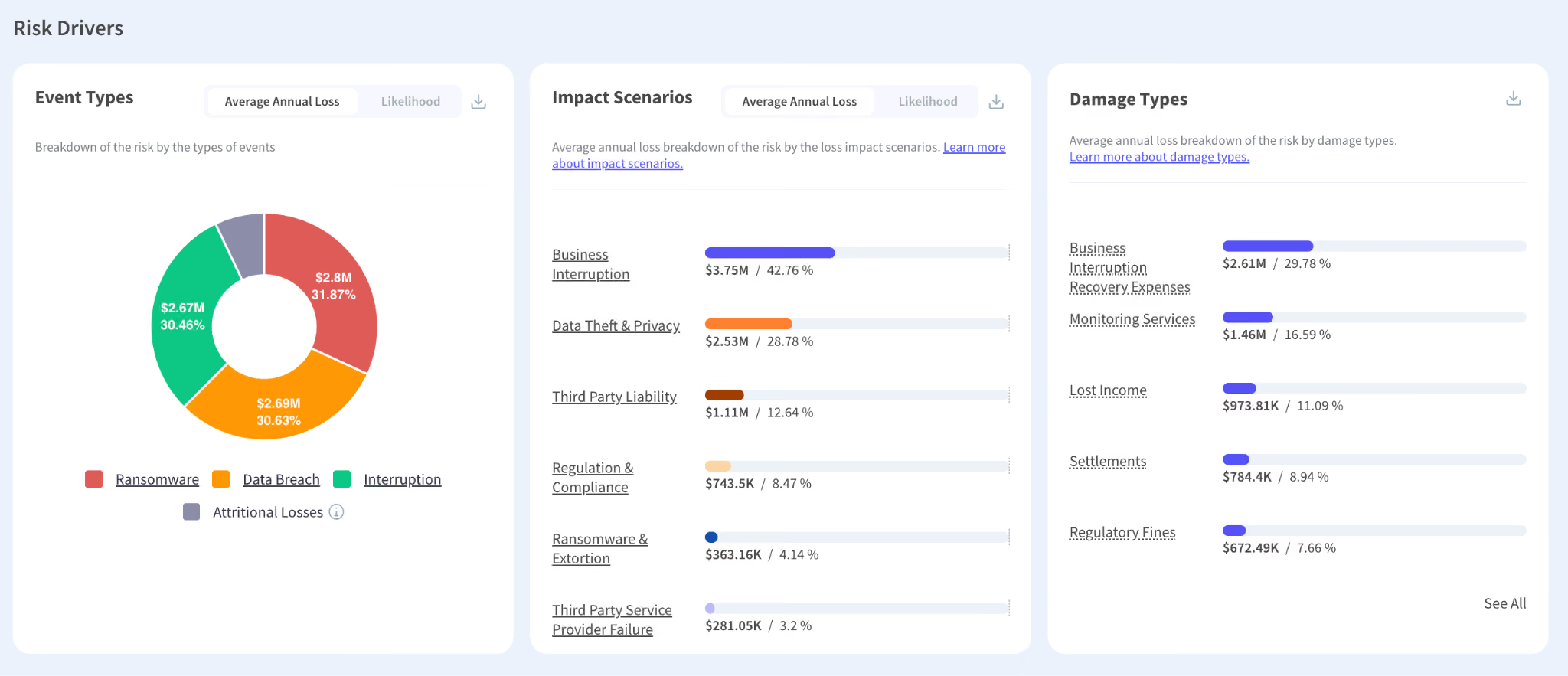
Models produce the numbers. Four statistical approaches dominate modern CRQ platforms.
- Monte Carlo simulation. The most widely adopted quantitative technique in cyber risk. Monte Carlo simulation runs thousands of randomized trials against probability distributions for frequency and severity inputs, producing a full range of potential outcomes rather than a single point estimate. Kovrr's engine runs 25,000 trials per quantification, which is what gives the resulting Loss Exceedance Curve statistical significance rather than the illusion of it.
- Bayesian networks. Graphical statistical models that calculate conditional probabilities between cybersecurity variables. Bayesian approaches let organizations update risk predictions as new threat intelligence arrives, which fits well with continuous data ingestion architectures.
- Cyber Value at Risk (CyVaR). Borrowed from financial risk management, CyVaR calculates the maximum potential financial loss within a specific timeframe and confidence level. It maps cleanly to how CROs and treasury teams already reason about market and credit risk, which is why it plays well in board-level cyber conversations.
- Actuarial and loss-history models. Statistical methods borrowed from insurance underwriting, using historical breach and claims data to forecast future losses. Platforms built on carrier-grade data heritage tend to produce numbers underwriters recognize during cyber insurance renewals.
Dynamic and Automated Approaches
Static methodologies decay fast. Two dynamic approaches keep quantification aligned with reality as the environment changes.
- Scenario-based modeling. Building specific, multi-variable attack paths and modeling their financial impact. Scenario intelligence lets teams isolate the worst-case impact of a targeted ransomware attack on a core system, a third-party service provider outage, or a data breach in a specific business unit. Top-down scenarios extend the same technique to enterprise-wide stress testing.
- Telemetry-driven automation. Continuous ingestion of security tool data, cloud posture signals, and identity provider events, feeding the quantification model in near-real time. Continuous control monitoring turns quantification from a point-in-time exercise into a live view of financial exposure as controls change.
The strongest modern CRQ platforms combine actuarial-grade Monte Carlo modeling with continuous telemetry ingestion and scenario-based drill-down. This hybrid architecture is what separates purpose-built CRQ platforms from spreadsheet-driven internal FAIR practices.
The Core Calculation Every Methodology Uses
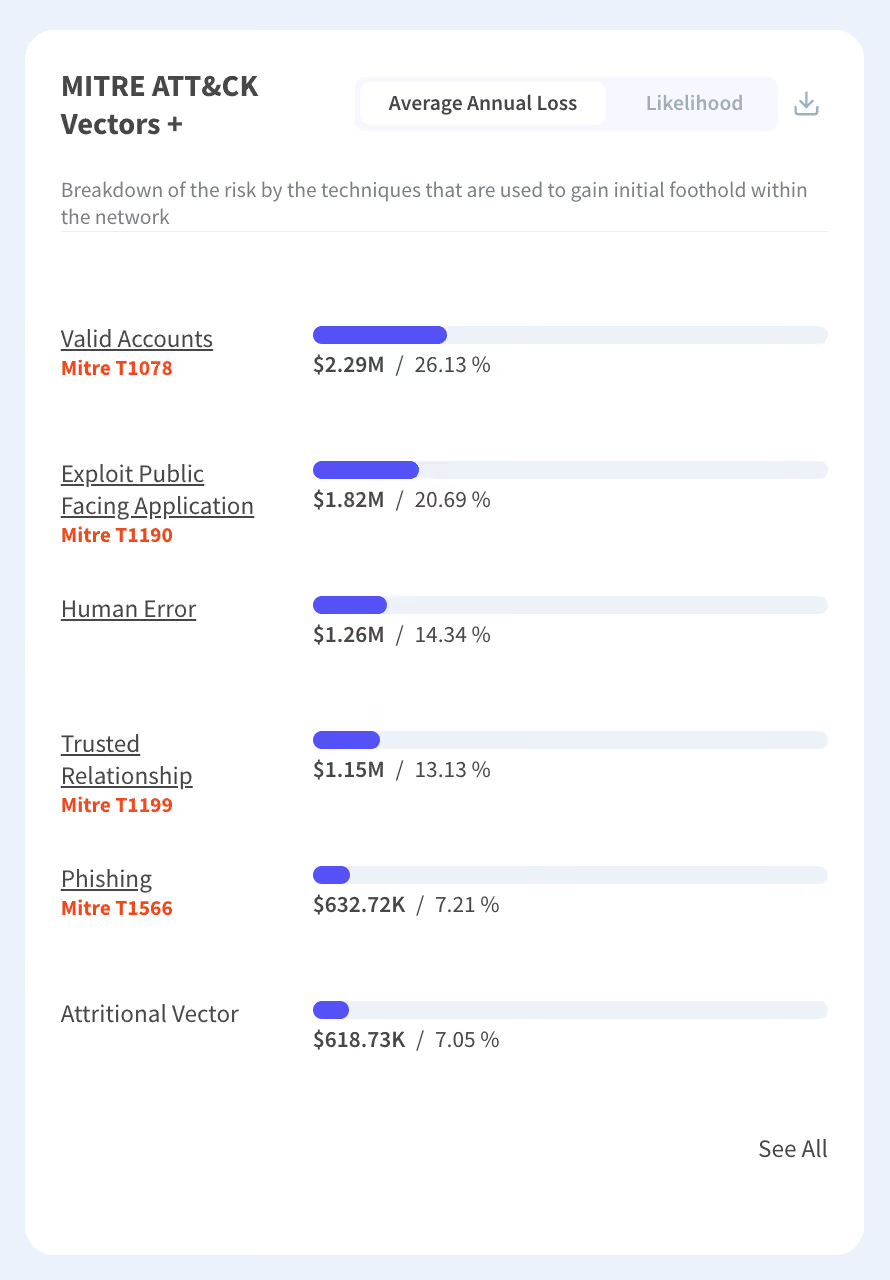
Regardless of methodology, nearly every quantitative platform applies the same foundational equation: Cyber Risk Exposure = Breach Likelihood × Breach Financial Impact.
The methodology determines how each side of that equation gets estimated. Frameworks structure the inputs. Statistical models compute the outputs. The full calculation runs through four phases:
- Asset valuation. Assign business value to the systems and data at risk, not IT replacement cost. This is where security and finance need to build the model together.
- Vulnerability assessment. Identify the control weaknesses that make each asset exposed, ideally through continuous telemetry rather than periodic questionnaires.
- Threat likelihood. Estimate the frequency of relevant threat events using historical incident data, industry benchmarks, and control maturity signals mapped to a framework like NIST CSF.
- Financial impact. Model the full loss distribution across primary direct losses, business interruption, legal and regulatory exposure, and secondary consequences like brand damage and customer churn.
How to Choose the Right Methodology
Methodology selection depends on the primary use case, the maturity of the risk program, and the audience that will consume the quantified outputs. Four questions cut through most vendor pitches.
- Who is the primary audience? CFOs and boards want AAL, 1:100, and a Loss Exceedance Curve. Auditors and regulators want framework-mapped documentation. Insurance underwriters want actuarial outputs in their vocabulary. The methodology should match the audience.
- How mature is the existing risk data? Organizations with rich internal loss data, security telemetry, and control maturity records can support advanced statistical modeling immediately. Programs starting from scratch typically benefit from a hybrid methodology that combines framework-driven structure with model-driven outputs, expanding as data quality improves.
- How much modeling expertise sits inside the team? Some methodologies require dedicated risk analysts fluent in the underlying math. Others produce equally defensible outputs through automated telemetry and pre-configured models. Buyers with limited internal modeling capacity often benefit from a managed CRQ program that pairs the platform with model calibration expertise.
- Does the methodology support operational workflows? A methodology that produces a beautiful annual report but does not connect to the cyber risk register, board reporting, budget prioritization, or third-party risk workflows will get abandoned. Fit for daily use matters more than theoretical elegance.
The choice of CRQ model is one of the most consequential architectural decisions in a cyber risk program, and buyers who take the time to evaluate methodology before committing tend to get significantly more value from whichever platform they ultimately select.
Common Pitfalls in CRQ Methodology Selection
Failed CRQ deployments follow patterns. The methodological mistakes below show up repeatedly:
- Confusing a framework for a model. Adopting FAIR or NIST 800-30 and expecting quantified financial outputs to appear. Frameworks structure thinking. They do not produce numbers.
- Overfitting to a single methodology. Locking the entire program into one theoretical approach when the environment demands flexibility. Regulatory requirements, insurance conversations, and board reporting each have their own vocabulary, and a rigid methodology strains under that pressure.
- Treating quantification as a one-time exercise. Point-in-time methodologies decay the moment threat data, controls, or business assets change. Continuous refresh is a methodological requirement, not a nice-to-have.
- Underestimating the input data problem. No methodology produces good numbers from bad inputs. Frequency data, severity data, and control maturity signals all need to be defensible, or the model's outputs are unreliable regardless of how sophisticated the math is.
- Ignoring model transparency. If the vendor cannot show how inputs translate into outputs, the buyer cannot defend the numbers when a board member asks. Methodological rigor is meaningless without transparency.
Where CRQ Methodology Is Heading
CRQ methodology continues to consolidate around a few principles: probabilistic modeling anchored in real loss data, continuous ingestion rather than periodic assessment, framework-agnostic architecture, and outputs that map to the language of finance rather than the language of IT.
The organizations getting the most value from cyber risk quantification (CRQ) are the ones that treat methodology as a foundation for continuous decision-making, not as an annual reporting requirement. The methodological choices made at the start of a program shape everything that comes after, and getting them right is worth the time before signing the contract.
The strongest way to understand a CRQ methodology is to see it run against your own data. Book a demo to see 25,000-trial Monte Carlo modeling, continuous telemetry ingestion, and framework-mapped outputs produce a defensible loss distribution tuned to your industry and control posture.

CRQ Methodologies FAQs
Speak to an ExpertWhat is the most widely used cyber risk quantification methodology?

Is FAIR the same as cyber risk quantification?
How is a Monte Carlo simulation used in CRQ?
Do I need a data science team to run a CRQ methodology?
How often should the methodology be run to keep outputs accurate?
Can multiple methodologies be used together in one program?