Blog Post
The Best AI Usage Monitoring Platforms for Enterprises in 2026
October 12, 2026
Search for AI monitoring tools and the results mix two unrelated markets. One watches model behavior, tracking latency, drift, token spend and hallucination rates for applications a team built itself. The other watches people, recording which AI tools employees reach, under which accounts, carrying what. Buying from the wrong list is the most common mistake in this category, and the analyst firms have already separated them.
Gartner names the second market AI Usage Control, defining it as technology that discovers the use of third-party AI and enforces an organization's security policies, inspecting content for sensitive data and raising alerts on anomalies. Every platform below belongs to that market. What separates them is which vantage points they watch from, and whether they read those vantage points together.
Why Does the Vantage Point Decide Everything?
Each place a platform can observe from sees one slice of an interaction and is blind to the rest. No amount of feature development changes what a given position can physically observe, so the architecture question comes before the feature comparison.
What the Network Sees
A proxy or firewall watching encrypted traffic records that a connection reached a known AI domain and how much data moved, which answers whether an unsanctioned tool was used. It cannot distinguish a corporate account from a personal one on the same device, and it cannot read what was inside the session.
What the Browser Sees
An extension reads the interaction before transport encryption applies, so it observes the content, the account and whether text was typed or pasted. It covers only what happens in a browser on a managed device, and the browser as the position where AI work happens explains why that covers more than it sounds.
What Identity Sees
Directory and sign-in records establish which accounts exist, which applications hold grants and which service principals were created. They prove an integration exists and say nothing about what passed through it afterward.
Which Surfaces Should a Platform Cover?
Eight, and a product's own integration catalog is the fastest way to check. Network, endpoint and detection response, browser, agents and model context protocol servers, cloud observability, large language model and OpenTelemetry streams, identity, and data loss prevention.
Why Count Sources Rather Than Features
A feature list describes intent and a source list describes reach. Asking how many integrations are live against how many the catalog offers produces a coverage ratio per category, which is a harder number to present well and a more useful one to receive.
What to Ask About Each Category
- Collection method: Whether the source pulls logs on a schedule or receives events as they occur.
- Attribution field: Which identifier the source supplies, since joining depends on a shared key.
- Refresh interval: How often it syncs, because continuous means different things to different vendors.
Does the Platform Read Sources Together?
The question that separates products built for this market from products extended into it. A platform holding eight integrations that each raise their own alerts is eight tools behind one login.
What a Joined Finding Looks Like
A single user sending at least ten megabytes to one AI tool within an hour and also making a single upload of a megabyte or more, inside a twelve-hour window. Neither half is remarkable alone. The finding exists because volume data and upload data were read against one identity.
Which Capability Does That Require
A layer that normalizes signals from every connected source onto shared identifiers before any rule runs. Kovrr calls its build of that layer the AI Interaction Data Fabric, and the general requirement is the same whoever supplies it, since the join rather than the sensors is what determines whether correlation is possible at all.
How to Test It in a Demo
Ask to see a finding that required more than one source, then ask which sources carried it. A product that can answer will show them. A product that cannot will show a dashboard with several panels on it.
Can the Platform Find AI Inside Software You Already Own?
Gartner's definition of the category includes fine-grained categorization that distinguishes AI-native services from AI embedded within existing applications. The second is where most discovery quietly fails.
Why Embedded AI Evades Discovery
A standalone assistant produces traffic to a recognizable destination. A summarization feature inside a tool your organization already licensed produces traffic to that tool's existing domain, which every control already permits. Nothing about the connection looks new.
What Finds It Instead
A vendor catalog that tracks which products have added AI features and what those features do, checked against the applications already in use. AI arriving inside software already purchased covers the governance consequence, and the discovery problem is the prior one.
What to Ask
Name three applications your organization already licenses that have shipped AI features this year, and ask the vendor how its platform would surface them. The answers separate catalog-backed discovery from destination matching.
How Do the Platform Categories Compare?
Vendors in this market cluster into three architectures, each with a characteristic strength and a characteristic blind spot.
Browser-Native Platforms
Push Security, Harmonic Security and LayerX operate primarily through an extension, reading prompt text and file uploads before anything leaves the device. Strongest on content and personal-account detection, weakest where work happens in a desktop application or on a device nobody manages.
Gateway and Proxy Platforms
Prompt Security, WitnessAI, Lasso Security and the AI modules inside larger secure access products sit in the traffic path. Strongest on enforcement at scale and on applications routed through them, weakest on anything that reaches a provider without crossing the gateway.
Identity-Centric Platforms
Grip Security maps shadow AI through directory records, OAuth tokens and application-to-application grants, needing no agent anywhere. Strongest at enumerating what exists and at finding integrations nobody registered, weakest on what the integration carried.
What Should an Evaluation Produce?
Four answers, each checkable rather than asserted, and each harder to fake than a feature matrix.
The Coverage Ratio
Connected sources against available sources, per category, measured in your own environment rather than in the vendor's demonstration tenant. A category at zero is a category the platform does not cover for you, whatever the catalog says.
The Attribution Rate
What proportion of observed AI activity resolves to a named person rather than a device or an IP address. Activity nobody can attribute cannot be governed, and tracking AI use across business units depends on that resolution working.
The Multi-Source Finding Count
How many findings in a trial period required more than one source to raise. A platform producing none is a collection of single-source alerts, and the count is the strongest available evidence of whether the join works.
Where Does Kovrr Sit?
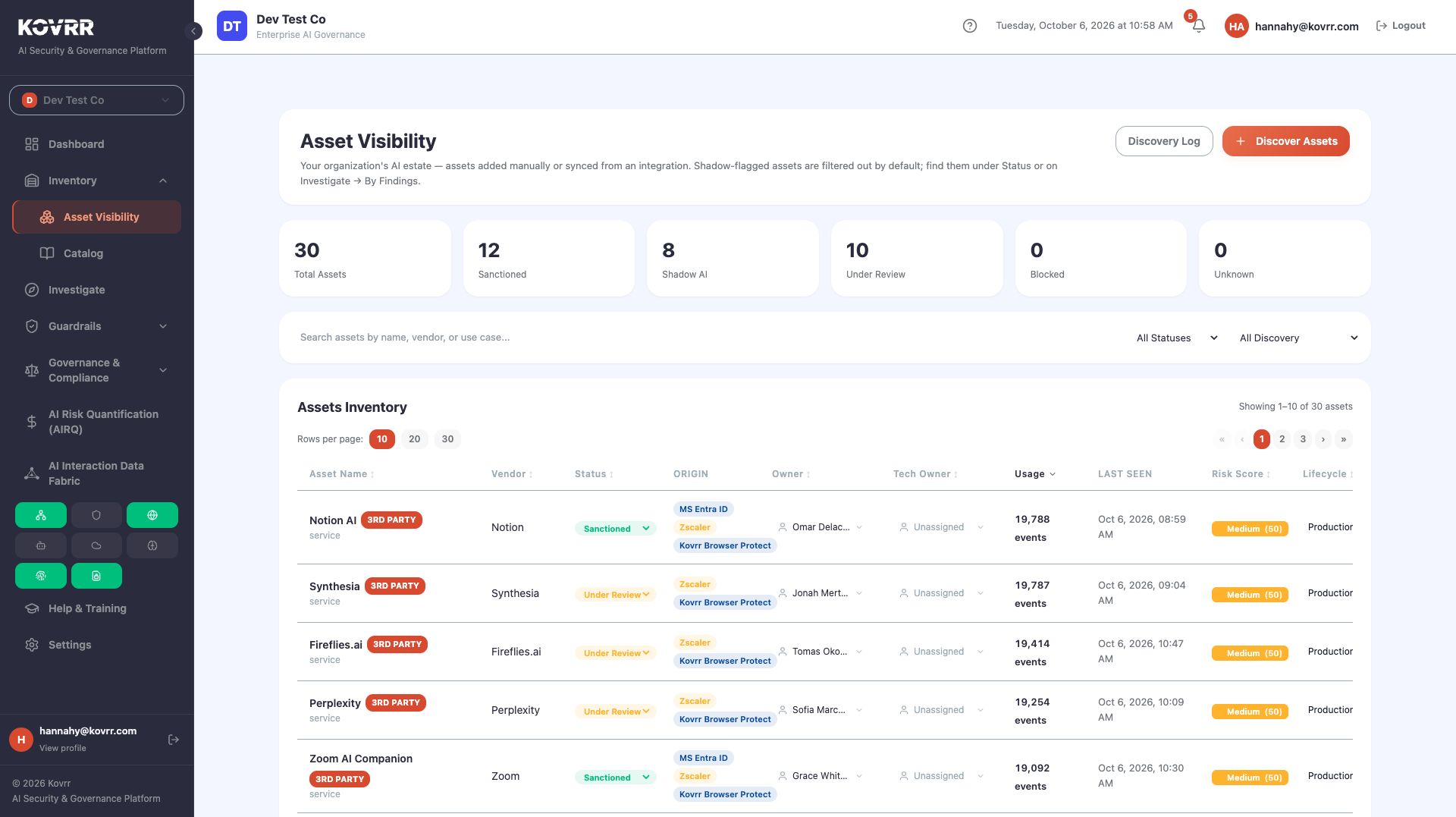
Kovrr's AI Security and Governance Platform is built around the correlation layer rather than a single vantage point, with asset visibility recording which sources detected each asset and usage monitoring resolving activity to named people.
What That Changes
Findings carry the sources that produced them, so a reviewer sees which surfaces contributed and which contributed nothing. The same records feed AI risk quantification (AIRQ), which prices the exposure that visibility reveals rather than reporting it as a count.
What It Is Not
An in-line enforcement gateway for every application. Organizations needing a proxy in the traffic path for all AI calls should evaluate the gateway category alongside it, and the two coexist without difficulty.
Buy for the Join, Not the Integration Count
The market Gartner calls AI Usage Control is distinct from model observability, and buying from the wrong list produces a tool that watches the wrong thing. Within the right market, each vantage point sees one slice and misses the rest, so coverage is a question about surfaces rather than features. Eight categories matter, and the useful measurement is connected sources against available sources in your own environment. What separates a platform from a bundle is whether those sources are read against shared identifiers before any rule runs, which a buyer can test by asking to see one finding that needed more than one source. AI embedded in software already licensed is where discovery fails quietly, and a vendor catalog rather than destination matching is what finds it.
To see which sources detect each AI asset in your own environment, book a demo mapped to your own estate.

.avif)
AI Usage Monitoring FAQs
Speak to an ExpertWhat is AI Usage Control?

What is the difference between AI monitoring and AI usage monitoring?
Which surfaces should an AI usage monitoring platform cover?
How do you test whether a platform correlates sources?
Why is AI embedded in existing software hard to discover?
What should an AI usage monitoring evaluation measure?