Blog Post
Browser AI Events in the SOC: What to Send and What to Suppress
August 19, 2026
Browser-layer AI monitoring produces events, and the natural next step is forwarding them to the security operations center. Consider what they arrive into. Industry research for 2026 puts false positives at close to half of all alerts, with around forty-two percent going entirely uninvestigated.
Browser AI events are behavioral anomaly alerts, and behavioral anomaly alerts are the category analysts already deprioritize, precisely because they are noisy by nature. Insider risk research attributes a substantial share of its cost estimates to exactly that dynamic. Forwarding a new high-volume behavioral feed into that queue produces a compliance record rather than a detection capability, unless someone decides in advance what belongs there.
Most Browser AI Events Are Policy Findings
The first decision is not technical. An employee pasting a customer record into an approved assistant has broken a policy. Nothing was compromised, no attacker is involved, and the appropriate response is a conversation with a manager or a change to the tooling. Sending that to a security analyst asks the wrong person to act on it.
Two Destinations, Not One
Policy findings belong with the governance owner, aggregated and reviewed on a cadence, feeding trend reporting and policy revision. Security detections belong in the SOC with a runbook attached. Routing both to the same queue guarantees the second gets lost in the first, since volume determines attention regardless of severity labels. Recording policy events in the AI inventory rather than the SIEM keeps them where the person who can act on them will read them.
What Genuinely Belongs in the SOC
Three categories earn a security destination, and the case for watching at the browser layer explains why they surface there rather than on the network. Credentials or secrets leaving to any destination, because the exposure is immediate and irreversible. Activity from an identity or endpoint that already has an open security case, since correlation is the SOC's function. Volume or automation patterns suggesting a compromised account rather than a careless user, which is a detection question rather than a policy one.
Do Not Send the Payload
This is the mistake most likely to create the exposure it was meant to detect. Browser AI telemetry can include the prompt text, which is where the regulated data was in the first place. Forwarding raw prompts to a SIEM copies customer records, credentials and health information into a second system with its own retention schedule, its own access model and a considerably wider audience.
Send the Classification, Not the Content
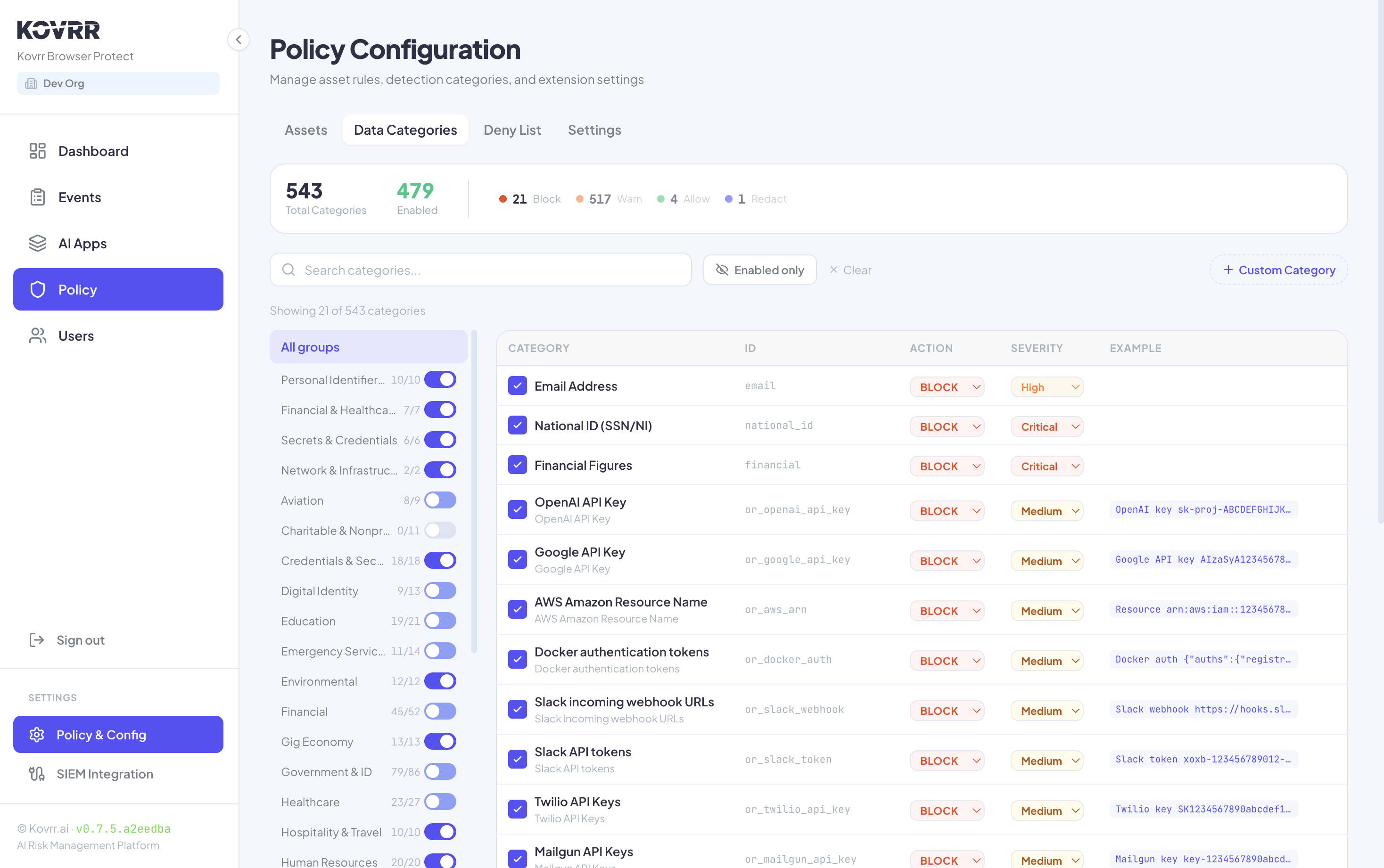
An event recording that a prompt matched a payment card pattern, at a stated confidence, from a named identity, at a timestamp, supports every detection rule worth writing. The card number itself adds nothing to the detection and adds a great deal to the retention obligation. Where investigators genuinely need content, holding it in the originating system under narrower access, with the SIEM event carrying a reference, keeps the exposure bounded. Anyone who has worked through how regulated data reaches AI tools will recognize the pattern being repeated.
Retention Follows the Data, Not the Tool
Prompt content copied into a log platform inherits that platform's retention rather than the obligation attaching to the data. A seven-year log retention policy holding health information creates a compliance position nobody chose, and it is discovered during an audit rather than designed. Classification-only events avoid the question entirely.
Three Rules Worth Writing
Detection logic for this feed is simpler than the tooling suggests, and three rules cover most of the value.
- Secret Patterns: Any match on credential, token or key formats, regardless of destination or volume, with immediate escalation.
- Volume Departure: Content size or prompt count exceeding an established baseline for that identity rather than a fixed threshold.
- Automation Signature: Prompt frequency inconsistent with human interaction, which indicates a script or a compromised session.
Identity Context Decides the Verdict
A fixed character threshold produces the same alert for a platform engineer pasting code into an approved coding assistant and a finance analyst pasting a similar volume into a consumer chatbot. One is normal work and one is an incident, and only identity and role separate them. Scoring against a per-identity baseline rather than an absolute number is what makes the rule survive its first week. Establishing that baseline is its own exercise, and behavioral baselines in production apply to people as readily as to agents. The reasoning matches identity-based enforcement at the browser layer.
Suppress the First Occurrence, Alert on the Third
One person trying a new tool once is not a security event. The same tool appearing across a third team within a week is. Thresholds tuned to spread rather than to individual instances keep the queue small enough that somebody reads it, and the pattern belongs in a policy review rather than an alert in the meantime.
Aggregate Before Ingestion
Two problems share one solution. SIEM licensing generally prices on volume, and analyst attention prices on click-throughs. Both are consumed by repetitive low-value events that a forwarder can collapse before they arrive.
Grouping identical or near-identical prompts into a single event with a count, filtering categories that were configured as permitted, and forwarding summaries rather than individual records for low-severity categories reduces both costs at once. Practitioner guidance on SIEM tuning suggests a small fraction of available data produces most of the actionable intelligence, and browser AI telemetry is unusually susceptible to that arithmetic because ordinary use generates constant events.
Decide the Volume Before You Enable the Feed
Estimating daily event count per thousand users before integration is a ten-minute exercise that prevents a difficult conversation later. Programs that enable the feed first and tune afterward spend the interval either paying for ingestion they did not budget or generating alerts nobody triages, and both outcomes damage the case for the control itself.
What the Analyst Needs at Two in the Morning
An alert reading that a user pasted sensitive data into a chatbot is not actionable. The analyst cannot tell whether it matters, and the natural response is to close it and move on.
Four fields change that. Which data category matched and at what confidence. Whether the destination is sanctioned, under enterprise terms or neither. Whether the identity has other open findings. What the runbook says to do, stated in the alert rather than in a wiki. An alert carrying those four is triageable in under a minute, and an alert missing them consumes ten and resolves nothing. The same reasoning applies to identifying and managing AI-related incidents generally.
Write the Runbook Before the Rule
A detection rule without a documented response is a rule that trains analysts to ignore its output. For each of the three rules above, decide who is contacted, whether credentials are revoked automatically, whether the session is terminated and who owns the follow-up with the individual. Where the answer to any of those is unresolved, the rule is not ready to enable regardless of how well it detects.
Measure the Feed, Not Just the Findings
Three numbers tell you whether the integration is working, and none of them counts alerts. The proportion of forwarded events that resulted in an action of any kind. The median time to triage for this rule family compared with the SOC average. The proportion of the AI estate the feed covers in practice, since browser telemetry misses unmanaged devices and personal profiles entirely.
That third number is the one most likely to be assumed rather than measured. A feed covering managed browsers on managed devices describes a subset, and reporting findings from it as though they describe the whole estate overstates coverage. Pairing it with discovery across the wider estate is what keeps the denominator honest.
Route by Owner, Not by Availability
Browser AI telemetry is genuinely valuable and most of it is not security telemetry. Policy findings belong with a governance owner on a review cadence, a narrow set of detections belong in the SOC with runbooks attached, and the prompt content belongs in neither. Deciding that split before enabling the feed is the difference between a control that gets used and one that gets muted. Kovrr's AI Security and Governance Platform classifies events at the point of capture, so what reaches a SIEM is the finding rather than the content.
To see which browser AI events would warrant a detection in your environment and which belong in a policy review, book a demo mapped to your own estate.

Browser AI Telemetry FAQs
Speak to an ExpertShould browser AI events be sent to a SIEM?

Why not forward the prompt content itself?
What detection rules make sense for this telemetry?
How do you avoid adding to alert fatigue?
What should a browser AI alert contain?
How much of the AI estate does browser telemetry cover?