
Blog Post
The Top AI Agent Security Vendors of 2026: A Buyer's Guide
August 1, 2026
Enterprise buyers evaluating AI agent security in 2026 face a market that has fragmented into specialized categories, each solving one layer of the problem well and other layers poorly. Identity vendors govern non-human credentials. Runtime vendors constrain what agents can do at the moment of execution. Established security platforms extend their existing offerings into the agentic space.
A fourth category, still small, combines discovery, monitoring, enforcement, and quantification into a single connected platform architected around fused telemetry across every signal source an agent might touch. Understanding which category actually fits an enterprise's operational reality is the difference between buying a tool that closes one control gap and buying a platform that operationalizes the full agent lifecycle.
This article covers why the AI agent security market split into distinct categories, the four vendor categories buyers should recognize, what to look for when evaluating agentic AI governance vendors, the six capabilities that separate serious platforms from marketing exercises, where Kovrr fits in the landscape, and the common mistakes buyers make when moving from evaluation to purchase. The goal is a defensible vendor decision that supports the full AI governance program enterprises need rather than a point tool that closes one gap while leaving three others open.
Why the AI Agent Security Market Split Into Categories
The market fragmentation makes sense once you look at how agentic AI creates risk. Agents introduce identity, runtime behavior, and audit challenges simultaneously, and no single technology stack was designed to address all three. Identity vendors emerged from the non-human identity space, focused on credentials, permissions, and lifecycle management.
Runtime vendors emerged from the LLM security space, focused on prompt injection, output filtering, and behavioral guardrails. Enterprise platforms extended their existing security offerings with agent-specific modules. Each category solves a real problem, and each one is insufficient on its own.
The buyer's challenge is that vendors within each category often position themselves as complete solutions to agent security when they cover only their specialized layer. Enterprises that select on the wrong axis end up with strong identity controls and weak runtime enforcement, or the reverse, and the missing pieces become visible only after the first incident forces attention. The security risks of AI agents in the enterprise span all four layers at once, which is why single-category solutions leave measurable exposure no matter how strong they are in their domain.
The Four Categories of AI Agent Security Vendors
The current market breaks cleanly into four vendor categories. Understanding which one a candidate vendor belongs to is more useful than comparing feature lists across the whole field, because vendors in different categories solve different problems.
Category 1: Agentic Identity and Access Governance
Vendors in this category focus on managing non-human identities for AI agents. They govern the credentials agents use, enforce least-privilege access, track agent identity delegation chains, and manage lifecycle events like provisioning and decommissioning. Representative vendors include Linx Security, Astrix Security (acquired by SailPoint under the Entro brand), Oasis Security, and Saviynt. Identity is a necessary layer of AI agent security, and it does not cover runtime behavior, discovery of shadow agents, or the broader visibility question of what agents are actually doing across the enterprise.
Category 2: Agent Runtime Security and Guardrails
Vendors in this category operate at the execution layer, applying real-time controls to what agents can prompt, read, and do. Their products typically include input filtering to prevent prompt injection, output inspection to block unauthorized actions, and behavioral constraints on tool and system access.
Representative vendors include Zenity, Pillar Security, Prompt Security (acquired by SentinelOne), Aim Security (acquired by Cato Networks), and Lakera (acquired by Check Point). Runtime enforcement is critical for stopping specific attacks in flight, and by itself it does not produce the discovery, cross-signal correlation, or governance program integration enterprise buyers need for a complete program.
Category 3: Enterprise Platform Extensions
Established cybersecurity platforms have added AI agent security to their existing offerings, typically through acquisition or native-built modules. Palo Alto Networks offers Prisma AIRS. Microsoft provides Entra Agent ID and Defender for AI agents. CrowdStrike offers Falcon AIDR (AI Detection and Response). These vendors bring the operational scale, integration depth, and enterprise support their existing platforms already provide, extended to cover autonomous AI. The tradeoff is that agent security often sits as one feature among many rather than a purpose-built center of gravity, and the depth in any single agent discipline can vary significantly by product line.
Category 4: Connected Platforms With Fused Telemetry
A fourth category is emerging that combines discovery, monitoring, enforcement, and quantification into a single platform architected around fused telemetry across every signal source an agent might touch. The defining feature of this category is data fusion rather than any single technical control. Signals from browser sessions, endpoints, network flows, identity providers, third-party AI catalog data, and MCP server activity all feed into one continuously updated view of the AI environment.
Kovrr sits in this category through the AI Security and Governance Platform and the AI Interaction Data Fabric that underpins it. This category is smaller than the others because the connective architecture takes longer to build, and it is materially better suited to enterprises that need to operate agent security as an integrated program rather than a collection of point controls.
What to Look for When Evaluating Agentic AI Governance Vendors
Vendor evaluation criteria for AI agent security break into two lenses. The first covers the operational disciplines every serious program needs. The second covers the enterprise-readiness factors that determine whether the vendor scales with the buyer's organization.
Operational Discipline Coverage
- Discovery across sanctioned and shadow deployments: The vendor should catch every agent operating across the enterprise, including shadow MCPs, community-built agents, and third-party agents connecting into internal systems.
- Runtime enforcement at every action: Real-time input, output, and behavioral guardrails that block policy violations before they execute, backed by continuous monitoring of agent behavior in production.
- Policy enforcement tied to inventory: Governance policies applied to specific agents at the moment they act, so runtime controls draw directly from the governance program rather than existing as parallel infrastructure.
Enterprise-Readiness Factors
- Fused telemetry across multiple signal sources: Data ingested from browser sessions, endpoints, network flows, identity providers, and AI catalog signals into one analytical layer, not a single-signal point tool.
- Integration with existing security and GRC stack: Native API integrations with enterprise identity providers, SIEM platforms, and GRC systems so agent security data flows to the tools the enterprise already runs.
- Regulatory framework alignment: Direct mapping to the EU AI Act, NIST AI RMF, ISO 42001, and sector-specific frameworks like DORA so compliance documentation flows from the platform rather than requiring manual reconciliation.
The Six Capabilities That Separate Serious Platforms
Beyond the category-level distinctions, six specific capabilities separate platforms that produce defensible enterprise programs from platforms that produce dashboards with limited operational leverage.
Data and Signal Capabilities
- Multi-source fused telemetry: Signals from browser, endpoint, network, identity, AI catalog, and MCP activity ingested into one analytical layer with cross-signal attribution linking every agent action back to the originating human principal and business process.
- Continuous rather than point-in-time discovery: New agents caught as they are deployed, abandoned agents flagged as they go idle, and the inventory kept current as the environment changes.
- AI apps catalog depth: Coverage of 15,000-plus AI applications with SBOM-level CVE tracking so third-party AI risk gets managed with the same rigor as traditional software supply chain risk.
Operational and Governance Capabilities
- Runtime guardrail enforcement with audit trails: Input, output, and behavioral controls applied at execution time, preserved in immutable logs that support post-incident forensics and regulatory audit.
- Compliance mapping across frameworks: Automated evidence collection and framework crosswalking so a single quantified risk maps across the EU AI Act, ISO 42001, NIST AI RMF, and sector-specific rules without duplicated effort.
- Direct integration with the enterprise risk register and board reporting: Discovered agents flow into the AI Risk Register with governed metadata per entry and into continuously updated board reporting views rather than living in a standalone dashboard.
Where Kovrr Fits in the AI Agent Security Landscape
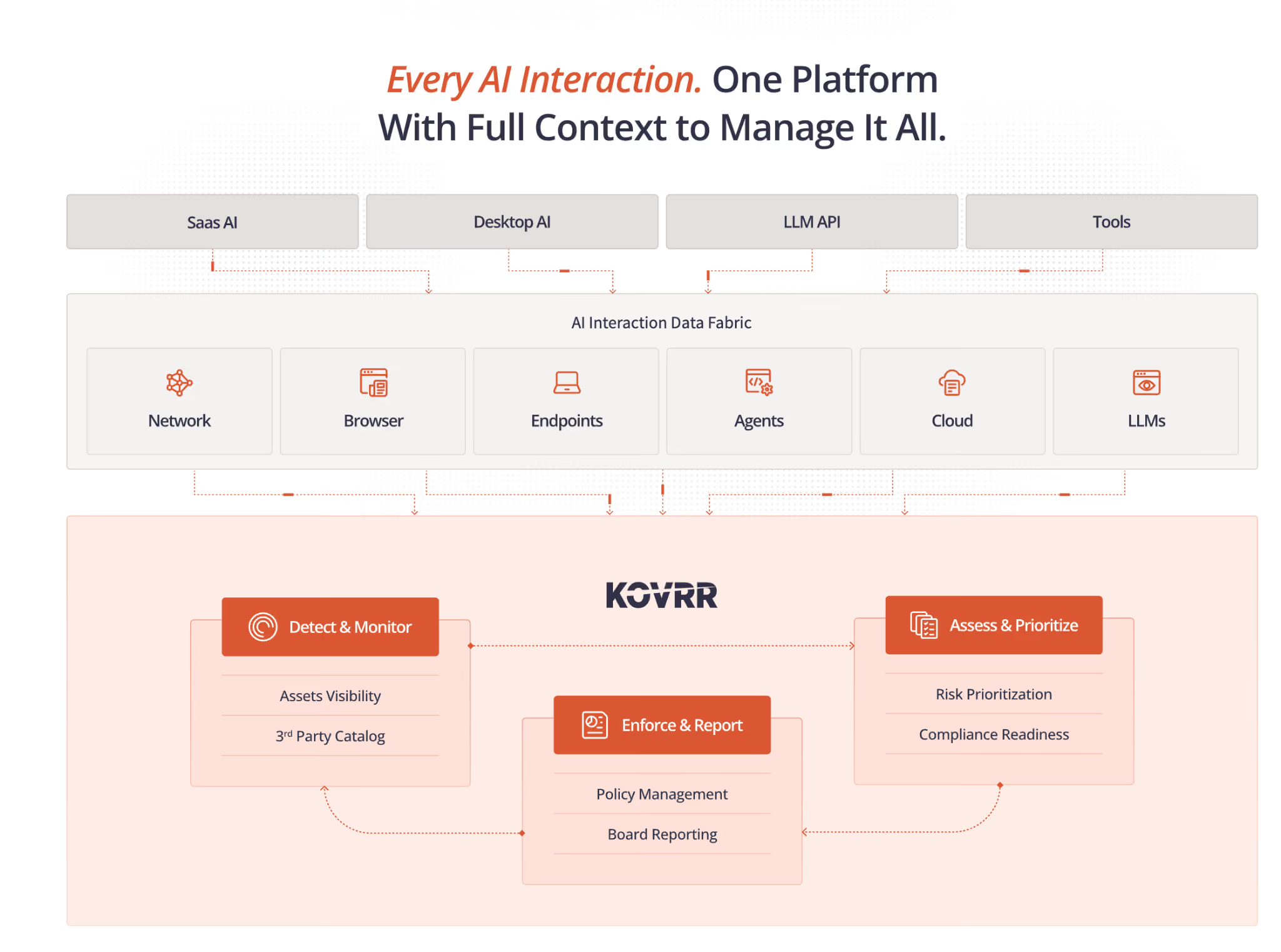
Kovrr sits in the fourth vendor category, combining discovery, monitoring, enforcement, and quantification into one platform architected around fused telemetry. The approach differs from the identity, runtime, and enterprise-extension categories in three specific ways worth understanding for buyer evaluations.
The AI Interaction Data Fabric ingests signals from browser sessions through the AI Security Extension, endpoint activity, network flows, identity providers, third-party AI catalog data, and MCP server activity into one continuously updated view. That fused signal set produces attribution linking every agent action back to a named human principal and specific business process, which is what turns raw agent telemetry into a governed inventory rather than a stream of alerts no one can correlate.
The platform integrates natively with the broader AI governance program covering asset visibility, compliance readiness, third-party risk monitoring, and AI cyber event response, so agent security operates as one discipline within a coherent program rather than a standalone silo. The AI risk quantification (AIRQ) capability is available as one downstream output for enterprises that want dollar-denominated exposure figures for board and insurance conversations, drawing on the same probabilistic modeling foundation that powers Kovrr's cyber risk quantification platform.
Common Mistakes When Evaluating AI Agent Security Vendors
Failed vendor evaluations follow predictable patterns. Two categories cover most of the traps.
Evaluation Process Mistakes
- Comparing across categories on the wrong axes: Runtime vendors and identity vendors solve different problems, so feature comparisons between them produce misleading results unless the buyer has already decided which category fits their operational reality.
- Selecting on demo depth rather than operational fit: Impressive demo capabilities do not always translate into production leverage, especially when the vendor's strength sits in one discipline the enterprise does not weight highly.
- Underestimating the discovery layer: Buyers who focus entirely on runtime and identity capabilities miss that neither works if the agent inventory is incomplete, which is where shadow AI and continuous discovery become the prerequisite rather than an optional feature.
Post-Selection Integration Mistakes
- Deploying without integration to the broader governance program: Vendors that operate as standalone silos produce controls without the AI risk visibility enterprise programs need to make strategic decisions.
- Skipping the third-party AI risk workstream: Buyers who focus only on internal agents miss a substantial portion of the total enterprise exposure, since third-party AI usage often outpaces internal deployment.
- Treating vendor selection as one-time rather than continuous: The agent security market is moving fast enough that vendor capabilities shift materially between annual renewal cycles, and buyers who lock in three-year contracts on premature capability assumptions carry real switching cost risk.
Making an Informed AI Agent Security Vendor Decision
Selecting the right AI agent security vendor is a category decision before it is a feature decision. Buyers who understand which of the four vendor categories fits their operational reality make materially better decisions than buyers who compare across categories on generic feature lists.
Enterprises that already operate mature identity programs may extend into agent identity governance as a natural next step. Enterprises that need runtime enforcement to unblock a specific agentic deployment may prioritize a runtime vendor. Enterprises that need the connective architecture spanning all four disciplines from day one benefit most from platforms in the fused telemetry category, where discovery, monitoring, enforcement, and reporting all draw from the same underlying signal layer.
To see how Kovrr turns fused signals across browser, endpoint, network, identity, and AI catalog sources into a single operational view of every AI agent and MCP server across the enterprise, book a demo of the AI Security and Governance Platform.

Top AI Agent Security Vendors FAQs
Speak to an ExpertWhat are the top AI agent security vendors in 2026?

What should I look for when evaluating agentic AI governance vendors?
What are the best tools for AI agent security and governance?
How is AI agent security different from traditional application or API security?
What is the difference between agent identity governance and agent runtime security?
How does connected telemetry change the AI agent security conversation?


.png)
