
Blog Post
AI Guardrail Platforms Compared for Enterprise Deployment
August 6, 2026
Enterprise AI guardrails are the technical controls that prevent AI systems from doing things they shouldn't, applied at the moment of execution rather than after the fact. They sit between the AI model or agent and the systems, data, and users it interacts with, filtering inputs, inspecting outputs, and constraining behavior against enterprise policy.
The market for AI guardrail platforms has fragmented into four architectural categories, each optimized for a different deployment scenario, and enterprises evaluating guardrails need to understand which categories fit their existing infrastructure, regulatory obligations, and program maturity before comparing individual vendors within any category.
This article covers why enterprise AI guardrails span multiple layers, the types of guardrails every serious program needs, the four categories of guardrail platforms competing for enterprise deployment, what to look for when evaluating platforms for enterprise use, how the comparison changes for regulated industries, and where Kovrr fits in the broader guardrail landscape. The goal is a defensible platform selection that supports the full AI governance program rather than a point tool that closes one policy gap while leaving others open.
Why Enterprise AI Guardrails Span Multiple Layers
Enterprise AI deployments almost never live in a single architectural layer. A financial institution running generative AI through Azure OpenAI Service also has developers building custom agents against internal APIs, business teams using SaaS AI features embedded in their productivity suite, and employees accessing browser-based AI tools during the workday. Guardrails have to operate at every layer where AI is being used, which is why single-layer guardrail solutions leave measurable exposure regardless of how strong they are in their specific domain.
Where Guardrails Actually Operate
Guardrails run at four architectural layers in the enterprise. Gateway-layer guardrails route traffic before it reaches the model. Cloud-native guardrails run inside the model provider's managed service. Specialist runtime firewalls inspect prompts and outputs in flight as dedicated engines. Application-layer middleware embeds directly into agent code. Each layer has different latency, deployment, and governance characteristics, and each solves a specific piece of the problem. Enterprises typically need controls at more than one layer, which turns guardrail selection into a portfolio decision rather than a single vendor question.
Why the Governance Layer Sits Above Them All
Technical guardrails at every layer produce enforcement events, but enforcement without governance context produces alerts no one can act on. The broader AI governance program has to coordinate policy across guardrail layers, map enforcement events back to the agent inventory, and produce audit trails that satisfy regulators regardless of which specific technical guardrail fired. This coordination layer is where fused telemetry and centralized governance produce leverage that individual technical guardrails cannot deliver on their own.
The Types of Guardrails Every Enterprise Program Needs
Guardrails vary in category and purpose. Two categories of technical control cover most of what enterprise programs need to deploy, and both should be in place before agents move into production at scale.
Runtime Input and Output Controls
- Input filtering: Screens incoming prompts, retrieved documents, and tool responses to prevent prompt injection, malicious instructions, and policy-violating content from reaching the agent or model reasoning layer.
- Output inspection: Reviews the agent's proposed responses and actions before they execute, blocking harmful, biased, or unauthorized outputs from reaching users or downstream systems.
- PII and sensitive data redaction: Automatically detects and redacts regulated information categories including personal data, healthcare records, financial identifiers, and internal confidential content.
Behavioral and Policy Controls
- Tool and system access constraints: Limits which APIs, databases, and internal systems the agent can call, with just-in-time credential scoping rather than standing broad-scope permissions.
- Rate limiting and step-count caps: Hard limits on tool calls, reasoning steps, or elapsed time per task prevent runaway loops and infinite retry behaviors that can exhaust compute budgets or degrade downstream systems.
- Policy-aligned action blocking: Runtime enforcement that draws directly from the enterprise governance policy, so a controls violation blocks execution rather than logging it after the fact.
The Four Categories of AI Guardrail Platforms in 2026
The enterprise AI guardrail market breaks into four categories organized by where the platform operates in the architecture stack. Understanding which categories fit an enterprise's deployment reality is more useful than comparing individual vendors across the full field.
Gateway-Layer Guardrails
Gateway platforms operate as a centralized control plane at the network level, routing enterprise LLM traffic and applying guardrails inline before requests reach the model providers. Representative platforms include Bifrost from Maxim AI, Kong AI Gateway, and Cloudflare's AI Gateway. Gateways fit enterprises with multi-model or multi-cloud deployments where centralized policy enforcement matters more than deep integration with any single model provider, since the gateway sits between the enterprise and every model the organization uses.
Cloud-Native Managed Guardrails
Cloud provider platforms bake guardrails directly into their managed AI services. AWS Bedrock Guardrails handles content filtering, PII redaction, denied topic enforcement, and RAG grounding verification. Azure AI Content Safety within Azure AI Foundry includes prompt shields for jailbreak defense and multi-severity content moderation. Google Cloud Model Armor provides native prompt protection and safety-attribute scoring within Vertex AI. These platforms fit enterprises whose AI is already concentrated within a single cloud provider and who prefer managed services with zero additional infrastructure to run.
Specialist Runtime Firewalls and Evaluators
Dedicated platforms operate as runtime firewalls or real-time assessment engines specialized in adversarial defense, hallucination detection, and compliance checking. Representative vendors include Lakera (acquired by Check Point), Prompt Security (acquired by SentinelOne), Pillar Security, Zenity, Galileo, Patronus, Cisco AI Defense (built on the Robust Intelligence acquisition), and F5 AI Guardrails.
Specialist platforms typically outperform other categories on prompt-injection defense and jailbreak detection because they specialize in exactly that problem, and they fit enterprises where adversarial AI defense is the primary driver of the guardrail investment.
Application-Layer Middleware and Frameworks
Code-level tools run alongside application logic and give developers programmatic control over conversation flow and output structure. NVIDIA NeMo Guardrails uses a specialized language called Colang to script conversational paths, manage dialog state, and execute multilingual safety filtering. Guardrails AI is a developer-first open-source framework for validating and correcting LLM outputs.
Application-layer tools fit engineering teams building custom AI applications where strict programmatic control over dialog flow and schema shapes matters more than turnkey policy enforcement.
What to Look For in an Enterprise-Grade AI Guardrail Platform
Enterprise buyers evaluating guardrail platforms should focus on the capabilities that determine whether the platform supports the broader governance program rather than just closing a specific technical gap.
Enterprise Readiness Requirements
- Coverage across multiple AI surfaces: The platform should handle generative AI, agentic AI, and browser-based AI interactions rather than specializing in a single deployment pattern.
- Integration with existing security and identity stack: Native API integrations with enterprise identity providers, SIEM platforms, and GRC systems so guardrail events flow to the tools the enterprise already runs.
- Audit-grade enforcement logging: Immutable logs of every enforcement decision preserved for the retention period the applicable regulatory framework requires, with reasoning context alongside the technical action.
Governance and Compliance Alignment
- Framework mapping: Direct alignment to the EU AI Act, NIST AI RMF, ISO 42001, and sector-specific frameworks so a single enforced control maps across multiple regulatory obligations.
- Policy consistency across layers: Enforcement decisions should draw from a single governance policy layer rather than requiring separate configuration for each guardrail deployment.
- Continuous compliance evidence: Automated evidence collection for regulatory audits, so compliance documentation flows from the platform rather than requiring manual reconciliation from technical logs.
How AI Guardrail Platforms Compare for Regulated Industries
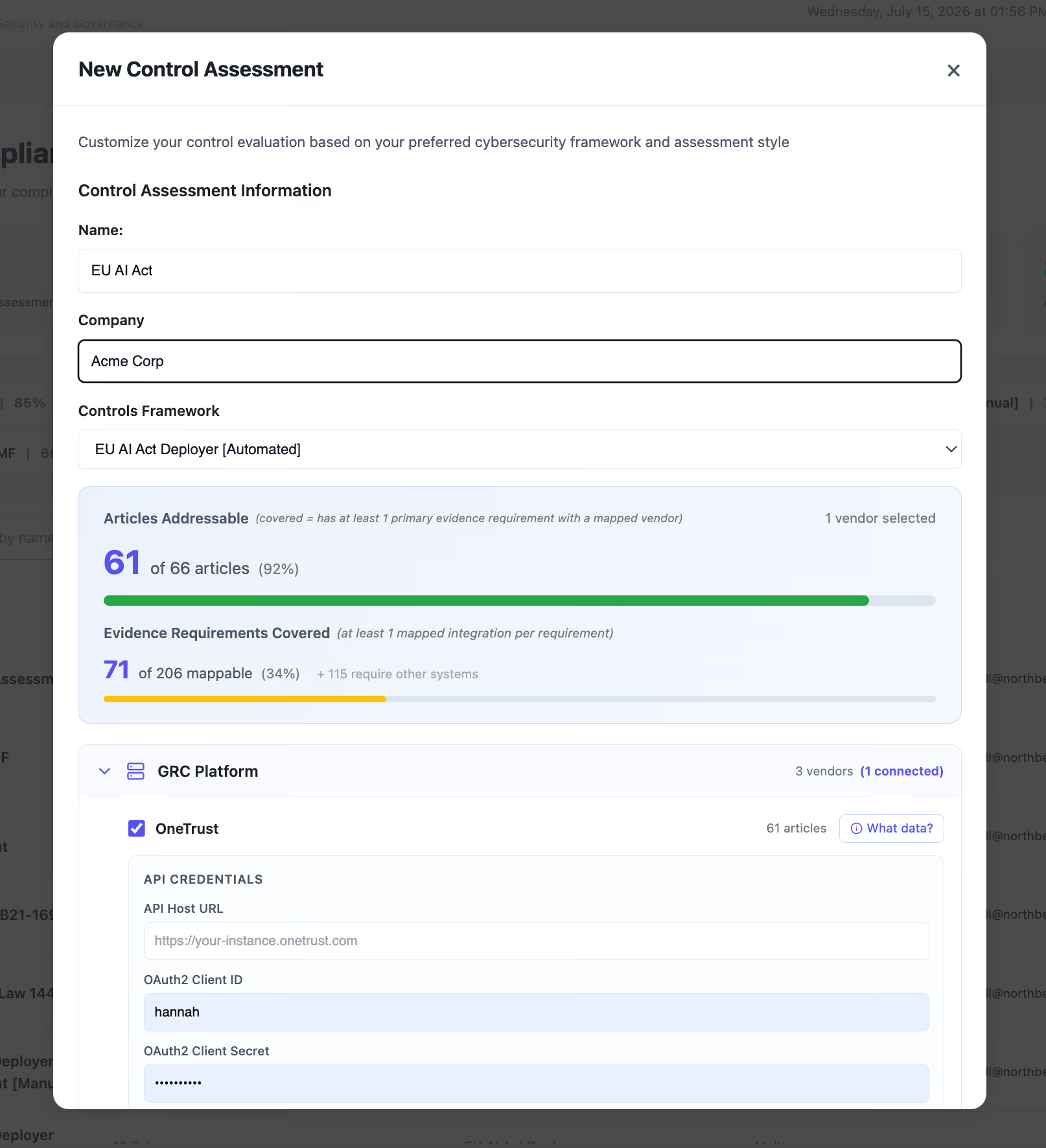
Regulated industries face additional guardrail requirements that shape platform selection meaningfully. The differences are worth understanding before running an evaluation against a generic feature list.
Financial Services Requirements
Financial institutions operating in the EU need guardrails that support DORA's ICT risk management and third-party risk requirements, produce audit trails compatible with financial regulator expectations, and align to sector-specific rules like NYDFS Part 500 and SEC cyber disclosure. Platforms that support automated evidence collection for these frameworks reduce the compliance overhead materially, which is why the operational approach to EU AI Act compliance has become foundational for FS institutions.
Healthcare and Life Sciences Requirements
Healthcare organizations need guardrails calibrated for HIPAA and healthcare-specific data protection, with PII and PHI detection tuned to the specific data categories that trigger regulatory disclosure obligations. The tolerance for false negatives on sensitive data leaks is materially lower in healthcare than in most other sectors, so platform selection often prioritizes detection accuracy over runtime performance in ways that other industries do not.
Public Sector and Critical Infrastructure Requirements
Public sector organizations and critical infrastructure operators face additional obligations around sovereignty, data residency, and specific national frameworks. Platforms that support on-premises deployment, sovereign cloud regions, and mapping to national AI governance frameworks like Singapore's Model AI Governance Framework or the UK's AI Safety Institute guidance fit these organizations materially better than pure SaaS platforms.
Where Kovrr Fits in the Enterprise Guardrail Landscape
Kovrr operates at the governance coordination layer rather than as a direct replacement for the technical guardrail platforms in the four categories above. The AI Security and Governance Platform ingests signals from every guardrail deployment across the enterprise, along with browser sessions through the AI Security Extension, endpoint activity, network flows, identity providers, third-party AI catalog data, and MCP server activity, and fuses them into one continuously updated view through the AI Interaction Data Fabric.
That coordination layer produces attribution linking every guardrail enforcement event back to a named human principal, a specific business process, and the AI Risk Register entry that governs the deployment. The same underlying data feeds governance policy across every guardrail layer, regulatory compliance evidence collection, and AI cyber event response workflows without requiring separate integrations for each downstream use. Kovrr is not competing with Lakera, Bedrock Guardrails, or NeMo on the specific technical control each of them provides. It coordinates policy and telemetry across all of them so the enterprise operates from one governance view rather than a set of disconnected point tools.
Making a Defensible Enterprise Guardrail Decision
Selecting the right AI guardrail platforms is a portfolio decision rather than a single vendor question. Enterprises typically need controls at more than one architectural layer, and the specific combination depends on the deployment stack, regulatory obligations, and program maturity. Cloud-concentrated enterprises may lean heavily on managed cloud-native guardrails. Multi-cloud enterprises benefit more from gateway-layer platforms.
Engineering-heavy teams building custom agents benefit from application-layer middleware. Every enterprise benefits from a governance coordination layer that sits on top of the technical guardrail portfolio and produces the unified view compliance teams, boards, and regulators expect.
To see how Kovrr coordinates telemetry and policy across every AI guardrail deployment in the enterprise, book a demo of the AI Security and Governance Platform.

AI Guardrail Platforms FAQs
Speak to an ExpertWhich platforms provide AI guardrails for enterprise deployment?

Which tools help enforce guardrails on autonomous AI agents?
How do AI guardrail platforms compare for regulated industries?
What is the difference between AI guardrails and AI governance?
Do enterprises need guardrails at every architectural layer?
How does fused telemetry improve AI guardrail effectiveness?