
Blog Post
Evidence on Demand, and Why Most Programs Cannot
September 2, 2026
A governance program looks complete until somebody asks it to prove something on a deadline it did not set. A supervisor sends an information request. An underwriter asks for control coverage before binding. A prospect's security team asks how a specific control operated last quarter, and the deal waits on the answer.
Most programs can describe what they do accurately and cannot evidence it inside the window. The difference is not a documentation problem. It is a latency problem, and latency is the one property of a governance program almost nobody measures.
Three Requesters, Three Windows, Three Formats
Programs typically prepare for the annual auditor, whose timeline is known months ahead and whose format is agreed in advance. The requests that cause difficulty come from the other three, none of which behaves that way.
A supervisor asks about a specific control on a specific date and wants the exception history alongside it. An underwriter wants coverage expressed as percentages with the date each control was last tested, before a renewal date that will not move. A customer or prospect wants a questionnaire answered and frequently a named artifact, on a timeline set by their procurement process, and an examination differs again in what it samples. Same underlying facts, three presentations, three deadlines.
Preparing for One Does Not Cover the Others
Audit preparation produces a package organized by framework, assembled in a defined period, and presented once. None of those properties helps with a question arriving unannounced about a date three months ago. Programs that treat the audit package as their evidence base discover this the first time a customer's security review lands mid-quarter, and the insurer and the board wanting different presentations is the same structural issue one audience wider.
Measure the Latency Before Somebody Else Does
The diagnostic is a single exercise and takes an afternoon. Pick a control. Pick a date roughly ninety days ago. Produce the evidence that the control operated on that date. Time it.
Programs that have never run it report a comfortable answer and produce a different one. The exercise also surfaces the specific dependency that determines the real number, which is almost always a person rather than a system.
Then Run It Against a Departed Owner
The harder version picks a control whose owner has left the organization. Where the evidence existed only as that person's knowledge, or in a mailbox that has been deactivated, the answer changes from slow to unavailable. It is the version worth running before a supervisor picks the control for you.
Testimony Is Not Evidence
The most common failure sounds like success. Asked to prove a control operated, a program convenes the people involved, reconstructs what happened from memory, tickets and email threads, and produces a narrative that is accurate and assembled after the request.
All of that is testimony. It degrades with time, it cannot be produced twice identically, it disappears when people leave, and an assessor sampling three controls will notice that all three answers arrived in the same voice and the same week. Evidence is a record that existed before anybody asked, which is a property of when it was created rather than of how convincing it reads. A trail storing only current state cannot supply it.
Four Properties That Make Evidence Producible
Each of these is a design characteristic rather than an effort level, and a program missing any one of them will be slow regardless of how hard people work.
- It Exists Unrequested: Generated as a byproduct of the control operating rather than assembled when somebody asks.
- It Is Addressable by Control and Date: Retrievable by which control and which period, rather than by which project or which person.
- It Survives the Individual: Held somewhere organizational rather than in a mailbox, a laptop or somebody's recollection.
Legibility to an outsider completes the set. A record legible only to the team that produced it requires a translation step, and translation under deadline is where accuracy degrades. A useful test is whether a new joiner could interpret it without asking anyone.
Attestation and Collection Answer Different Questions
An attestation records that somebody claimed something at a point in time. Collected evidence records that something happened, with a source and a timestamp attached. Both are legitimate and only one answers a question about March.
The practical consequence is worth stating precisely. Where a control is verified automatically, the evidence is a byproduct and the production request becomes a query. Recording the model or system version alongside it, as change records require, is what makes the query answerable for a past date. Where a control is attested, the production request becomes a second attestation about the first, which is weaker than the original and arrives later. Programs relying heavily on attestation should know which controls those are before somebody selects one, and continuous verification changes the category a control sits in.
Some Evidence Cannot Be Collected Automatically
Judgment does not automate. Why a risk was accepted, what a committee weighed, why an exception was granted and on what basis are decisions rather than events, and no integration produces them. For those the artifact is a dated record naming an individual, written at the time. The requirement is not that it be automated but that it exist before the request, which is the same standard applied differently.
Store Facts Once, Present Them Per Requester
The instinct when a new requester appears is to build a package for them, and doing that three times produces three packages that disagree with each other by the second quarter.
Holding the underlying facts neutrally, with the presentation assembled per audience, avoids that. Coverage percentage, last-tested date, owner, exception status and model or system version are the same facts whether a supervisor, an underwriter or a customer is asking. What differs is the ordering and the emphasis, which is a formatting exercise rather than a fresh evidence exercise. Mapping one normalized control set outward, as framework crosswalking does for requirements, is the same idea applied to audiences.
What to Fix First
The latency exercise produces a specific answer and the remedy follows from where the time went.
Where time went into locating evidence, the problem is addressability and the fix is recording against the control rather than the project. Where it went into asking people, the problem is attestation dependence and the fix is verifying automatically what can be verified. Where it went into explaining what a record meant, the problem is legibility and the fix is a note written at the time. Where the evidence did not exist at all, the finding is more serious than a latency problem and belongs on the register rather than in a process improvement.
The Request Is the Test
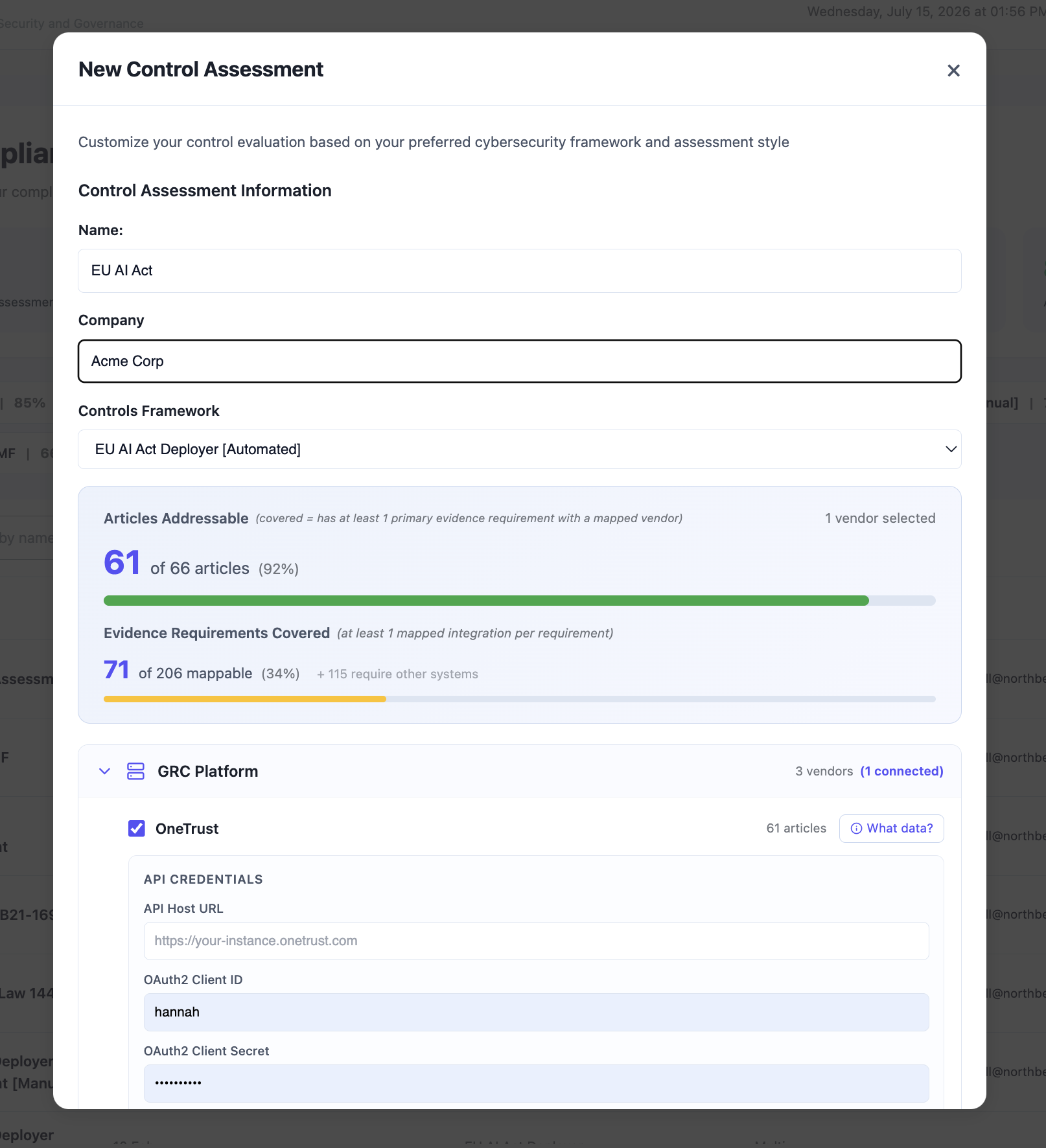
A program's quality is not visible in its documentation, because documentation describes intent. It becomes visible when somebody outside asks for proof of a specific control on a specific past date and the clock is theirs. Evidence that existed before the request, addressable by control and period, independent of any individual and legible to an outsider is producible on that timeline. Everything else is reconstruction, which is slower, weaker and eventually unavailable. Kovrr's compliance readiness assessment records evidence against requirements as it is collected, so producing it later is retrieval rather than assembly.
To see how much of your required evidence connected systems could produce today, book a demo mapped to your own environment.

Evidence Production FAQs
Speak to an ExpertWhy can most governance programs not produce evidence quickly?

How do you test evidence latency?
What is the difference between testimony and evidence?
What makes evidence producible on demand?
Can all governance evidence be automated?
Should you build a separate package per requester?