
Blog Post
How Emerging AI Regulations Impact Organizational Risk Governance
July 28, 2026
Emerging AI regulations are fundamentally reshaping organizational risk governance by converting what were once voluntary best practices into mandatory, audit-ready obligations. The most significant impact is the move from informal AI risk assessments and optional frameworks to documented, repeatable governance programs that regulators can inspect, penalize, and enforce. Organizations that treated AI governance as a strategic nice-to-have are now facing regulatory deadlines, financial penalties, and compliance requirements that demand operational maturity.
The EU AI Act, NIST AI Risk Management Framework, ISO 42001, and a growing list of sector-specific and national regulations are converging on a common set of demands. Organizations must maintain a complete inventory of their AI systems. They must classify those systems by risk level. They must demonstrate continuous monitoring, human oversight, and documented control effectiveness. And increasingly, they must prove all of this through auditable evidence rather than self-attestation.
This article examines the specific ways emerging regulations are changing risk governance, which frameworks matter most, where organizations are falling short, and how to build a governance program that meets regulatory requirements without creating an operational bottleneck.
The Regulatory Landscape in 2026
The AI regulatory environment has expanded rapidly over the past two years. Organizations now face obligations from multiple frameworks, many of which overlap in scope but differ in specifics.
The EU AI Act
The EU AI Act is the most comprehensive AI regulation in force globally. It establishes a risk-based classification system for AI systems (unacceptable, high, limited, and minimal risk), with strict requirements for high-risk systems including conformity assessments, technical documentation, transparency obligations, human oversight requirements, and ongoing post-market monitoring. Enforcement provisions include fines of up to 35 million euros or 7% of global annual turnover, whichever is higher.
Key deadlines are approaching:
- February 2, 2025. Prohibitions on certain AI systems and requirements on AI literacy started to apply
- August 2, 2025. Specific rules start to apply, including Notified Bodies, GPAI Models, and Penalties
- December 2, 2026. Bans on harmful AI-generated content and AI watermarking requirements take effect
- December 2, 2027. The remainder of the AI Act starts to apply, except Article 6(1) for High-Risk AI Systems
For organizations deploying AI in the European market or processing data from EU residents, EU AI Act compliance is no longer a planning exercise. It is an operational requirement with approaching deadlines. Learn more about what data organizations need for EU AI Act compliance.
NIST AI Risk Management Framework
The NIST AI RMF remains a voluntary framework in the United States, but its influence on regulatory expectations is growing. Federal agencies, regulated industries, and government contractors increasingly reference NIST AI RMF as the baseline standard for AI risk management. The framework's four core functions, Govern, Map, Measure, and Manage, provide a structured approach that many state-level and sector-specific regulations are adopting as their reference model.
While NIST AI RMF does not carry the force of law on its own, organizations that align to it position themselves well for emerging U.S. regulations and demonstrate due diligence that can be valuable in liability disputes.
ISO 42001
ISO 42001 establishes an international standard for AI management systems. Certification under ISO 42001 requires organizations to demonstrate a systematic approach to governing AI systems, including risk assessment, control implementation, and continuous improvement. As with other ISO management system standards, certification involves independent audits and periodic reviews.
Sector-Specific and National Regulations
Financial services organizations face additional AI governance requirements from regulators, including DORA in the EU, the Monetary Authority of Singapore (MAS), and emerging guidelines from U.S. banking and securities regulators. Healthcare, insurance, and public-sector organizations face their own AI-specific obligations. Singapore's AI risk guidelines, which Kovrr has analyzed in depth through its coverage of Singapore's approach to AI risk and institutional resilience, represent one of the most detailed national frameworks outside the EU.
Five Ways Regulations Are Changing Risk Governance
1. From Voluntary Best Practice to Mandatory Accountability
The most foundational impact of emerging regulations is the elimination of optionality. Organizations that previously governed AI informally, through ad hoc reviews, optional policies, or delegated responsibility to individual teams, now face mandatory requirements with enforcement mechanisms and financial penalties.
Under the EU AI Act, organizations deploying high-risk AI systems must maintain documented risk management systems, perform conformity assessments, and produce technical documentation that regulators can inspect. This represents a structural change in how organizations resource and prioritize AI governance. It is no longer sufficient to have a policy. Organizations must demonstrate that the policy is implemented, monitored, and continuously updated.
2. Deployer Accountability for Third-Party AI
One of the most consequential regulatory developments is the growing accountability placed on organizations that deploy AI, even when they did not develop it. The EU AI Act holds deployers responsible for ensuring that AI systems they use comply with applicable requirements, regardless of whether the system was built internally or purchased from a vendor.
This means that organizations using off-the-shelf AI products, embedded AI features in SaaS platforms, or AI models from third-party vendors cannot delegate compliance to the vendor. They must independently verify that the AI systems in their environment meet regulatory standards. This requirement dramatically expands the scope of third-party AI risk monitoring and makes vendor AI risk assessment a core governance function rather than a procurement afterthought.
Organizations with mature programs use a vendor AI risk catalog to assess third-party AI exposure at scale, scoring vendors based on the AI models they deploy, the data those models access, and the controls in place.
3. New Risk Categories That Traditional Frameworks Miss
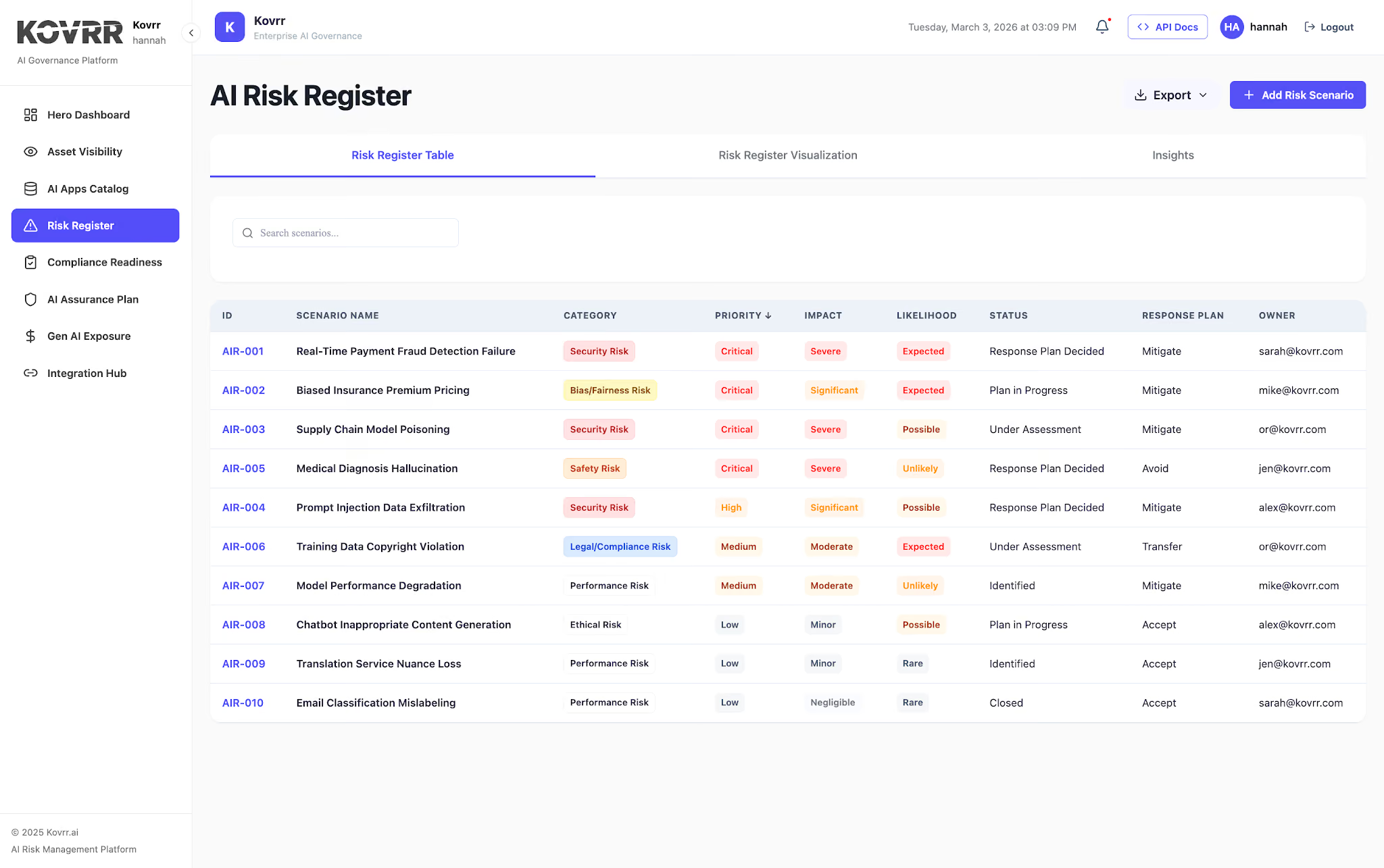
AI regulations introduce risk categories that traditional IT and cybersecurity governance frameworks were not designed to address. These include:
- Model hallucination and output accuracy. AI systems that generate inaccurate, misleading, or fabricated outputs create liability under regulations requiring transparency and trustworthiness
- Algorithmic bias and fairness. Regulations increasingly require organizations to test for and mitigate discriminatory outcomes in AI systems, particularly in high-risk domains like hiring, lending, and insurance
- Data drift and model degradation. AI models that perform well at deployment can degrade over time as the data they encounter diverges from training data. Regulations require continuous monitoring, not just initial validation
- Autonomous decision-making. As AI agents take actions with real-world consequences, regulations mandate human oversight mechanisms and fail-safe controls
- Shadow AI. Unsanctioned AI tools adopted by employees create compliance exposure that organizations cannot manage if they cannot detect it. Read more about shadow AI, where it hides, and what it costs.
Organizations that try to manage these risks using their existing cybersecurity or GRC playbooks will find significant gaps. AI governance requires its own risk register with scenario-based methodology tailored to AI-specific threats, scored for both likelihood and financial impact.
4. Mandated Cross-Functional Governance Structures
Because AI risk spans technical, legal, ethical, operational, and financial domains, regulators are increasingly requiring organizations to establish cross-functional governance structures rather than delegating AI oversight to a single department. The EU AI Act requires organizations to designate responsible persons for AI compliance. NIST AI RMF emphasizes the Govern function as the foundation that integrates AI risk management across organizational layers.
In practice, this means that organizations need:
- A governance committee with representation from security, legal, compliance, data science, operations, and business leadership
- Documented roles and responsibilities for AI risk ownership, including scenario-level accountability in the risk register
- An AI compliance officer or equivalent role with authority to coordinate cross-functional governance activities and report to executive leadership
- Integration of AI risk into the broader enterprise risk management (ERM) framework so that AI governance aligns with how the organization manages cyber, operational, and financial risk
5. Continuous Compliance as an Operational Requirement
Regulations are moving away from point-in-time assessments toward continuous compliance obligations. The EU AI Act's post-market monitoring requirements, NIST AI RMF's emphasis on ongoing measurement, and ISO 42001's continuous improvement cycle all require organizations to demonstrate that compliance is maintained dynamically, not just achieved once during an audit cycle.
This has significant implications for governance technology. Manual compliance processes that rely on spreadsheet-based tracking, periodic audits, and email-based evidence collection cannot keep pace with the continuous monitoring requirements that regulations now demand. Organizations need automated compliance readiness platforms that continuously map their AI inventory against applicable frameworks and produce audit-ready evidence without manual effort.
Kovrr's automated EU AI Act compliance module represents this approach, continuously mapping enterprise artifacts directly to EU AI Act articles and maintaining documentation that is always ready for regulatory inspection.
Where Organizations Are Falling Short
According to EY's research on how organizations are addressing AI risks, many enterprises have formal AI policies but still lack comprehensive management controls. The common failure modes include:
- Incomplete AI inventories. Organizations cannot comply with regulations they do not know apply to them. Without continuous AI asset discovery, shadow AI and embedded third-party AI create unmanaged compliance exposure. Learn why AI asset discovery matters for governance.
- Qualitative risk assessments. Regulators increasingly expect quantitative evidence of risk measurement, not just qualitative labels. AI risk quantification that produces financial estimates gives organizations defensible metrics for regulatory reporting and board communication.
- Siloed governance. AI risk managed exclusively within IT or data science misses legal, ethical, and operational dimensions that regulations explicitly require organizations to address.
- Static compliance. Point-in-time assessments that are outdated within weeks of completion do not meet continuous monitoring obligations. For a deeper look at how to operationalize ongoing compliance, read about EU AI Act compliance and how it starts with operationalizing governance.
- Insufficient board reporting. Regulations like the EU AI Act create board-level liability for AI governance failures. Boards need quantified financial exposure data and compliance readiness reporting, not summary-level status updates. For guidance on structuring these reports, read communicating AI risk to the board.
Building a Regulation-Ready AI Governance Program
Organizations that want to meet current requirements and position themselves for the regulations still emerging should focus on five operational priorities:
- Establish continuous AI asset discovery. Deploy browser-level telemetry and endpoint monitoring that provides a real-time inventory of all AI systems, including shadow AI and third-party embedded AI. Regulatory compliance starts with knowing what you need to govern.
- Build a scenario-based AI risk register. Create an AI risk register that catalogs AI-specific risk scenarios mapped to applicable regulations. Each scenario should be scored for financial likelihood and impact, assigned an owner, and tracked over time.
- Automate compliance mapping and evidence collection. Invest in platforms that continuously map your AI inventory against regulatory frameworks and generate audit-ready documentation automatically. Manual compliance processes will not scale to meet the volume of regulatory requirements taking effect in December 2026 and December 2027.
- Quantify AI risk in financial terms. Insurance-grade risk quantification translates regulatory exposure into dollar-value estimates that executives and boards can act on. Financial quantification also enables organizations to prioritize compliance investments based on the severity of potential penalties and losses.
- Monitor third-party AI exposure. Establish a vendor AI risk monitoring program that assesses AI-related risks in your supply chain. Deployer accountability under the EU AI Act means vendor compliance is your compliance.
What This Means for Risk Leaders
The regulatory environment for AI governance is no longer theoretical. Enforcement deadlines are approaching, penalties are significant, and the scope of organizational accountability is expanding to include third-party AI systems that many organizations do not even know they are using. Risk leaders who wait for regulatory clarity before investing in governance infrastructure will find themselves building under deadline pressure with limited options.
The organizations best positioned for the regulatory wave are those investing now in continuous AI asset discovery, scenario-based risk registers with financial quantification, automated compliance mapping, and third-party AI monitoring. These capabilities do not depend on any single regulation being finalized. They are foundational to every framework on the horizon.
Request a demo to see how connected AI governance technology prepares your organization for the regulatory requirements already in force and those still emerging.

AI Regulation Impact FAQs
Speak to an ExpertWhat are the financial penalties under the EU AI Act?

Do AI regulations apply to organizations outside the EU?
How should organizations prepare for regulations that are not yet finalized?
What is the difference between NIST AI RMF and ISO 42001?
Is the NIST AI RMF legally binding?

.png)

