
Shadow AI in Finance: One ChatGPT Paste, Four Signals, One Exposure



What is shadow AI in finance?
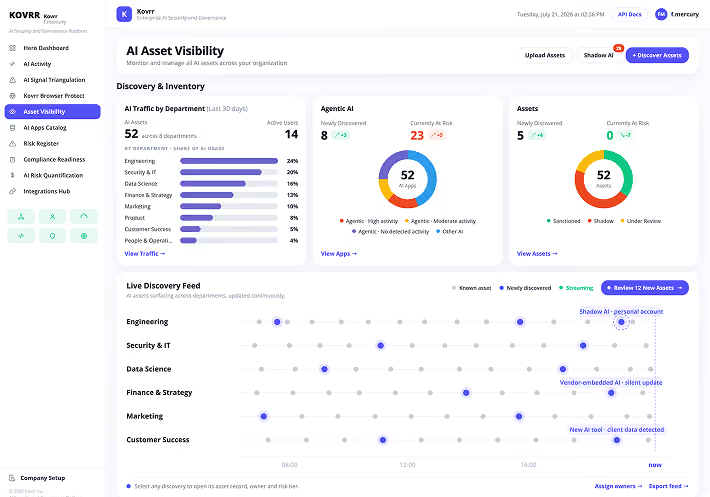
It is when finance staff use unsanctioned consumer AI tools, like a personal ChatGPT account, to speed up work such as month-end close. The work happens outside the approved apps, such as the ERP and the sanctioned copilot, and the data leaves with it.
Why is pasting financial data into ChatGPT a regulated-data exposure?
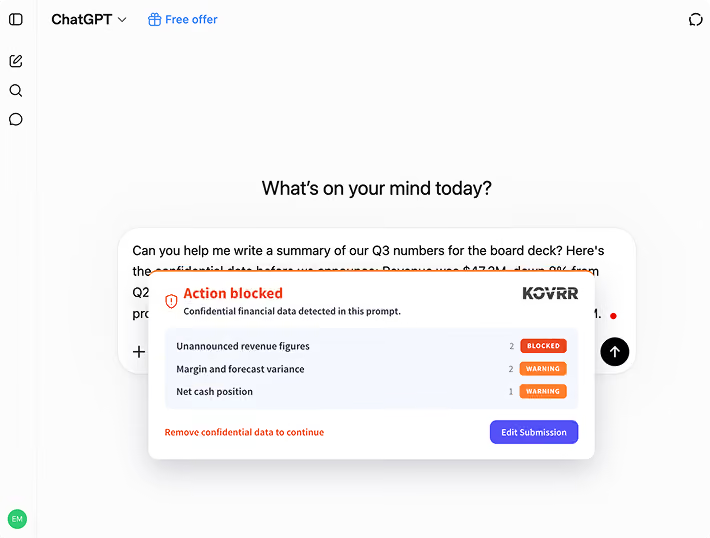
In this scenario the pasted content is classified financial data. The tool trains on user input, keeps data for 30 days or more, and has no enterprise data agreement in place. That combination qualifies as regulated-data exposure under GLBA and SOX.
Why can’t a single security tool catch it?
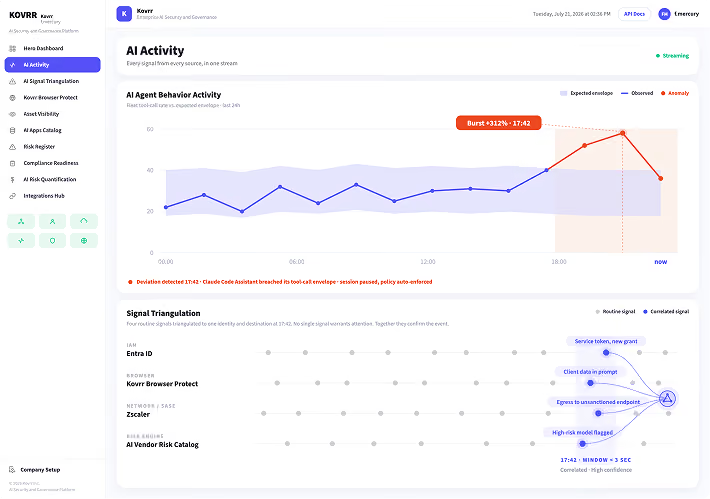
Each tool sees only a sliver, and each sliver looks benign alone. The network saw a 41 KB upload to a GenAI domain but couldn’t read it. Identity saw a SOX-regulated finance user on a managed device but not what that user did next. The browser extension saw the paste but nothing beyond the session. The vendor catalog knew the tool trains on input but not who reached it or what was sent.
What is signal triangulation?
It means reading signals from several sources together inside a window of under three seconds. The overlap is where benign-looking events become one reportable exposure. In this scenario, that is what let Kovrr stop the sensitive data leak.
Which sources does the AI Interaction Data Fabric use?
In this event it read Application Identity Management, the Kovrr AI Security Extension (browser), Network, and the Kovrr AI Vendor Risk Catalog (risk engine). It combines Kovrr-native signals with third-party telemetry. Endpoint, DLP, agent telemetry, and cloud sources are also integrated, but they weren’t triggered by this event.


