
Blog Post
AI Agent Governance: How Enterprises Should Approach It
August 4, 2026
Governing AI agents at enterprise scale requires a fundamental change in how security, risk, and compliance teams think about AI oversight. The generative AI era focused governance on output quality: what the model says, what it produces, and whether the content meets policy standards.
The agentic era demands governance of action and delegated authority: what the AI is allowed to do, what systems it can touch, and how its decisions trace back to human accountability. Autonomous agents call APIs, access data, and execute business logic without a human in the loop for every step, which means they need to be treated as governed members of the digital workforce rather than tools sitting inside a single application.
Enterprises that get agent governance right create the operational and regulatory foundation that lets them deploy agentic AI at scale. Enterprises that treat it as a policy document without runtime enforcement discover the gaps the first time an agent takes an action no one authorized.
This article covers why agent governance requires a new approach, the four control planes every serious program needs, how accountability works for autonomous decisions, the compliance implications enterprises should plan for, and the three-layer architecture that makes agent governance operational rather than aspirational.
Why AI Agents Require a New Governance Approach
The core reason legacy AI governance frameworks fall short is that they were designed for systems that produce content in response to a human prompt. Agents produce action. Every governance control that assumed a human reviews the model's output before it enters a business process breaks the moment the agent executes the action itself.
Enterprises that already have mature generative AI governance often underestimate how much has to change. Policy documents that specify approved use cases still apply, but they now have to define what an agent can do rather than what an agent can say. Approval workflows that gated content release have to be replaced with runtime enforcement, since agents do not pause for a human review cycle by default. Risk assessments that captured model bias and hallucination risks have to be extended to cover cascading multi-agent failures, credential misuse, and autonomous decision accountability. This is why AI risk management increasingly operates as a function of AI governance rather than as a separate discipline sitting alongside it.
The good news is that the shape of an effective agent governance program is already emerging. It centers on four control planes, three architectural layers, and a small number of principles that map cleanly to the regulatory frameworks enterprises already track.
The Four Control Planes of AI Agent Governance
A defensible agent governance program manages four categories of control simultaneously. Each one addresses a distinct failure mode, and skipping any of them creates exposure the other three cannot cover.
Governance and Accountability
The first control plane defines who is responsible for each agent, what its authorized purpose is, and how its lifecycle is managed. This means maintaining a central agent registry that inventories every deployed agent along with its capabilities, target models, and active connections. It means assigning a named human business owner to every agent, someone who is legally and ethically accountable for the agent's actions across its lifetime.
It also means defining tiered autonomy models so low-risk tasks can run fully autonomously while high-stakes decisions like financial transactions or external communications require human-in-the-loop checkpoints. Without this control plane, shadow agent deployments accumulate faster than the security team can find them.
Identity, Permissions, and Tool Access
The second control plane governs what an agent is allowed to do once it has been deployed. Every agent needs a governed non-human identity, distinct from any human login or shared service account. Permissions need to be scoped to the specific tools and APIs the agent's task requires, using time-bound credentials rather than persistent long-lived tokens.
Every agent also needs a kill switch that can revoke its credentials instantly if it displays anomalous behavior. Without proper identity discipline, a single compromised agent inherits access broader than any human user would carry, which is where most agentic breach scenarios begin.
Data Governance and Information Boundaries
The third control plane manages what an agent can see and where its outputs can go. Agents reason based on the data they retrieve, so oversharing at the data layer creates exposure the enforcement layer cannot fix. Scoped retrieval architectures like Retrieval-Augmented Generation confine agents to pre-approved data repositories.
Real-time input and output filters block agents from accessing sensitive records or exposing corporate data through their responses. Dynamic data masking prevents the agent from seeing values it does not need to complete its task. This is the control plane where enterprise data classification programs and AI governance programs need to be operationally connected.
Continuous Monitoring and Runtime Auditability
The fourth control plane keeps governance active after deployment. Periodic reviews decay fast in agentic environments where models update, tools change, and behavior drifts continuously. Immutable audit logs record every input, reasoning step, tool invocation, and data change so any action can be reconstructed after the fact.
Compositional risk analysis monitors how multiple agents interact, since a sequence of individually low-risk actions can collectively cross an enterprise risk threshold. Regulatory mapping validates live agent behavior against frameworks like the EU AI Act and NIST AI Risk Management Framework so the governance program can produce evidence when regulators ask.
Accountability for Autonomous AI Decisions
The accountability question is the one that keeps boards and audit committees awake at night. When an autonomous system makes a decision that goes wrong, someone has to be responsible for that decision, and legacy accountability models were not designed for systems that operate without a human in the loop.
Assigning Named Human Owners
Every agent should have a named human owner, documented in the agent registry, whose responsibility for the agent's behavior is enforceable through policy. The owner should be able to explain what the agent does, why it was deployed, what data it accesses, and what oversight controls are in place.
This is not a symbolic assignment. When an agent takes an action the enterprise later regrets, the named owner is the person who explains it to leadership and, if necessary, to regulators. Organizations formalizing this responsibility often designate an AI compliance officer to serve as the accountability anchor across the full agent portfolio.
The Delegation Chain From Human to Agent
Accountability breaks down when the audit trail cannot distinguish between an action a human user took and an action an agent executed on behalf of a human. Every agent action needs to carry a verifiable delegation chain: the agent's unique identity, the human principal who authorized the agent's role, the policy under which the action was permitted, and the specific task the action supported. Without this chain, autonomous actions become unattributable, and unattributable actions are indefensible in front of regulators, auditors, or the board.
Board-Level Responsibility for AI Decisions
Board and executive committees increasingly bear direct fiduciary responsibility for AI-driven decisions that affect customers, employees, or financial performance. That responsibility flows downward through the AI governance program, which is why communicating AI risk to the board has moved from a nice-to-have to a program requirement.
Boards need visibility into which agents are deployed, what decisions they make autonomously, how those decisions are audited, and what happens when an agent behaves unexpectedly. This is where quantified AI risk visibility becomes essential, since abstract accountability language does not survive a serious board conversation without underlying data.
Compliance Implications of Deploying AI Agents
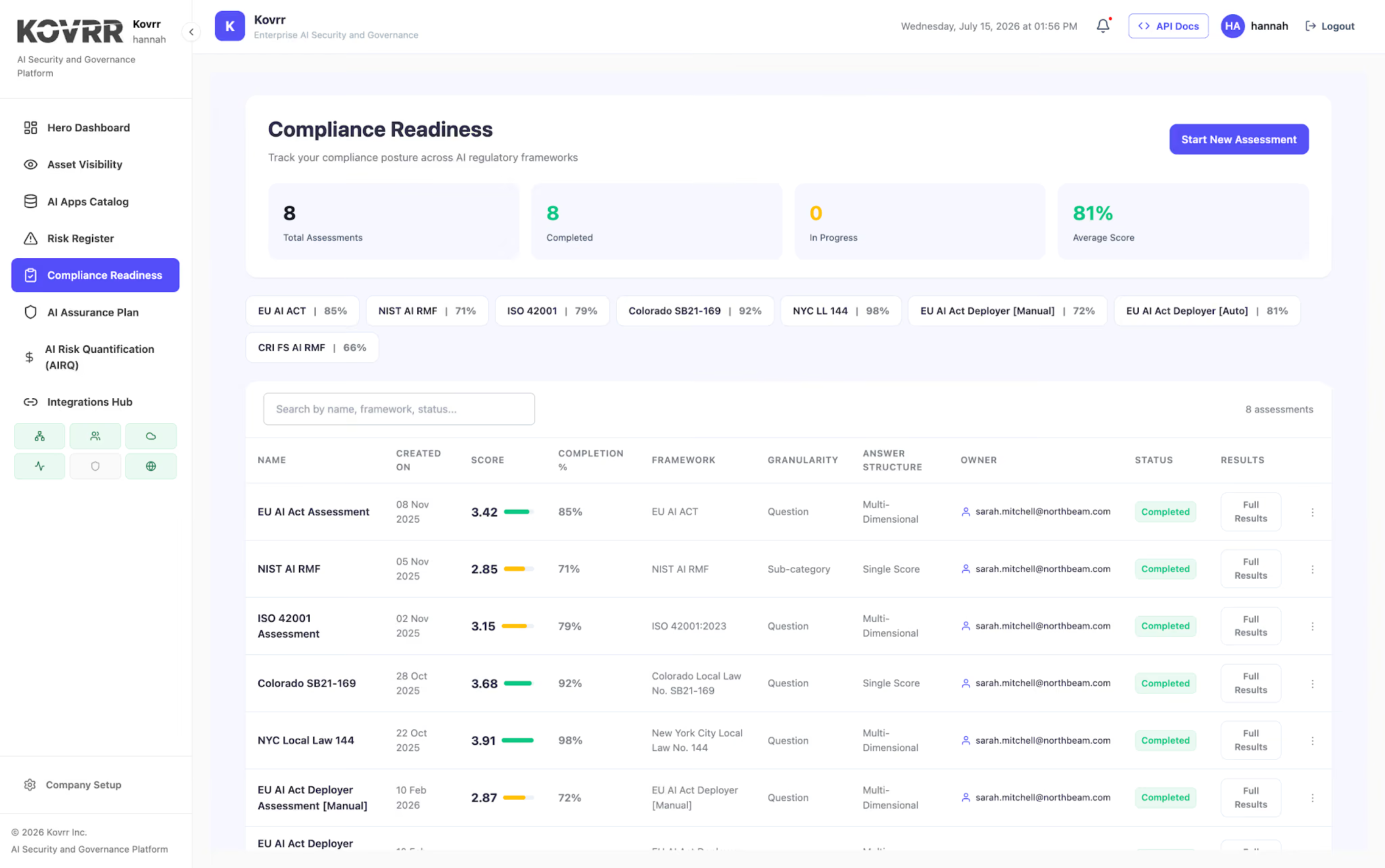
Agentic AI intersects with several major regulatory regimes, and enterprises deploying agents need to plan for the compliance obligations from day one rather than as a retrofit.
Regulatory Frameworks That Apply
- EU AI Act: Agents used in high-risk categories require documented risk management, technical documentation, human oversight, and post-market monitoring under the phased enforcement timeline through December 2027.
- NIST AI Risk Management Framework: The Govern, Map, Measure, and Manage functions apply directly to agentic deployments, with the Govern function taking on additional weight given autonomous action.
- ISO/IEC 42001: The AI management system standard requires documented policies, risk assessments, and continuous improvement processes that agentic systems have to be built to satisfy.
Documentation Requirements
- Purpose and scope documentation: Every agent needs a written record of its intended purpose, the business process it supports, and the boundaries of its authorized action.
- Risk assessment records: Documented evaluation of the agent's potential harms, mitigations in place, and residual risk, updated on a defined cadence.
- Continuous audit trails: Immutable logs of every agent action, reasoning path, and decision, retained for the period the applicable regulatory framework requires.
The organizations moving fastest on EU AI Act preparation are the ones treating operational governance as the starting point for compliance rather than the endpoint, since documentation without runtime enforcement is exactly what regulators are learning to identify as insufficient. What data is required for EU AI Act compliance has emerged as one of the harder open questions enterprises are still working through.
The Three-Layer Governance Architecture
Effective agent governance operates across three architectural layers. Each one enforces a different aspect of the program, and all three have to be present for the full stack to hold together.
Build-Time Governance
- Standards council review: A cross-functional committee reviews agent design templates, approves model selection, and assigns initial risk tiers before any agent moves toward deployment.
- Reference architectures: Approved patterns for agent identity, permission scoping, and tool access that development teams can implement without reinventing the security model.
- Risk classification frameworks: A defined method for tiering agents by autonomy level, data sensitivity, and downstream business impact.
Deployment-Time Governance
- Agent control registry: A validated inventory that assigns each agent a unique ID, defines its explicit system permissions, and maps its human ownership.
- Policy attachment: Governance policies applied to the agent at deployment time so runtime enforcement has something to enforce against.
- Rollout gating: Explicit approval workflows that hold high-risk agents from production until required documentation and controls are in place.
Runtime Governance
- Continuous behavior monitoring: Real-time observation of agent actions, tool calls, and data access patterns, flagging deviation from baseline.
- Inline enforcement: Data masking, output filtering, and action blocking applied at the moment the agent tries to act, not after the fact.
- Kill switch and rollback: Deterministic mechanisms to revoke credentials, halt reasoning loops, and reverse actions when the agent behaves outside authorized bounds.
Common Mistakes in Agent Governance
Failed governance programs follow predictable patterns. Watching for these avoids most of the pain other enterprises are learning the hard way.
Mistakes at Deployment
- No central agent registry: Individual teams deploy agents without coordination, which means the security team never has an accurate inventory to govern against.
- Shared service account credentials: Agents inherit broad standing credentials that make least-privilege enforcement impossible after the fact.
- Missing human ownership: Agents deploy without a named business owner, leaving accountability distributed to no one when things go wrong.
Mistakes at Runtime
- Policy without enforcement: Governance documents specify what agents should not do, but nothing at the runtime layer blocks the prohibited actions.
- Static audit logs: Logs record only what the agent did, without the reasoning steps or tool invocations that make the action reconstructable later.
- No compositional monitoring: Individual agent actions are watched in isolation, missing the multi-step sequences that cross risk thresholds collectively.
Making Agent Governance Operational
Agent governance is not a policy exercise. It is an operating discipline that combines inventory, identity, data controls, and runtime enforcement into a continuously updated view of what every deployed agent is doing and whether it is behaving within authorized bounds.
Enterprises that build the four control planes and three architectural layers together produce a governance program that both satisfies regulators and gives boards the confidence to approve broader agentic deployment. Enterprises that treat governance as documentation without runtime teeth will keep discovering the gaps after each incident rather than in advance.
To see how Kovrr connects agent inventory, quantified exposure, governance policy, and runtime enforcement into a single operational view, book a demo of the AI Security and Governance Platform.

AI Agent Governance FAQs
Speak to an ExpertHow should organizations govern AI agents across the enterprise?

What are the compliance implications of deploying AI agents?
How should organizations think about accountability for autonomous AI decisions?
What is the difference between AI agent governance and AI agent guardrails?
How do you prevent shadow AI agents from bypassing governance?
How does agent governance connect to AI risk quantification?