Blog Post
Mapping AI Product Vulnerabilities to MITRE ATLAS Scenarios
November 16, 2026
A CVE tells a security team that a flaw exists in a product. It does not tell a risk team what the company stands to lose if that product is running. Closing that distance takes a second vocabulary, one that describes how an attacker moves instead of where the bug sits, and for AI systems the shared version is MITRE ATLAS.
Four products and five published vulnerabilities show the method. Every CVE detail comes from NVD or the vendor's own advisory, and every technique ID comes from the current ATLAS release. The exercise also overturns an assumption most people bring to it. None of the five is a flaw in a model. Each sits in the product, framework or pipeline wrapped around one, which Microsoft's researchers state in their own findings when they conclude that your LLM is not a security boundary.
What Does a CVE Record Leave Out?
The route in, the reach once inside and the loss at the end, which are the three things a scenario needs.
A record names a product, a version range and a weakness. It carries a severity score, and the score depends on who assigned it. CVE-2026-12537, a flaw in Google's Gemini CLI, shows the effect. The vendor's advisory carries a 10.0 critical rating, while the NVD record shows 7.8 high from NIST's own analysis next to the 10.0 that Google assigned under the newer CVSS 4.0 scale. One identifier produces three ratings because each assumes different conditions around the product, and no score can know how a given company runs the tool.
The record also describes only part of the flaw. NVD's text covers a crafted file in the .gemini folder reaching the container launcher. The advisory covers a second route as well, where the CLI's yolo mode ignored its tool allowlist and let injected instructions reach a shell. A risk team working from the NVD text alone would model one scenario where two exist.
What Does ATLAS Add?
A shared description of the attacker's route, with a rating for how much real-world evidence stands behind each step.
The ATLAS release dated 2026.10, last modified on October 28, holds 16 tactics and 221 techniques and sub-techniques. Each entry carries a maturity rating, which the ATLAS glossary defines as an assessment of the evidence supporting a technique. Realized means observed in real-world incidents, adversarial operations or unintended consequences. Demonstrated means shown to work in realistic exercises or testing, and Feasible means shown to work in research or controlled settings. Of the 221 entries, 117 are Realized. A Realized technique gives a frequency estimate something to anchor on, while a Demonstrated or Feasible one signals that the estimate will rest on judgment.
Technique IDs change between releases. AML.T0056 and AML.T0057 both return page not found on the ATLAS site and neither appears in 2026.10, so a team working from an older guide may be citing IDs that no longer exist. Every ID below was checked against the release itself.
Four Products, Five CVEs, Mapped
Gemini CLI in a CI Workflow
ATLAS has no case study for this one, so the mapping is ours and not MITRE's. The untrusted-content route runs through indirect prompt injection (AML.T0051.001, Realized), AI agent tool invocation (AML.T0053, Demonstrated) and command and scripting interpreter (AML.T0050, Realized). The crafted-file route has no clean equivalent. Modify AI agent configuration (AML.T0081) comes closest and the fit is imperfect. Saying so matters, because a mapping that forces every flaw into a technique overstates what ATLAS covers.
The reach is the CI runner and whatever secrets the workflow holds, and the loss event is unauthorized code execution in the build environment. Fixes shipped in version 0.39.1 of the CLI and 0.1.22 of the GitHub Action. CISA's June 24 assessment on the NVD record recorded no exploitation at that date but rated the flaw automatable with total technical impact. That suits a scenario with low observed frequency and a severity set entirely by the permissions the workflow holds.
Microsoft 365 Copilot, Known as EchoLeak
Microsoft's record for CVE-2025-32711 describes AI command injection in M365 Copilot that lets an unauthorized attacker disclose information over a network. NVD tags the record as an exclusively hosted service, so customers had no version to patch. The scoring split repeats here, with NIST rating it 7.5 high and Microsoft 9.3 critical.
ATLAS's own case study traces the incident in twelve steps, and the ones that matter for sizing are few. An attacker sends an email (AML.T0093, Realized). A later user request triggers the stored instructions (AML.T0051.002, Demonstrated). Copilot reads data the user can reach (AML.T0085.000, Demonstrated), and a rendered image request carries it out (AML.T0025, Realized). The end state is external harms (AML.T0048, Realized), here the disclosure of confidential business data.
The reach is the user's existing permissions. Whatever a person's Copilot can retrieve, an injected instruction can retrieve too, so sizing starts with how broadly files and mail are shared inside the tenant. That is an access question the company owns.
Semantic Kernel, Two Flaws in One Framework
The same Microsoft write-up covers two critical flaws its own research team found. NVD lists both, CVE-2026-26030 and CVE-2026-25592, at 9.9 critical from GitHub as the assigning authority, and shows no score from NIST for either. In the Python package, an agent using the default search plugin over an in-memory vector store built a filter from model-supplied text and ran it through eval, and the blocklist meant to stop abuse could be bypassed, so one injected prompt could become code running on the host. In the .NET SDK, a file download function was exposed to the model by accident, which put its destination path under the model's control and allowed a script to land in the Windows Startup folder. The fixes are version 1.39.4 for Python and 1.71.0 for .NET.
ATLAS's case study for the Python flaw maps it to direct prompt injection (AML.T0051.000, Realized), AI agent tool invocation (AML.T0053, Demonstrated), command and scripting interpreter (AML.T0050, Realized) and machine compromise (AML.T0112, Demonstrated). The reach is the host running the agent and the loss event is host compromise.
Microsoft tells defenders to define a vulnerable window for each deployment, from the day a vulnerable version went live to the day the fixed one was installed, and to hunt for signs of compromise inside it. That advice doubles as a sizing input, since time exposed is a term in any frequency estimate.
Amazon Q Developer Extension, a Flaw With No Realized Loss
AWS's bulletin for CVE-2025-8217 says version 1.84.0 of the VS Code extension shipped with malicious code after a GitHub token with too broad a scope in the build configuration let an attacker commit to the repository. AWS also says the code failed to run because of a syntax error, so no customer environment changed, and it withdrew 1.84.0 and released 1.85.0.
ATLAS's case study maps the intended chain from the exposed token (AML.T0055), through software supply chain compromise (AML.T0010.001) and a malicious package run by users (AML.T0011.001), to a deployed agent (AML.T0103) prompted to delete files and cloud resources (AML.T0101). Every step is rated Realized. The scenario produced no loss and is still fully formed, so a register that records only incidents with losses would never contain it. Sizing it takes two facts the bulletin cannot supply, which developer machines held 1.84.0 and what cloud credentials those machines carried.
What Do the Five CVEs Have in Common?
Three loss events reached by several routes, which makes for a smaller register than the CVE list suggests.
Code execution on a host or pipeline covers the Gemini CLI flaw and both Semantic Kernel flaws. Disclosure of confidential data covers EchoLeak. Destructive agent action on developer systems and cloud resources covers the Amazon Q extension. The ATLAS techniques are the routes into each event and they feed frequency, while what the product could touch sets severity, the structure turning the OWASP agentic list into expected loss sets out for a different taxonomy.
The ratings add something the OWASP mapping does not cover. In both code execution cases the chain runs Realized, then Demonstrated, then Realized, and the Demonstrated link is AI agent tool invocation (AML.T0053), the step where text becomes action. Entry and execution have real-world evidence behind them. The pivot between them has the least, so that is where a frequency estimate rests on judgment and where a range is more honest than a point figure. The patches closed specific sinks while the injection routes that fed them stay open, which is the position carrying prompt injection as a priced condition is written for.
What Does a Team Need Before the Next CVE Lands?
Four facts about its own estate, because none of them appear in an advisory.
- Whether the product runs here and in which version: every advisory above is scoped by version.
- What it can reach: the tools, credentials and data stores behind it set severity.
- What untrusted content it reads: inbound mail, pull requests and retrieved documents are the entry side.
- How long a vulnerable version was live: the exposure window Microsoft tells defenders to define.
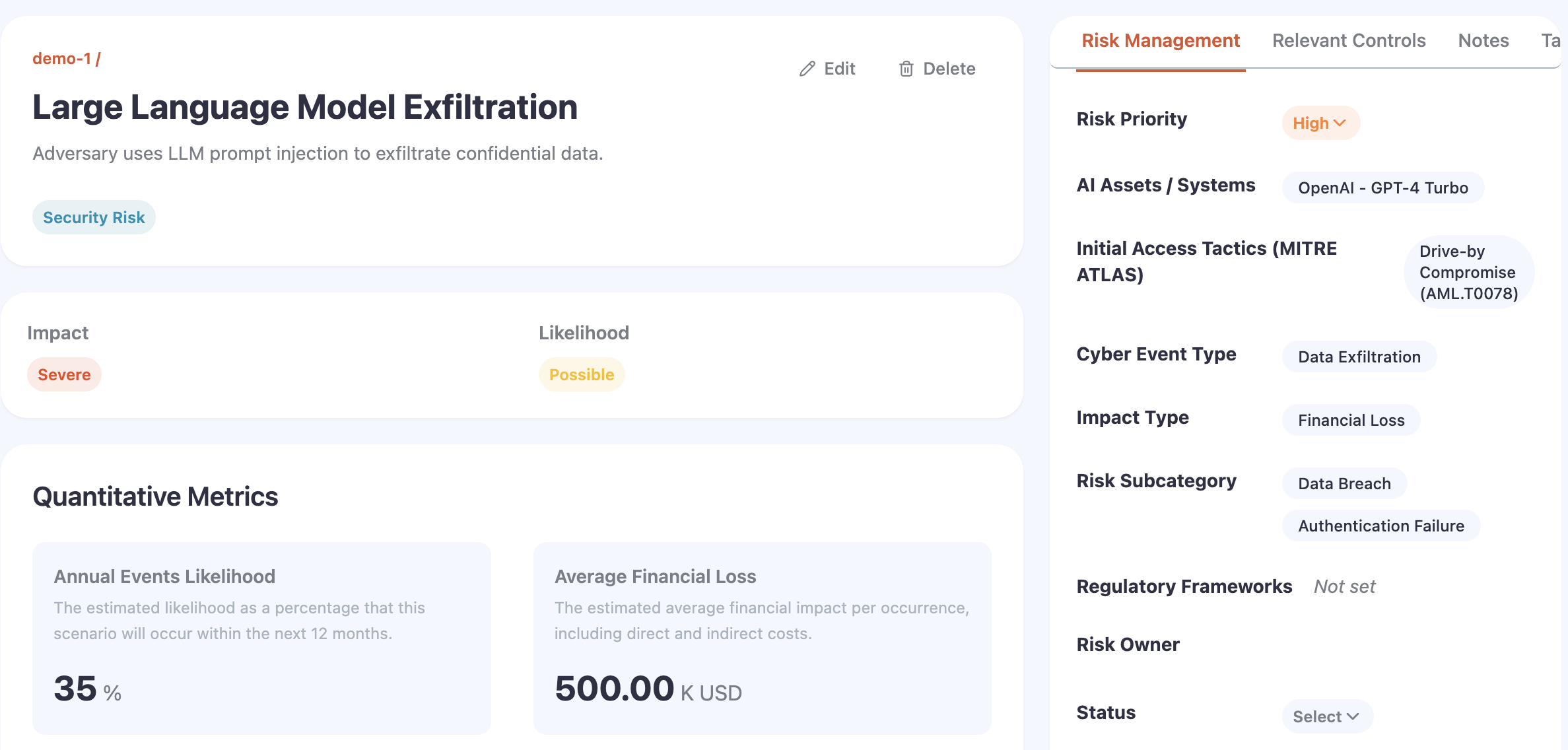
The first is a visibility question. Kovrr's AI Security and Governance Platform sees every AI interaction through the security tools a company already owns and fuses them into one finding with no new sensor, so the inventory comes from existing telemetry. It keeps governance running where AI runs, for people and agents, with a full audit trail. The AI risk register records each scenario with its mapped ATLAS initial access technique beside the modeled likelihood and financial loss, and AI risk prioritization ranks scenarios by the loss each carries instead of by severity label. For board audiences the same scenarios roll up into modeled exposure through AI risk quantification.
Where Does the Mapping Stop?
At likelihood, which neither a CVE nor ATLAS supplies.
ATLAS describes how adversaries behave. It does not say how often one will try a given route against a given company, and the exploitation data on a CVE record goes stale quickly. A mapped scenario should therefore state which routes rest on Realized techniques and which rest on judgment. The conventional side of this idea is covered in cyber risk quantification based on the MITRE ATT&CK framework, and the monitoring side in mapping AI interaction monitoring to the OWASP Top 10 for LLMs.
A CVE Names a Location, a Scenario Names a Loss
A CVE places a flaw in a product and ATLAS describes the route an attacker takes to it. Neither says what the company loses, which depends on what the product can reach, what untrusted content it reads and how long a vulnerable version stayed live. Five CVEs across four products reduce to three loss events, with the entry and execution steps of the code execution chains backed by Realized techniques and the pivot between them resting on judgment. Kovrr's AI risk register holds each scenario with its mapped ATLAS initial access technique beside the modeled likelihood and loss, which keeps the technique and the sizing in one record.
To see AI product vulnerabilities mapped to ATLAS techniques and ranked as scenarios, book a demo with our AI risk experts.

AI Vulnerability and MITRE ATLAS FAQs
Speak to an ExpertWhat is MITRE ATLAS?

What is CVE-2026-12537 in Gemini CLI?
How do you map a CVE to a MITRE ATLAS technique?
Why do NVD and the vendor give different severity scores for the same CVE?
How can ATLAS technique ratings inform a risk estimate?
What should a company know about its AI estate before the next vulnerability is published?