



Orphaned Grant
An orphaned grant is an authorization held by an AI agent or another non-human identity that stays valid after the work it was issued for has ended or the person who sponsored it has left.
The Access Outlives the Reason for It
An agent receives access for a purpose. A quarterly reconciliation job is typical, and so is a workflow one employee automated for their team. When the purpose ends, nothing in most environments ends the access with it. The credential keeps authenticating with its original scope, and if the agent is still scheduled, it keeps calling every system the grant opens. An orphaned grant names that state, and the name separates an agent that is between tasks from one with no task to return to.
Most of Them Start With an Event Nobody Connected to the Agent
A project concludes or a pilot ends, and the grant persists because no system links the project's status to the agent's credentials. A sponsor leaves or changes role, and the authorization outlives their relationship with the organization, since offboarding disables the person's accounts and rarely touches the service identity their agent runs under. Replacement produces the quietest version, where a newer agent takes over the function and the previous one keeps its credentials. Every one of those events shows up in the directory or in whatever tracks project status, and in most environments none of them triggers a review.
Excessive Agency Measures Scope, an Orphaned Grant Measures Purpose
Excessive agency describes an agent holding more permission than its task requires. An orphaned grant describes an agent holding any permission after its task is gone. An agent can carry both conditions at once, and the second compounds the first, because the reach of an overscoped credential stays live for every month nobody revokes it. Narrowing scope reduces what a compromise reaches, and ending orphaned grants reduces how long that reach is available at all.
Part of the Cost Arrives Without an Attacker
An orphaned grant on a running agent costs money before anyone exploits it, since the agent keeps consuming model calls and licensed seats. Discovery adds a second bill, covering secret rotation, log review across the months the grant was live and, where regulated data was in reach, a determination about whether a notifiable event occurred. Pricing an orphaned identity works through both streams alongside the contingent breach exposure.
Finding Them Takes a Joined Record
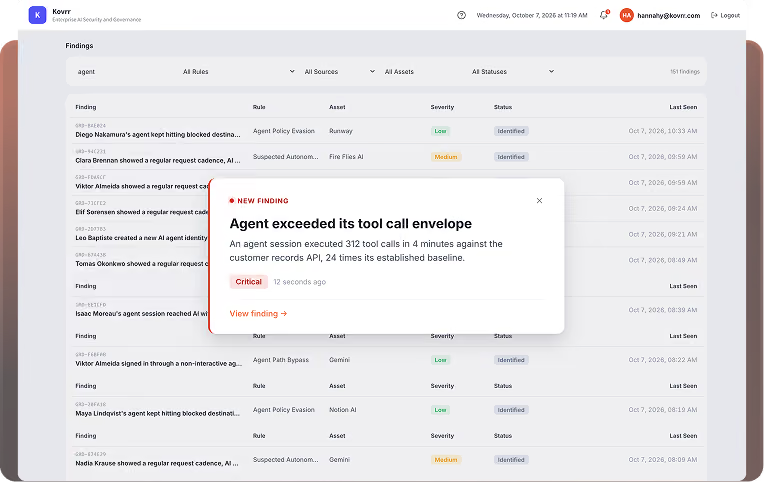
No single source shows which agent holds which grant under whose authority. The identity provider knows what was issued to a service principal and frequently cannot name the human behind it, while the target system knows what was accessed and nothing about who authorized the agent. A usable record, the one counting standing grants starts from, joins the agent identifier, the grant and its scope, the human authority it descends from, the issue date, and the last time it was exercised. Kovrr's AI Security and Governance Platform builds that record from the security tools an organization already runs, which is the enumeration retiring an agent depends on.
Related Terms


Full AI Visibility. Full Control. One Connected Platform.
Enterprise AI is expanding faster than most governance programs can track. Kovrr connects every AI signal across browser, endpoint, network, identity, and vendor systems into a single platform so security, governance, and risk teams work from the same evidence.