
Blog Post
NIST AI RMF vs ISO 42001: Choosing Your AI Governance Framework
August 11, 2026
NIST AI RMF and ISO/IEC 42001 answer different questions, so the choice is rarely about which one is better. One gives you a risk process your engineering teams can run. The other gives you a management system an auditor can certify. Organizations that treat them as rival options usually pick the wrong one for the problem in front of them.
The practical question is what your buyers, regulators and board are asking for. A procurement team requesting proof of certification cannot be satisfied by a self-assessment, and a data science team asking how to test a model for bias will find little help in a clause about management review. What follows is what each framework is built to do, where they overlap, and why most enterprises past a certain size end up running both.
What Each Framework Is Built to Do
Both address AI risk, and they operate at different altitudes. Confusing the two produces either a certified organization with no working risk process or a well-run risk process nobody outside the company will accept as evidence.
NIST AI RMF as an Operational Playbook
The NIST AI Risk Management Framework is voluntary, free, and organized around four functions. Govern establishes accountability and policy. Map builds context around a system and its intended use. Measure tests performance, bias and robustness. Manage treats and monitors the risks identified. The accompanying playbook and profiles turn each function into suggested actions rather than requirements, which is why engineering and data science teams tend to reach for it first.
The framework carries no certification. Nothing prevents an organization from claiming alignment, and nothing external validates the claim. The Govern function is where most programs either take hold or quietly stall, because accountability decisions made there determine whether the other three functions have an owner.
ISO/IEC 42001 as a Management System
Published in December 2023, ISO/IEC 42001 is the first international standard for an AI Management System, and it is certifiable through accredited bodies in a two-stage audit. Clauses 4 through 10 are mandatory and cover context, leadership, planning, support, operation, performance evaluation and improvement. Annex A adds 38 reference controls across nine objectives, applied selectively.
Selection is itself an audited decision. Clause 6.1.3 requires a Statement of Applicability recording which controls apply, which do not, and why, so an undocumented exclusion becomes a nonconformity rather than an omission. The standard shares its harmonized structure with ISO 27001 and ISO 9001, and organizations already certified against either can usually extend in three to six months where a program starting fresh should plan for six to twelve.
The Differences That Change the Decision
Three distinctions carry real weight. The rest are matters of preference.
- Certifiability: ISO 42001 produces an auditable certificate. NIST AI RMF produces an internal self-assessment only.
- Altitude: ISO governs the organization and its processes. NIST addresses individual systems and their measured behavior.
- Cost: NIST is free to apply. ISO carries certification fees, audit cycles and documentation overhead.
Certification Is the Dividing Line
Everything else is negotiable and this one is not. Enterprise procurement, public sector tenders and vendor questionnaires increasingly ask for evidence a third party has verified, and a self-assessment does not answer that question regardless of how rigorous it is. Where the driver is commercial rather than technical, the framework choice is already made.
Where Each One Is Stronger
NIST goes deeper on measurement. Testing for bias, drift, robustness and adversarial behavior is described in operational terms, and its impact assessment practices map onto work a technical team recognizes. ISO goes deeper on accountability, documented decision-making and continual improvement, which is what an auditor examines and what a board can be shown. Neither depth substitutes for the other. Programs that lean entirely on one side tend to show it, and weak governance raises exposure regardless of which framework name sits on the cover.
Choosing One to Start With
Sequence matters more than selection, because starting with the wrong one wastes months rather than causing permanent harm.
Start With NIST AI RMF When the Problem Is Operational
Choose NIST first when no external party is demanding certification, when the immediate need is getting a repeatable process running across systems already in production, or when budget rules out audit fees this year. The framework also suits organizations selling primarily into US markets, where it functions as the recognized baseline. Teams building a defined AI risk management practice from nothing generally move faster here.
Start With ISO 42001 When the Problem Is Commercial
Choose ISO first when customers or tenders ask for certification, when an existing ISO 27001 management system makes extension cheap, or when the organization operates across jurisdictions and needs one internationally recognized answer. Regulated industries tend to land here for the same reason they hold other management system certificates, and treating AI risk as a governance function rather than a technical project fits the standard's assumptions.
Why Most Enterprises End Up Running Both
Past a certain size the question resolves itself. ISO provides the structure that satisfies external parties. NIST provides the measurement depth that makes the structure more than paperwork. Running both is common enough that the interesting problem becomes how to avoid paying twice for the same evidence. Deciding which systems fall in scope comes first either way, and visibility across AI systems determines whether an assessment covers the estate or a sample of it.
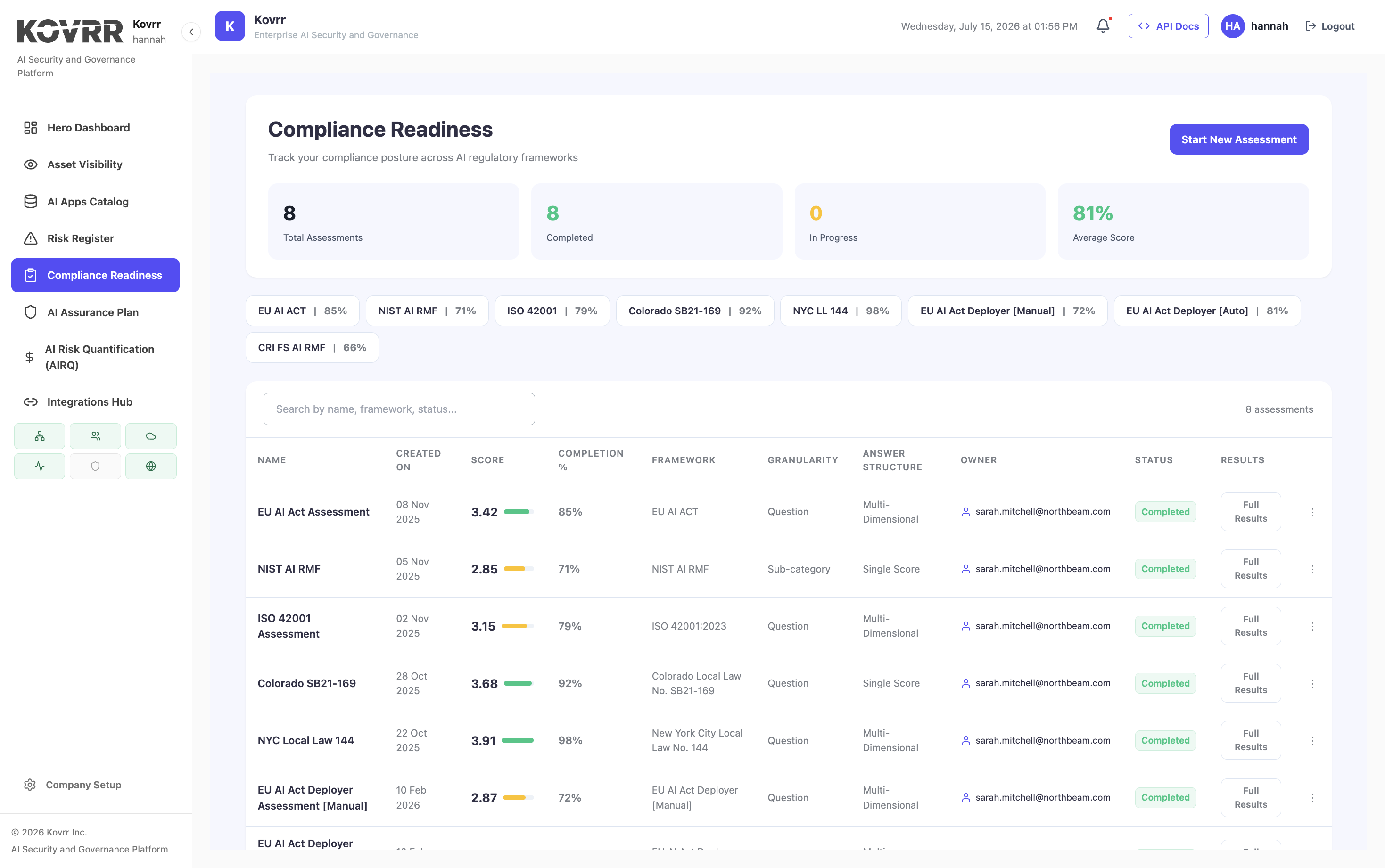
Scores differ by framework because each asks for different evidence from the same organization. A program strong on documented accountability posts a higher ISO figure than NIST figure, and one strong on model testing does the reverse. Reading both together tells you which kind of work is thin, which is more useful than either number alone. A durable governance program tends to balance the two deliberately.
Mapping Once and Reporting Many Times
The overlap between frameworks is substantial, and the same evidence satisfies several requirements when it is captured with that intent. Five control areas carry most of the shared weight.
- Impact Assessment: ISO objective A.5 and NIST Map both want the same documented view of context, affected people and intended use.
- Data Governance: ISO objective A.7 covers provenance, quality and preparation, matching NIST Measure and EU AI Act Article 10.
- Third-Party Relationships: ISO objective A.10 and NIST Govern both require recorded diligence on models and data you did not build.
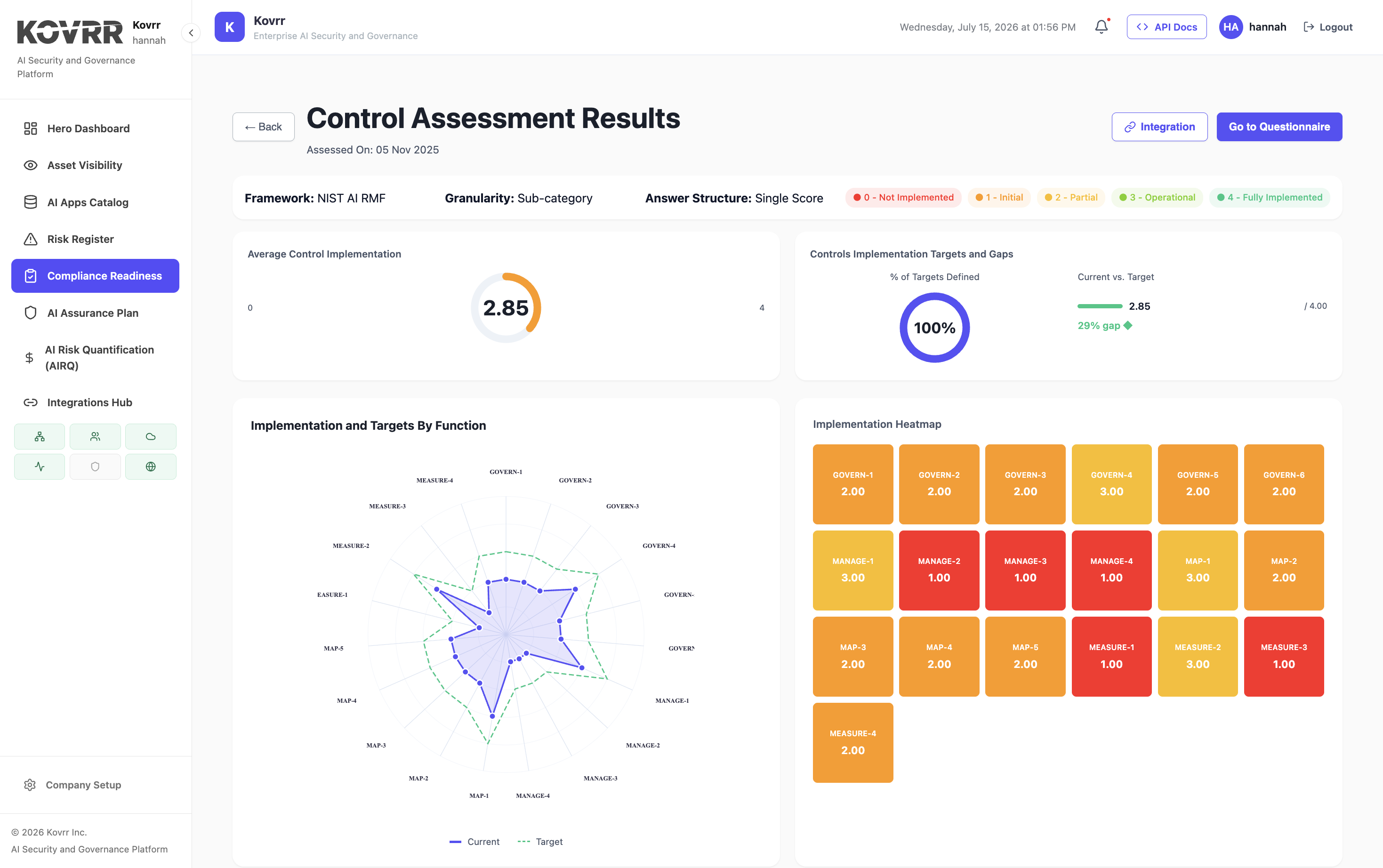
Lifecycle controls under ISO objective A.6 carry technical documentation and event logging, which answer EU AI Act Articles 11 and 12 alongside NIST Manage. Objective A.8, information for interested parties, covers external reporting and incident communication, reaching Article 73 serious incident reporting on the same evidence. Capturing each item once against a normalized control set removes the duplication that makes multi-framework programs feel unbounded, and it produces something measurable rather than a binary claim of alignment. Moving from awareness to measurable governance is what separates a program a board can track from a policy document nobody revisits.
Where the Frameworks Do Not Overlap
Mapping has limits worth knowing before anyone promises full reuse. ISO expects management system artifacts with no NIST equivalent, including internal audit programs, management review records and the Statement of Applicability. Objectives A.2 through A.4, covering policy, internal organization and resourcing, are organizational in a way NIST never addresses directly. NIST expects measurement depth ISO never asks for, particularly around adversarial testing and performance monitoring. Roughly a fifth of the work remains framework-specific, and pretending otherwise produces an audit finding. Scoping that remainder honestly at the start costs less than discovering it during a stage two audit, which is why a structured assessment of AI risk belongs ahead of any certification timeline.
Neither Framework Satisfies the EU AI Act
Certification is not conformity. ISO 42001 certification demonstrates a managed approach to AI, and it does not by itself establish that a high-risk AI system meets the Act's requirements, because only harmonized standards cited in the Official Journal carry presumption of conformity and those are still being developed. NIST alignment carries no legal weight in the EU at all.
The Act imposes obligations neither framework contains, including registration in the EU database, conformity assessment procedures, CE marking and specific technical documentation contents. Treating either framework as an EU compliance answer leaves those unaddressed, though the same operational governance work feeds both, and the underlying evidence overlaps enough that framework work is rarely wasted. Organizations mapping EU AI Act obligations alongside ISO and NIST controls find most of the difference is procedural rather than substantive.
Other Regimes Follow the Same Pattern
Colorado's AI legislation, New York City's hiring audit rule and sector-specific guidance each want evidence a framework program already generates, presented differently. Building the evidence base once and reporting into each regime is the only approach that scales, which is why preparing across frameworks together beats sequencing them one at a time.
Picking the One Your Situation Demands
Answer three questions and the choice usually makes itself. Someone outside the company asking for certification points to ISO 42001. An internal need to get systems measured and monitored points to NIST AI RMF. An existing ISO 27001 certificate makes the ISO route considerably cheaper than it looks. Enterprises with all three conditions run both and map once. Platforms such as Kovrr's AI Security and Governance Platform assess several frameworks against a single control set, so readiness per framework comes out of one exercise rather than several.
To see how one control set scores against NIST AI RMF, ISO 42001 and the EU AI Act at the same time, book a demo mapped to your own AI systems.

AI Governance Framework FAQs
Speak to an ExpertWhat is the difference between NIST AI RMF and ISO 42001?

Can you get certified against NIST AI RMF?
Which AI governance framework should we choose first?
Does ISO 42001 certification mean EU AI Act compliance?
How much overlap is there between the frameworks?
Where does ISO/IEC 23894 fit alongside 42001?