Blog Post
The Best AI Vendor Risk Management Tools in 2026
October 24, 2026
Conventional vendor risk tooling asks whether a supplier will suffer a breach. For an AI provider that question is necessary and incomplete, because the larger exposure is what the provider does with your material while operating exactly as intended.
Retention periods, training use, inference location and the model serving an endpoint are data governance questions rather than security ones. Most platforms in this market have no field for them, which is the first thing to check.
What Does an AI Vendor Assessment Have to Ask?
Four questions a conventional security review never reaches.
Training Use
Whether submitted content is used to train or improve the provider's models, and whether that differs between consumer and enterprise tiers of the same product. The answer frequently differs by plan, which makes the contracted tier part of the assessment rather than a procurement detail.
Retention and Deletion
How long inputs persist, where deletion requests reach and whether derived artifacts such as embeddings are covered. A deletion commitment that excludes embeddings leaves the material present in a form nobody asked about.
The Model Behind the Endpoint
Which model serves the service, since many providers resell or route to another organization's model. The named vendor and the organization processing your content can be different parties, and three vendors resting on one dependency is what that produces at portfolio level.
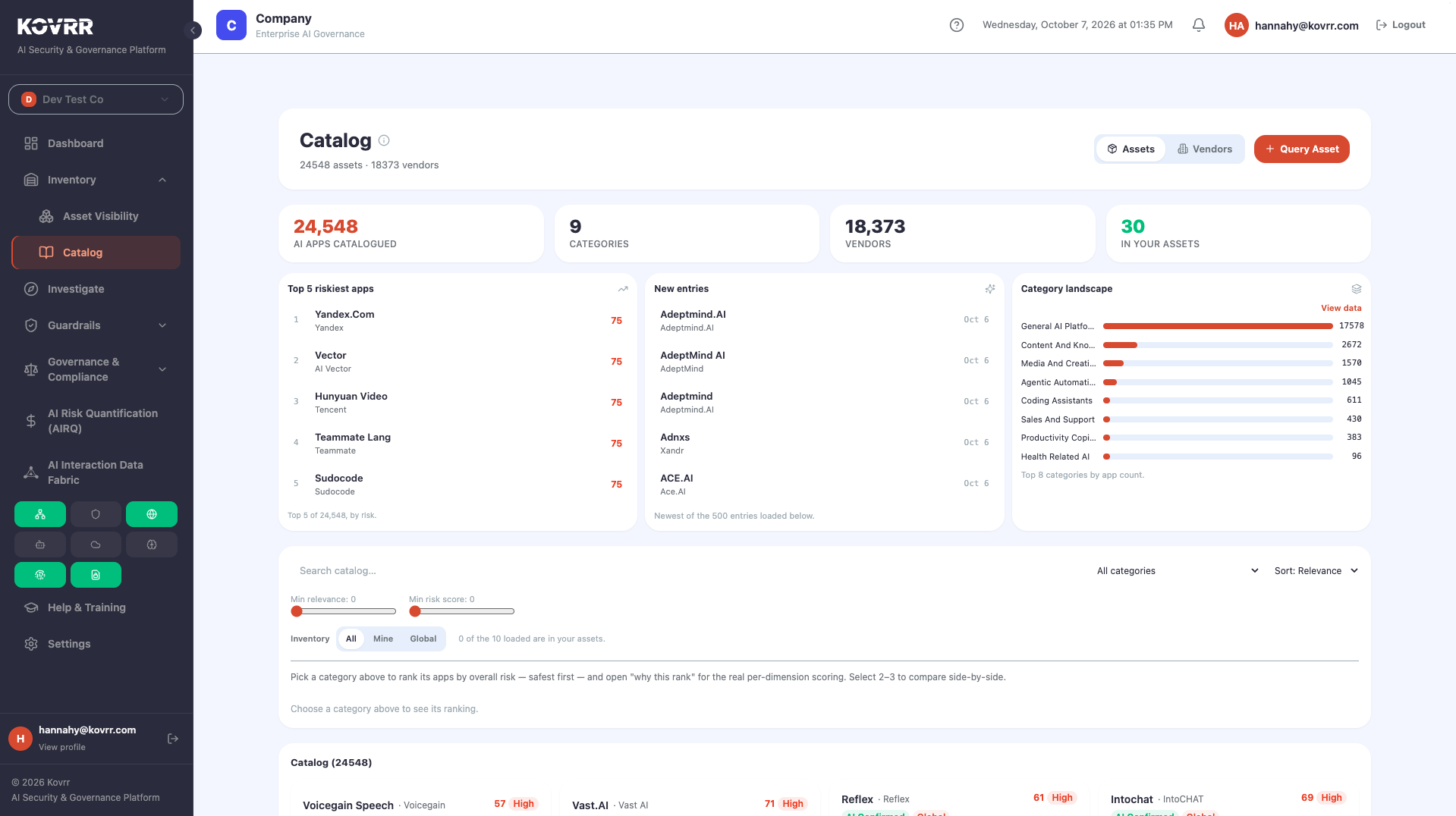
What Does Catalog Coverage Buy?
A starting position on day one rather than a result in six weeks. The benefit is real and frequently oversold.
What It Replaces
The onboarding questionnaire for vendors somebody has already assessed. Pre-validated networks carry historical assessments that can be pulled immediately, which removes weeks from a procurement cycle for common suppliers.
Why Raw Size Is the Wrong Measure
A catalog of twenty thousand providers helps only where your suppliers are among them. The useful figure is coverage of your own estate, meaning what proportion of the vendors in your own estate resolve to a catalog entry, and that proportion differs enormously between organizations.
What to Ask in a Trial
Load your own vendor list and count the matches. A platform resolving most of it has a catalog that fits you, whatever its headline total, and one resolving a third does not.
What Can a Questionnaire Not See Afterward?
Four changes, and the fourth is specific to AI suppliers.
- Subprocessor changes: The provider's own suppliers change without the contract needing to change.
- Model substitution: The model behind an endpoint is swapped, deprecated or re-versioned on the provider's schedule.
- Corporate change: Acquisition alters who holds the data and under which jurisdiction.
The Fourth One
The product gains AI features the questionnaire never covered. An application assessed as a document store two years ago now summarizes, drafts and reasons over its contents, and the assessment on file describes a product that no longer exists.
Why That One Is Hardest
Nothing triggers a reassessment. No contract changed, no incident occurred and no renewal date arrived, so the only signal is somebody noticing. AI arriving inside software already purchased covers the governance consequence.
How Often Should Vendor Risk Update?
On different cadences for different inputs, which is the distinction most products collapse.
Continuous Signals
Breach disclosures, exposed infrastructure, adverse media and certificate changes are observable from outside and can be watched constantly. They describe the provider's security posture rather than its data practices.
Periodic Signals
Training use, retention, oversight arrangements and deletion mechanics are internal, so they come from attestation on a schedule. Continuous monitoring cannot see them and a questionnaire can, which makes the two complementary rather than competing.
Event-Triggered Signals
A subprocessor change, a model deprecation or an acquisition should prompt a reassessment regardless of where the schedule sits. A platform without event triggers reassesses on a calendar that has no relationship to when anything changed.
Do Findings Connect to Business Impact?
Rarely, and it is what stands between a long vendor list and a decision.
What a Rating Omits
A vendor scored high risk and a vendor scored moderate carry the same label whatever they hold. One processes regulated records for a core workflow and the other summarizes meeting notes, and no rating scheme distinguishes them.
What Supplies the Difference
What the vendor can reach inside your estate, meaning which assets connect to it and which data categories those assets touch. Third-party monitoring tied to the asset inventory produces that mapping, and a vendor lookup answers the narrower question of what is known about one provider.
Which Tools Sit Where?
Three groups, split by what they observe rather than by how they market themselves.
Exchange and Catalog Platforms
ProcessUnity with its validated exchange, and Mitratech, lead with pre-assessed vendor networks and automated questionnaire population. Strongest on removing onboarding friction for common suppliers.
Outside-In Monitoring Platforms
Security rating providers observe externally visible posture continuously across large vendor populations. Strongest on breach and exposure signals, blind to anything internal by construction.
AI-Specific Platforms
Kovrr and a small number of others resolve AI providers specifically, carrying model provenance, training and retention attributes alongside the security ones. Strongest where the question is what a provider does with your material rather than whether it will be breached.
What Should an Evaluation Establish?
Three things, each testable in a trial.
What proportion of your own vendor list resolves to catalog entries, since headline catalog size says nothing about fit. Whether the platform holds training, retention and model provenance as fields rather than as free text in an uploaded document. Then whether a finding connects to which of your assets the vendor reaches, because a rating without that connection cannot be prioritized. Assessing an AI vendor before signing covers the pre-contract half, and the platform ties vendor findings to the assets and identities already inventoried.
Ask What They Do With It, Not Only Whether They Leak
Conventional vendor tooling asks whether a supplier will be breached, and for an AI provider the larger exposure is what happens while it operates as intended. Training use, retention including derived artifacts, and which organization's model serves an endpoint are data governance questions that most platforms carry no field for. Catalog coverage buys a starting position rather than a result, and the measure that matters is what proportion of your own suppliers resolve, rather than the headline total. Questionnaires go stale in four ways after signing, and the AI-specific one is a product gaining features the assessment never covered, which nothing triggers a review for. Findings also need to connect to which assets a vendor reaches before a rating becomes a decision.
To see vendor findings tied to the assets and data each provider reaches, book a demo mapped to your own estate.

AI Vendor Risk FAQs
Speak to an ExpertWhat should an AI vendor risk assessment ask that a security review does not?

Does catalog size matter in AI vendor risk tools?
What can a vendor questionnaire not see after the contract is signed?
Why is a product gaining AI features the hardest vendor change to catch?
How often should AI vendor risk information update?
Why do vendor risk ratings fail to support prioritization?