Blog Post
Where the Integration Sits Decides What an AI Governance Tool Can See
November 24, 2026
An AI governance tool that integrates with the AI platforms gets deep coverage of a fixed list. Whether that is enough depends on where the integration sits, because that decides what the tool can see about everything that is not on the list.
Two architectures are in use. One connects to the AI platforms themselves and reads each platform's admin, audit or compliance interface. The other reads the security tools an organization already runs, across identity, browser, network, endpoint and data loss prevention. Both are legitimate and they fail in different places. Evaluate the Join, Not the Sensors argues about how sources are combined. This piece argues about where they are attached.
What Does Platform-Side Integration Do Well?
It gives authoritative depth inside the tenant it is connected to.
A platform knows its own entitlements, its own workspaces and the conversations it governs. Its admin interface can return the full list of who is entitled, which is a denominator no telemetry stream can supply, since a stream shows only the people who reported. Where a platform exposes conversation content to administrators, that is also depth a network source does not have. Kovrr reads these interfaces too, and building an AI usage inventory from three reads uses a provider admin API for exactly that denominator.
What Can a List Not Cover?
A list leaves out three things, and each of them keeps growing.
The Next Platform
Coverage equals the integrations that have been built. A new AI tool is invisible until someone writes, tests and maintains an integration for it, and every platform exposes different fields and identity formats, so each one is a separate project. Kovrr's catalog holds more than 18,000 AI applications, and a list of integrations is a small subset of a catalog that size. Reading the stack removes the dependency. A tool that touches identity, a browser, the network or an endpoint appears in those records whether or not anyone has heard of it, provided one of those sources can see it.
The Session Outside the Tenant
A platform's interface reports the sessions its own tenant governs. A personal account on the same platform is outside that tenant, so its conversations never reach the admin view. One Domain, Two Tenants, Only One Governed covers why that single attribute decides whether a conversation is governed, and why per-vendor controls and reconstruction from other sources complement each other.
Everything That Is Not a Platform
Some AI activity has no admin interface to integrate with. Desktop clients that pin their certificates keep their traffic out of network inspection by design. Coding agents and MCP servers running under an employee's own credentials authenticate with a token, so no directory attributes them to a person. AI features embedded in software a company already licenses never register as a separate platform at all. These are the categories a fixed list is least likely to contain, and they are the ones growing fastest.
What Does Reading the Stack Give Up?
Depth per platform, and reach where the stack itself is blind.
Where traffic is encrypted and nothing inspects it, a network source reports that a destination was reached and little more. Browser coverage is bounded by how many devices are managed, and network coverage by how much traffic crosses corporate egress. Kovrr's detection also reports the category of data, the severity and the action taken, and never the content of a prompt, which is a design choice with a cost. A team that needs conversation content for discovery or a legal hold gets it from the platform's own interface, which is the strongest argument for using both.
How Should a Buyer Test the Architecture?
Four questions, each of which exposes where the integration sits.
- What does the tool report about a platform it has no integration for? If the answer is nothing, the coverage is a list. If it is a named account and a risk score, the coverage is the stack.
- What happens on the day a new AI tool appears? The honest answer is how long it takes to show up, and whether anyone has to build something first.
- What does it see of a session outside the governed tenant? An answer that depends on the platform's own interface covers governed sessions only.
- If one source is removed, what does it still report? A foundation keeps reporting and an addition does not.
Where Does Kovrr Sit?
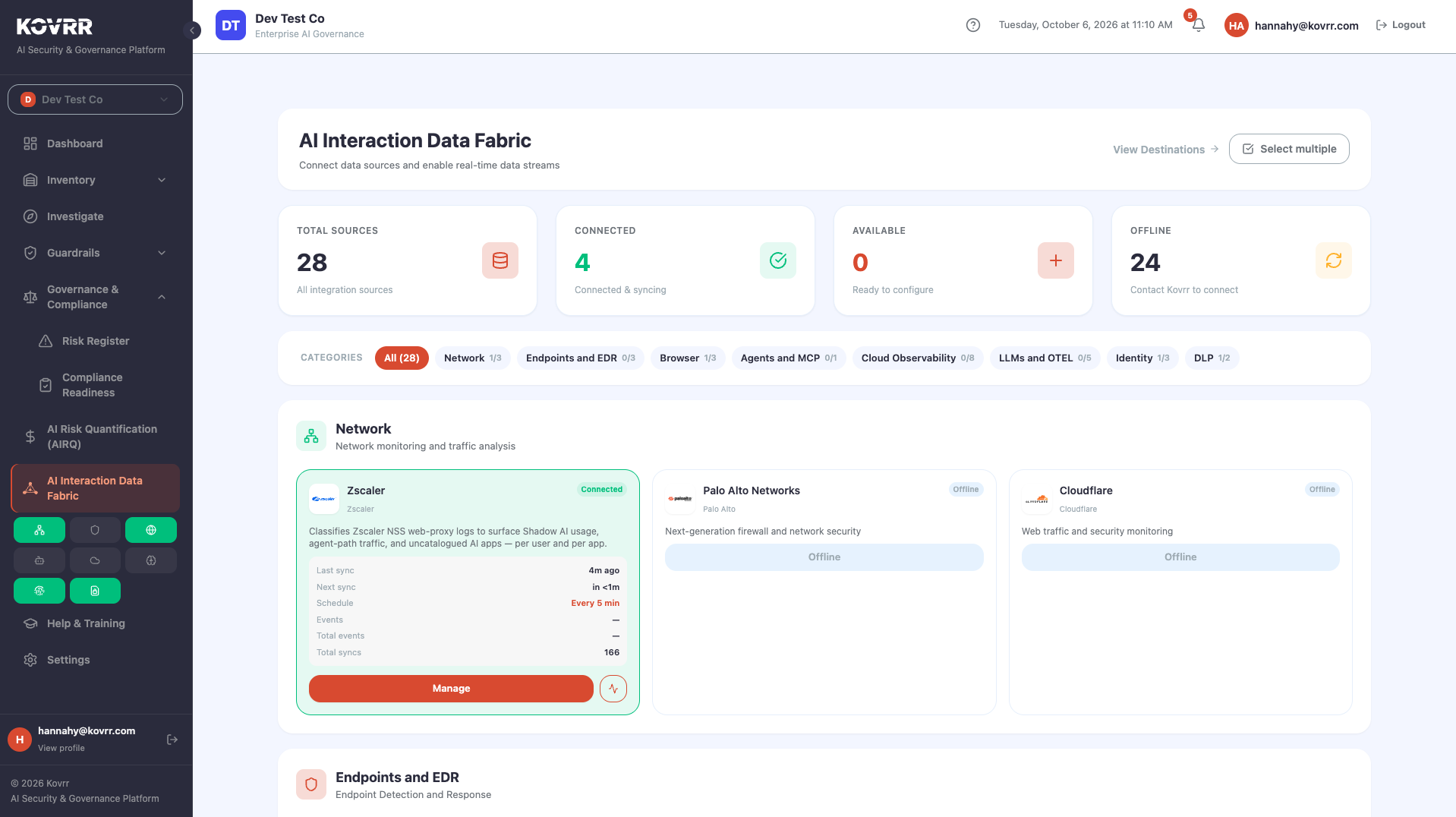
Kovrr's AI Security and Governance Platform sees every AI interaction through the security tools a company already owns, and fuses them into one finding with no new sensor. It draws on eight source categories, which include identity and browser alongside the network and endpoint sources a company already runs, and it reads a provider admin API for the entitled population, so platform-side depth adds to the picture where an integration exists without setting the limit of what the platform can see. The principle carries into enforcement. See with what you own, and enforce where it matters, through Kovrr Browser Protect for people, the Kovrr MCP Agent Broker for agents and bidirectional integrations with a company's own controls, all of them optional. Finding the tools nobody integrated is the use case Real-Time AI Asset Inventory & Shadow AI Monitoring, and Monitor & Control Employees' AI Usage covers what employees do with them. Together that is AI governance and AI usage control in one platform, with governance that runs where AI runs, for people and agents, with a full audit trail. What is an AI data fabric explains the layer that does the joining.
Source or Foundation
Platform-side integration is a strong source and a weak foundation. It gives authoritative depth inside the tenants it connects to and a complete count of who is entitled, and its coverage is the list of integrations that exist. Reading the stack gives breadth that a new tool cannot step around, at the cost of depth where a source cannot see inside the session. The workable architecture uses both and decides which one limits the other. A tool built on the list can be no wider than the list, and a tool built on the stack can add platform-side depth wherever it is available while still reporting everywhere it is not.
To see which AI tools in your environment sit outside any platform's own admin view, book a demo with our AI risk experts.

AI Governance Integration FAQs
Speak to an ExpertWhat is the difference between platform-side and stack-side AI governance integrations?

Why can an AI platform's own admin interface not show all AI usage?
How does an AI governance tool find a new AI tool nobody integrated?
What does reading the existing security stack give up?
Should an AI governance tool use both architectures?
What questions test where an AI governance integration sits?