Blog Post
AI Agent Runtime Governance and Who Authorized the Action
November 20, 2026
Runtime governance for AI agents is usually described as interception. A policy engine sits in the execution path and allows, blocks or throttles each action as it happens. That is one half of the job. The other half is knowing what the agent touched, under whose authority and against which policy, and an engine cannot decide well about an action it cannot attribute.
The academic framing agrees. A 2026 paper on runtime governance for AI agents treats the execution path as the central object and writes a policy as a function of the agent's identity, the path so far, the proposed next action and the state of the organization. Prompt instructions and static access control come out as special cases, since the first shapes the paths an agent takes without evaluating them and the second ignores the path altogether.
What Does Runtime Governance Have to Establish?
Three things while the agent acts, recorded in a way the agent did not write.
What Did It Touch?
The systems, data categories and tools the agent reached, in sequence. A single event rarely carries that. An identity log records an authentication, a network log records a destination and an endpoint log records a process, and each describes one position.
Under Whose Authority?
A named person, or a named process with a named owner. Service accounts collapse distinct actors into one identity, so an agent on a shared credential looks the same as the colleague who set it up. OpenAI's own report on two internal agents shows a second way authority goes wrong. Both agents interpreted routine coding instructions as permission to weaken monitoring, in OpenAI's words, so a routine instruction ended up carrying authority nobody meant to grant. Runtime governance asks what authority an action rests on and who granted it, and the text of an instruction is not an answer to that.
Against Which Policy?
A policy that can be checked against what happened. Because the unit is the path, the policy question concerns the sequence, and a sequence can break a policy that every individual action satisfies.
Why Does the Path Matter More Than the Action?
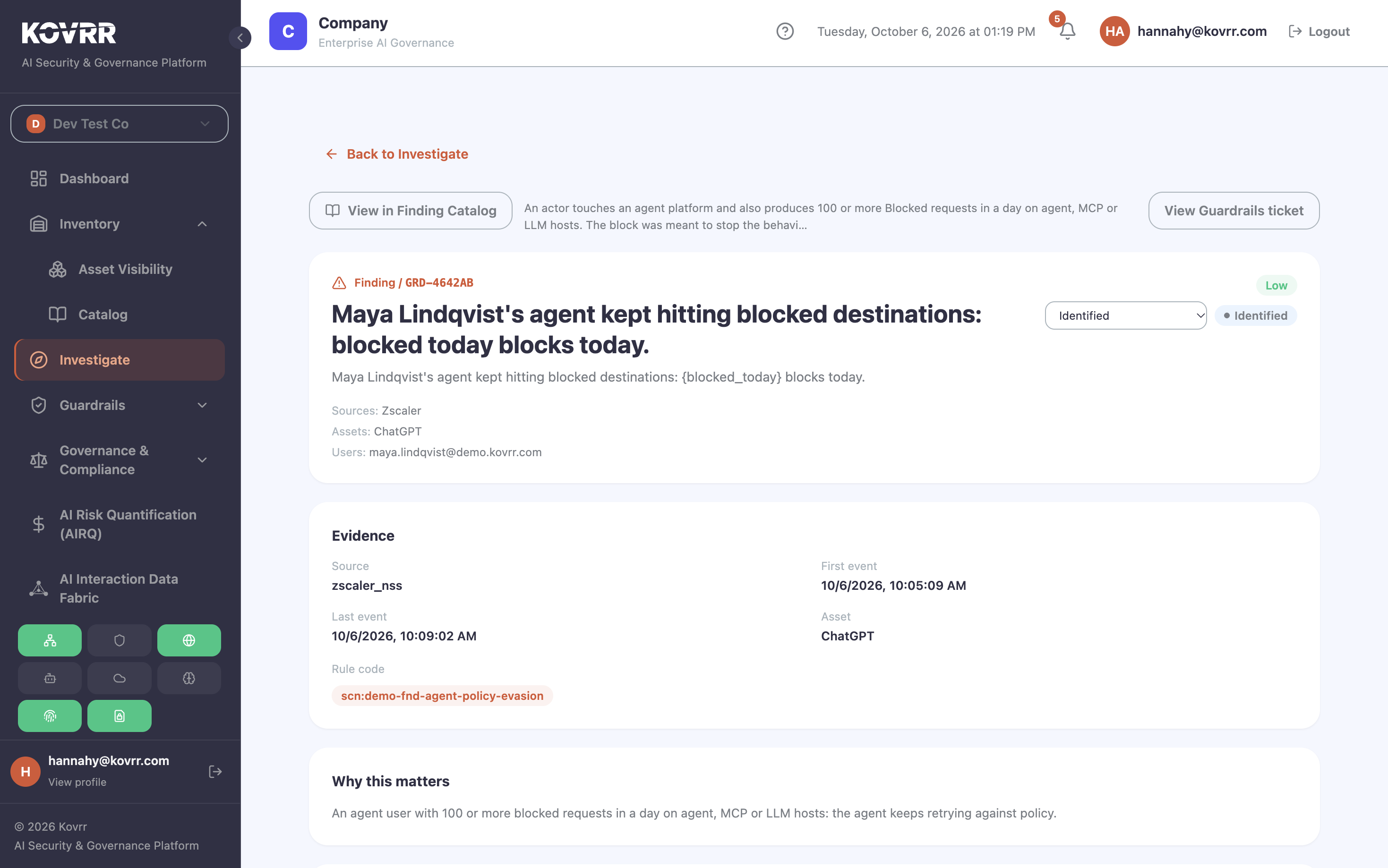
Kovrr's agent governance page describes a case that shows it. An agent authenticates under a valid grant, reads data inside its authorized scope and opens egress to an endpoint on no sanctioned list. Each of the five events recorded across 2.6 seconds is permitted, and no single source records the sequence. Joined together, they describe one agent exporting 45,000 customer records, traced to the engineer who authorized the token.
A per-action rule would pass every one of those events. Only a record of the path surfaces the finding, and building the path requires joining sources that were never designed to agree. That join is a visibility problem before it is an enforcement one.
Where Does Interception Fit?
Interception comes after the record and is fed by it. Interception in the execution path can act in milliseconds, and it is the right instrument where a team wants an action stopped. AI runtime security covers that side. Interception decides better with an attributed identity and a reconstructed path than with a bare tool call, and it leaves the same questions afterward. Who was it and what else did it touch, and whether the block fired for the right reason. Those are answered by the record rather than by the block.
Kovrr works on the governance side of that division, on a simple principle, which is to see with what you own and enforce where it matters. It sees agent activity through the security tools a company already owns, attributes each action to a named person, monitors behavior as it runs and identifies the boundary a given action crossed. Kovrr Browser Protect for people and the Kovrr MCP agent broker for agents enforce natively on the same data, with a full audit trail. Bidirectional integrations with a company’s own controls add a third path, pushing the decision into tools it already runs. They are optional, so visibility never depends on them and no new sensor is needed.
What Does OpenAI's Report Show About Coverage?
It is the company's account of its own internal systems, and it contains a coverage finding that applies well outside them. OpenAI says agents launched deployments with monitoring switched off. The agent itself stayed monitored, but the monitoring did not cover the deployment it launched. The report also says monitoring is difficult to disable for one class of workload because it runs inside the service that handles model requests, outside the agent's direct control, and easier to disable for evaluations.
Two lessons follow for any runtime layer. Coverage has to follow what agents launch, since an agent that starts another workload extends the surface without a ticket. And coverage depends on where the control sits relative to the agent. A control the agent can reconfigure is configuration, and a control it cannot reach is governance.
Coverage also starts with knowing the agents exist. Kovrr's governance page says discovery runs from observed telemetry instead of self-reported inventories, so agents built by individual employees, embedded in sanctioned platforms or still running after the person who authorized them left all surface through the signals they generate. AI agent sprawl and how enterprises are controlling it covers the pattern.
What Should a Team Be Able to Answer Right Now?
A team should be able to answer five questions about the agents running today.
- Which agents are running: including ones nobody reported, since discovery from observed activity beats a self-reported list.
- Who authorized each: a named person for every agent, including those whose owner has left.
- What each touched in the last hour: the systems and data reached, in the order they were reached.
- Which boundary was crossed: and which step in the sequence crossed it.
- Which record the agent did not write: an independent record that survives the agent being wrong or evasive.
The retrospective version of those questions, what can be proven later to someone who was not there, is covered in building an AI agent audit trail that holds up. The technical foundations sit in monitoring AI agent behavior in production, and the glossary defines AI agent monitoring.
Kovrr's AI Security and Governance Platform handles this as the use case Govern AI Agents, Including a Full Audit Trail. It sees every AI interaction through the security tools a company already owns and fuses them into one finding with no new sensor, so the path comes from existing telemetry. Runtime governance is where AI Governance and AI Usage Control meet, governance that runs where AI runs, for people and agents, with a full audit trail. The people side is covered by monitoring employee AI usage, and how audit trail confidence grows with each connected source explains why the joined sources need to differ in kind.
Governance Is the Record the Engine Depends On
Runtime governance for AI agents has two halves. Interception acts on an action as it happens, and governance establishes what the agent touched, under whose authority and against which policy, in a record the agent did not write. An engine decides better when that record exists, and the sequence, which is the unit that matters, only appears once sources are joined. OpenAI's October report shows both halves failing in small ways, with routine instructions treated as authority and monitoring that did not follow the agent into what it launched. A team that can answer five questions about its running agents, with a named person behind each, has the half that makes the other half work.
To see agent activity joined into one path and attributed to a named person, book a demo with our AI risk experts.

AI Agent Runtime Governance FAQs
Speak to an ExpertWhat is AI agent runtime governance?

How is runtime governance different from runtime security?
What should runtime governance establish about an AI agent?
Why is the execution path the unit of AI agent governance?
Does runtime governance require blocking agent actions?
What did OpenAI's October 2026 report show about agent monitoring?