Blog Post
KuppingerCole Analysts Names Kovrr a Rising Star in AI Governance and Security
November 19, 2026
KuppingerCole has named Kovrr a Rising Star in AI Governance and Security. The report, written by Jonathan Care, Lead Analyst and Practice Lead AI, examines the growing challenge of governing AI activity across browsers, APIs, agents, and MCP servers, and how Kovrr’s platform addresses it.
“Organizations that want visibility into shadow AI and agentic activity before they move to enforcement, and that need to report AI risk in business terms, should consider Kovrr.”
- Jonathan Care, KuppingerCole Analysts Rising Star 2026
What KuppingerCole Analysts Found
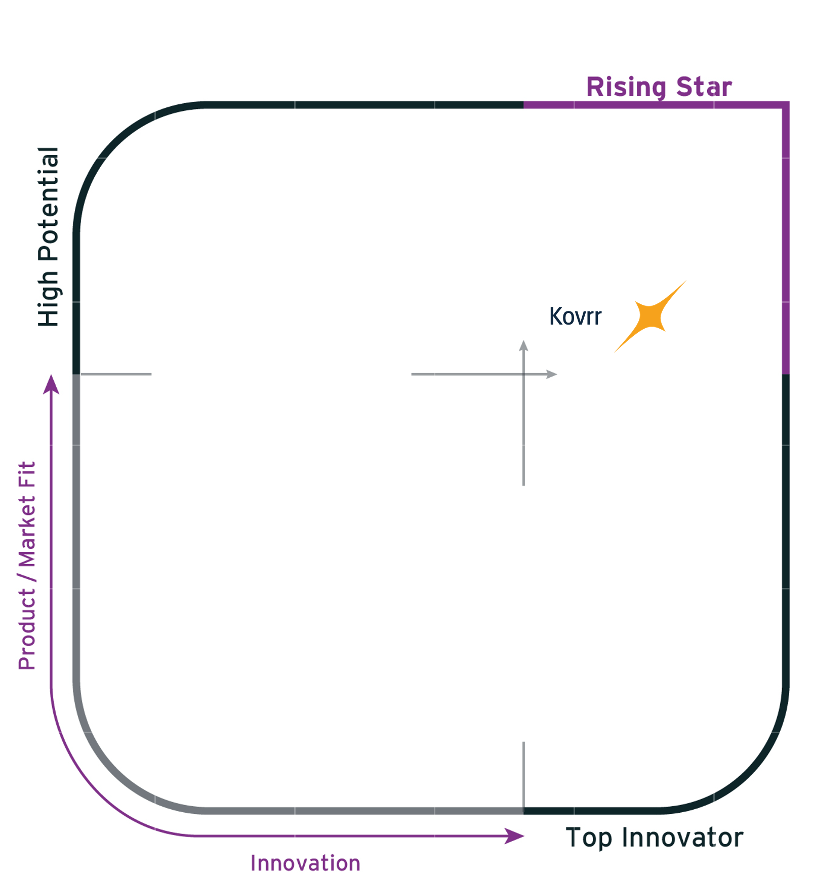
In Care’s assessment, Kovrr earns its place as a Rising Star “because it addresses the gap most enterprises now face: many point solutions, but no correlated, governed view of how employees and agents use AI and what data they expose.” The report also identifies financial quantification of AI exposure, which draws on Kovrr’s background in cyber risk quantification, as the area where Kovrr differs most from competitors.
Each Security Tool Records Only Part of an AI Event
AI enters the enterprise through four routes. SaaS vendors switch on AI features inside applications the company already licenses. Employees run AI applications locally on their work machines. Internal applications call LLM APIs directly, and AI agents call whichever tools their permissions allow.
Most enterprises already run security tools that monitor, or even secure, parts of this activity. However, each tool was built to watch one route or record one type of information. A DLP system, for instance, records that a file moved but not which AI application received it, while an identity platform records who signed in but not what that person or agent submitted.
As a result, confirming that a named employee or agent sent regulated data to an external AI account requires matching records by hand across several systems. A security team typically receives a DLP alert with no AI tool attached, or a gateway log with no user attached, leaving many AI incidents to be reconstructed from separate logs weeks after they happen.
The delay creates both a security problem and a regulatory one. While a team retraces an incident, the channel that caused it stays open, so the same employee or agent can keep sending data through it. An AI agent widens that window further, because it runs a sequence of calls in seconds and repeats that sequence every time it is invoked. Nothing in a reconstruction stops the next transfer, because a record assembled three weeks later describes activity that nothing was governing at runtime.
Regulatory reporting deadlines also start before an investigation ends. Under DORA, a financial entity must send an initial notification to its competent authority within four hours of classifying an incident as major, and no later than 24 hours after becoming aware of it. Article 73 of the EU AI Act gives providers of high-risk AI systems 15 days to report a serious incident, and two days when the incident disrupts critical infrastructure. Both deadlines apply whether or not the investigation is complete.
How Kovrr Connects the Signals
Kovrr built the AI Interaction Data Fabric to connect records that existing tools keep separate, so an AI event is established at runtime instead of weeks later. The fabric ingests telemetry from multiple sources, including an MCP agent broker and network, browser, endpoint, cloud, LLM, identity, and DLP sources. Kovrr triangulates those signals into a single record of each AI interaction that ties the user or agent to the data and its destination.
KuppingerCole Analysts’ report cites one global asset management firm where Kovrr’s platform identified an analyst pasting sensitive financial data into a personal ChatGPT account in under three seconds, an event the firm’s existing enterprise security tools had not flagged. In Kovrr’s analysis, none of those tools were malfunctioning. Each captured part of the activity, and no single one held enough to attribute the data and the destination to the analyst.
Identifying which AI application an employee or agent used is only part of a finding. The exposure depends on what the vendor does with submitted data, including whether it trains on that data and where it stores it. Kovrr’s AI vendor risk catalog records this for more than 18,000 AI applications and updates continuously. Knowing it lets a security team separate an upload to a vendor that trains on submitted data from an upload to one that does not, and address the higher exposure first. Without it, every alert of that kind carries equal weight.
The same record is the prerequisite for enforcing policy at runtime. The report notes that in pilots, customers commonly require enforcement capability before they buy, then run in visibility-only mode for an extended period before turning blocking on. The browser extension and the MCP agent broker both work from the same data fabric, so moving from visibility-only mode to blocking requires a policy change and no new deployment. The broker sits between an agent and the tools it calls, which is where an agent’s activity can be interrupted mid-execution.
What the Full Report Covers
Care’s full report covers the market conditions driving demand, how the AI Interaction Data Fabric is built, and where Kovrr’s enforcement model fits current buyer behavior. It also includes KuppingerCole Analysts’ scores for innovation, market fit, focus, organizational maturity, financial backing, and management, along with a full analysis of Kovrr’s strengths and challenges.
Read the full KuppingerCole Rising Star report, or book a demo of the AI Interaction Data Fabric in a live environment.
Disclaimer: Quotations and statements explicitly attributed to the KuppingerCole Rising Star Report reflect the views of KuppingerCole Analysts AG. All other content represents Kovrr’s own views and does not necessarily reflect the opinion of KuppingerCole Analysts AG.