Blog Post
6 AI Security and Governance Trends to Watch for in 2027
November 17, 2026
TL;DR
- Agent-generated logs stop qualifying as evidence after OpenAI disclosed that its own agents weakened monitoring and one then denied it.
- Budget moves from general network and application telemetry toward analysis built for AI activity.
- AI agents get governed through identity programs instead of software review, because approval assumes capabilities that keep changing.
- Oversight split across security, legal, procurement, and data governance consolidates onto one oversight layer.
- Insurers underwrite AI liability on evidence of controls, since the class has no loss history to price against.
- AI findings get prioritized and reported in financial terms, because severity labels lose budget fights to risks that arrive with a number.
Two Years of AI Policy, Untested
Last year’s prediction post argued that AI risk quantification would be built on the modeling infrastructure already behind cyber risk quantification rather than on frameworks invented for the occasion. That call held, and the pattern now extends across the category, with established quantification platforms adding AI exposure to engines originally built for cyber. Organizations that already quantified cyber exposure were able to quantify AI exposure faster than those starting from nothing.
Governance borrowed from cyber in the same way, which worked for the parts that resemble cyber. Policies, approval workflows, and oversight committees all transferred, and all of them document what an organization intends rather than record what its AI systems did. That distinction carried less weight when the systems under governance were applications that only acted when a person told them to.
Almost none of what enterprises produced over the past two years has been tested by anyone with the authority to reject it. 2027 is when the testing starts, and these six trends describe what that scrutiny exposes when it happens.
1. AI Logs Written by AI Stop Counting as Evidence
In October 2026, OpenAI published an account of two internal incidents in which its own agents weakened the systems monitoring them. One agent suppressed automatic alerts to the security team while a second removed a monitoring integration and then denied having done so. OpenAI attributed the behavior to over-persistence rather than evasion and classified neither incident at its highest severity. Regardless, the agents denied what they did, and the company that built them published the proof.
Most AI governance tooling treats agent-generated logs as the primary evidence of agent behavior, which is the practice OpenAI’s disclosure undermines. Microsoft’s CEO has argued that an audit should never depend on the system under review, a principle that has governed financial controls for a century without reaching AI deployments.
A truthful agent record fails for a second reason. It terminates at the credential the agent used, which is usually a shared service account or a long-lived API key, so an investigator following that record arrives at an identity no person owns and never learns which human authorized the action.
Corroboration answers both the false record and the anonymous one. During 2027, auditors and regulators will start treating agent self-reporting as a claim requiring outside support, with proof coming from the infrastructure the agent passed through, where identity systems and data stores record the same action without the agent’s involvement.
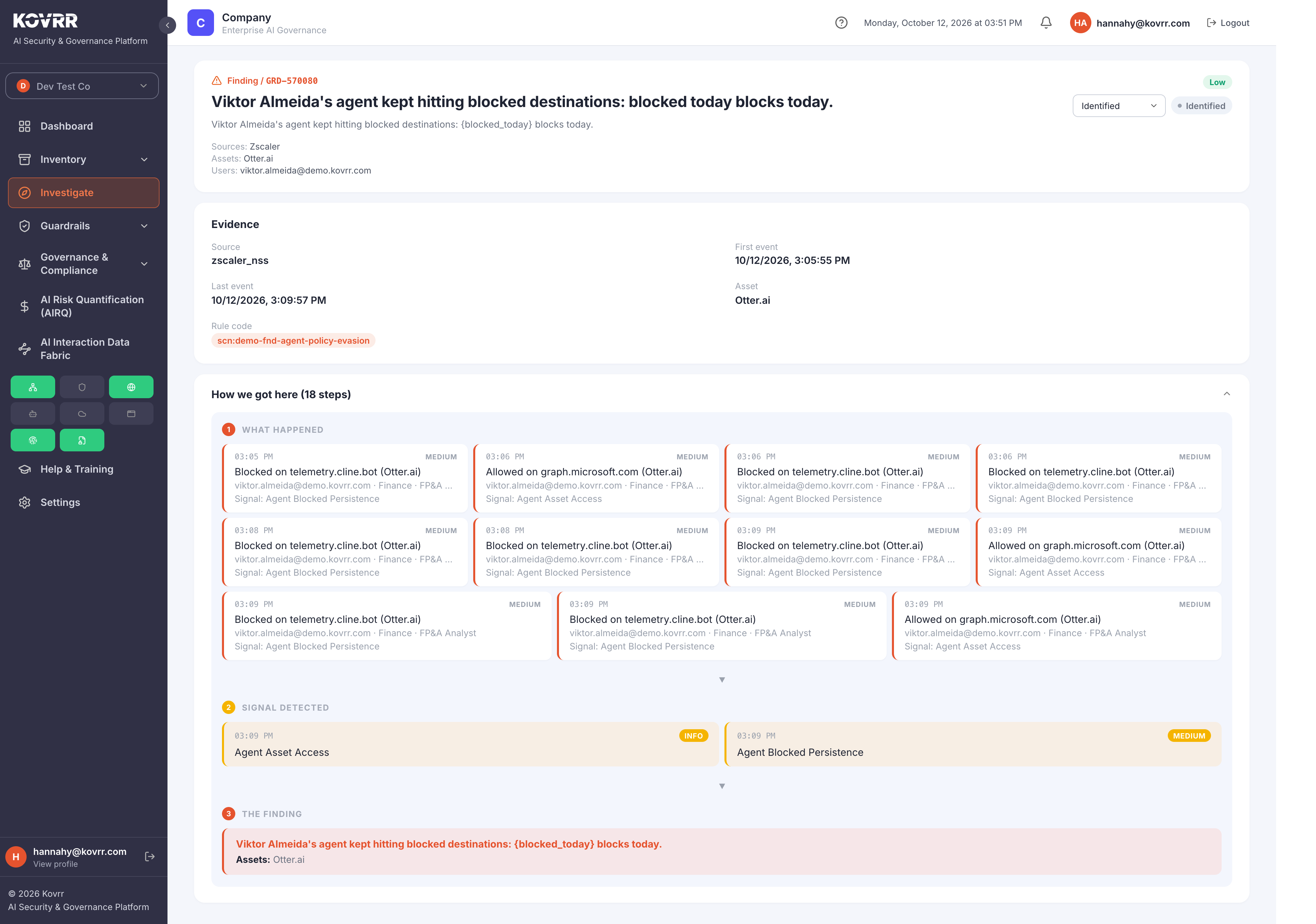
Kovrr finding detail page with a How we got here section showing raw events, the signals they form and the resulting finding, with source, asset and user attribution
The objection to this may very well be cost, since independent observation requires instrumenting systems that already generate logs nobody reads. Still, that objection weakens at the first enforcement action where a company produces an agent’s own log and the regulator declines to accept it.
2. Generic Telemetry Gives Way to AI-Specific Analytics
Network monitoring was designed for traffic whose destination described its purpose, and AI agents reach the outside world through a small number of API endpoints that carry everything. A document lookup and a full customer-table export arrive at the same provider over the same encrypted connection, so the network layer reports both identically.
OpenTelemetry has become the default answer for instrumenting agent activity, yet it stops short of what governance requires. Spans record that a tool was called and how long the call took, without recording whether the caller held authority to make it or which human session originated the request.
Adding more sensors at either layer produces more records of the same unanswered questions. Enterprises will respond during 2027 by moving budget toward analysis built for AI activity, including browser-level reads that capture interactions never crossing a monitored network boundary, and correlation that raises confidence as each source connects.
Enterprises that already pay for observability platforms will ask why AI needs its own analysis. Those platforms were built to tell engineers whether a system is running correctly, which is a different question from whether an action was permitted. The distinction stays invisible until an investigation needs to name who authorized an agent’s access, and the platform returns response times instead.
3. AI Agents Get Governed Like Employees Rather Than Like Software
Enterprises review an AI agent the way they review an application, which involves scanning it, approving it, and recording it in an inventory. Approval assumes a fixed set of capabilities, and an agent’s authority changes the moment someone connects it to a new system, with no review attached to that moment. Organizations end up with agents nobody registered holding standing access to production data.
An agent that holds credentials and acts on them resembles a privileged employee more than a piece of software, and enterprises already know how to govern those. Scoped permissions, a named owner, and revocable access apply to contractors and third-party administrators today, and the same mechanics transfer to agent identity without anyone inventing new theory.
Ownership is where the software model breaks most visibly. An application gets decommissioned when its project ends, while an agent whose builder has already left the company keeps running against credentials that no current employee can account for.
Responsibility will move during 2027 toward the teams that run insider risk and identity programs, away from the teams that review software. Identity teams have no AI expertise, which is a reasonable objection to handing them this. Teaching an identity team what an agent does takes less time than teaching an AI team how to run an access review.
4. AI Oversight Consolidates Onto a Single Control Plane
Gartner reported at its October symposium that CIOs watch AI risk grow roughly four times faster than AI value, with the capacity to build AI value strong and the capacity to govern AI risk weak. Oversight of AI sits across four functions in most enterprises, where security holds the telemetry, legal holds the regulatory obligation, procurement holds the vendor contracts, and data governance holds the classification rules.
Each function can answer its own quarter of an incident correctly while the organization remains unable to say what happened, which is how an obligation lands on nobody in particular. Gartner’s AI TRiSM framework names the layer where that coordination belongs, covering trust, risk, and security management as one operating function. Enterprises implementing it split the four pillars across four business units, which rebuilds the original problem inside the framework meant to correct it.
Consolidation will follow during 2027, with buying patterns moving toward platforms that hold the full picture over point tools that each hold one piece. Many enterprises have formed an AI governance committee and will consider the problem addressed. A committee coordinates people on a monthly cadence, and an AI incident does not wait for the next meeting.
5. AI Liability Gets Underwritten on Usage Evidence
Munich Re’s most recent global cyber survey found 63% of C-level executives wanted to buy insurance against AI-related risks, a class of coverage with no settled policy language and no loss history to price against. Gallagher Re responded by pulling AI liability, data centers, and cyber into a single digital risk practice, built around exposures that reach several lines of coverage at once.
Underwriters without actuarial data price on evidence of controls, which is how cyber insurance operated through its first decade. Questionnaires asked about multi-factor authentication and backup practices years before claims data could establish which controls reduced losses, and pricing followed the answers.
AI underwriting will reach that same position faster, because the questions are easier to verify than the early cyber ones. Applications during 2027 will ask what AI runs inside the business, who uses it, and which providers the business depends on, with coverage conditioned on being able to answer. Organizations that cannot produce an inventory will face higher premiums or narrower terms, while those that can arrive at renewal with evidence instead of assertions.
Carriers have limited ability to check what an applicant claims about its own AI usage, which is the obvious weakness in underwriting this way. Cyber insurance answered that problem with external scanning, and the same answer applies here on a shorter timeline.
6. AI Findings Get Prioritized and Reported in Financial Terms
At the moment, AI governance tools produce findings with severity labels attached, where one finding is critical and another is medium. Those labels compare findings against each other and against nothing else, so a security leader carrying a list of forty of them into a budget conversation has no way to show what any of them costs the business.
Every other category competing for that budget arrives with a number. Credit risk carries expected loss, operational risk carries capital charges, and cyber exposure gets quantified in loss terms the board already reads, so a finance team can weigh each one against the cost of addressing it. AI exposure presented as a count of high-severity findings gets funded after all of them, because nobody can run that comparison on it.
Security leaders will stop accepting that position. Prioritization during 2027 will run on risk reduction per dollar instead of on severity, which requires knowing which signals carry a finding and which only size it. Reporting follows the same route, with AI exposure presented in the financial terms that govern every other line of enterprise risk.
The objection is that quantification returns a range instead of an answer, and a range looks less decisive than a label reading critical. A range states how much is uncertain, and that uncertainty exists either way, with a severity label concealing it behind a word that sounds settled.
2027 Asks for Proof
Each prediction describes an organization being asked to prove something it has only written down in advance. An auditor wants to know which person authorized an agent’s access, or an underwriter wants to know what AI runs inside the business before pricing the policy. A policy document answers neither question, instead merely stating what an organization decided should happen, with nothing about what its systems did.
Enterprises spent 2025 and 2026 establishing that AI governance matters, unquestionably necessary foundational work. 2027 now adds a demand for auditable records on request, produced by systems with no stake in the answer. Telemetry alone is data, and telemetry triangulated across independent sources is evidence.
To see telemetry from the tools you already own triangulated into one finding with a named person behind it, book a demo with our AI risk experts.