
Blog Post
EU AI Act Compliance Roadmap: What Enterprises Must Document and When
August 8, 2026
The EU AI Act reached a turning point this summer, and the headlines got it half right. Obligations for high-risk AI systems were postponed to December 2027 under the Digital Omnibus, adopted in June 2026. The transparency rules under Article 50 were not postponed, and they apply from August 2, 2026.
Enterprises reading spring 2026 guidance are working from a timeline that no longer exists, and enterprises reading the headline about a delay may believe nothing is due. Both readings create exposure. What follows is the sequence that applies now, the documentation each stage requires, and what the extra sixteen months on high-risk obligations are useful for.
What the Digital Omnibus Changed
The Commission tabled the Digital Omnibus on AI in November 2025 after implementation ran behind schedule, largely because harmonized standards and national competent authorities were not ready. Political agreement followed in May 2026, and the Council confirmed final approval on June 29, 2026. The result moved some dates, left others untouched, and added a new prohibition.
Obligations for stand-alone high-risk systems listed in Annex III moved from August 2, 2026 to December 2, 2027. High-risk AI embedded as a safety component in products already regulated under Annex I moved to August 2, 2028. Watermarking requirements under Article 50(2) were deferred to December 2, 2026 for systems already on the market, a shorter reprieve than the Commission originally proposed.
The Dates Are Backstops, Not Fixed Points
The postponement carries a condition most summaries omit. High-risk obligations trigger once the Commission adopts a decision confirming that standards and support tools are complete, followed by a six-month transition for Annex III systems and twelve months for Annex I. December 2027 and August 2028 are the outer limits if no such decision arrives sooner, so planning to the backstop assumes the slowest possible path.
A New Prohibition Arrived
The agreement added AI systems used to generate non-consensual intimate imagery and child sexual abuse material to the prohibited practices under Article 5, effective December 2, 2026. Organizations tracking only the deferred deadlines would miss a new obligation appearing inside the same instrument.
What Applies on August 2, 2026
Article 50 transparency obligations apply in full, and they reach further than most high-risk provisions because they attach to interaction rather than sector. Any organization deploying a customer-facing chatbot, generating synthetic media, or producing AI output presented to a person falls inside scope regardless of risk classification.
- Interaction Disclosure: People must be told they are interacting with an AI system unless it is obvious.
- Synthetic Content Marking: Generated or manipulated audio, image, video and text must be machine-readably marked.
- Deepfake Labeling: Content resembling real people, places or events must be disclosed as artificially generated.
One carve-out matters for planning. Article 50(2) marking requirements do not apply to systems already placed on the market at that date, and those systems have until December 2, 2026. The Article 50 transparency obligations otherwise take effect with no transition period, and the AI Office holds enforcement and fining powers from the same date.
Classification Is the First Documentation Task
Every obligation downstream depends on how a system is classified, and classification is itself a documented decision. Four tiers exist under the Act. Unacceptable-risk practices are banned outright. High-risk systems carry the heaviest requirements. Limited-risk systems attract transparency duties only. Minimal-risk systems attract none. Working through a structured categorization process before the documentation stage prevents rework later.
How Annex III Classification Works
A system falls into the high-risk category when it operates in one of eight listed areas, including biometrics, critical infrastructure, education, employment, access to essential services, law enforcement, migration, and administration of justice. Employment screening and candidate ranking sit squarely inside the list, which catches organizations that never considered themselves AI companies.
The Article 6(3) Derogation and Its Limits
An Annex III system escapes high-risk classification only when it fails to materially influence a human decision. Four narrow conditions qualify. A system performing a narrow procedural task such as reformatting or deduplication qualifies. A system improving an activity a human already completed qualifies. A system detecting patterns in prior decisions without replacing the human assessment qualifies. A system handling preparatory work ahead of human evaluation qualifies.
Profiling voids the derogation entirely. A system evaluating or predicting a person's performance, health, location or behavior remains high-risk with no route out. Claiming the derogation also creates its own paperwork, since providers must document the assessment in writing, notify the national competent authority before placing the system on the market, and register it in the EU database.
Provider or Deployer Changes the Obligation Set
Providers carry the documentation burden. Deployers carry operational duties around human oversight, input data quality, log retention and monitoring. The distinction collapses under Article 25, where a deployer who puts their own name on a system, substantially modifies it, or changes its intended purpose becomes the provider and inherits the full set. Fine-tuning a third-party model for a hiring workflow is exactly the scenario that triggers the transfer, which makes third-party AI vendor assessment a classification exercise rather than a procurement formality.
What High-Risk Documentation Requires
Article 11 requires technical documentation drawn up before a system reaches the market and kept current thereafter, with the contents specified in Annex IV. Retention runs ten years after the system is placed on the market or put into service. The dossier is not a one-time artifact, since every substantial change obliges an update.
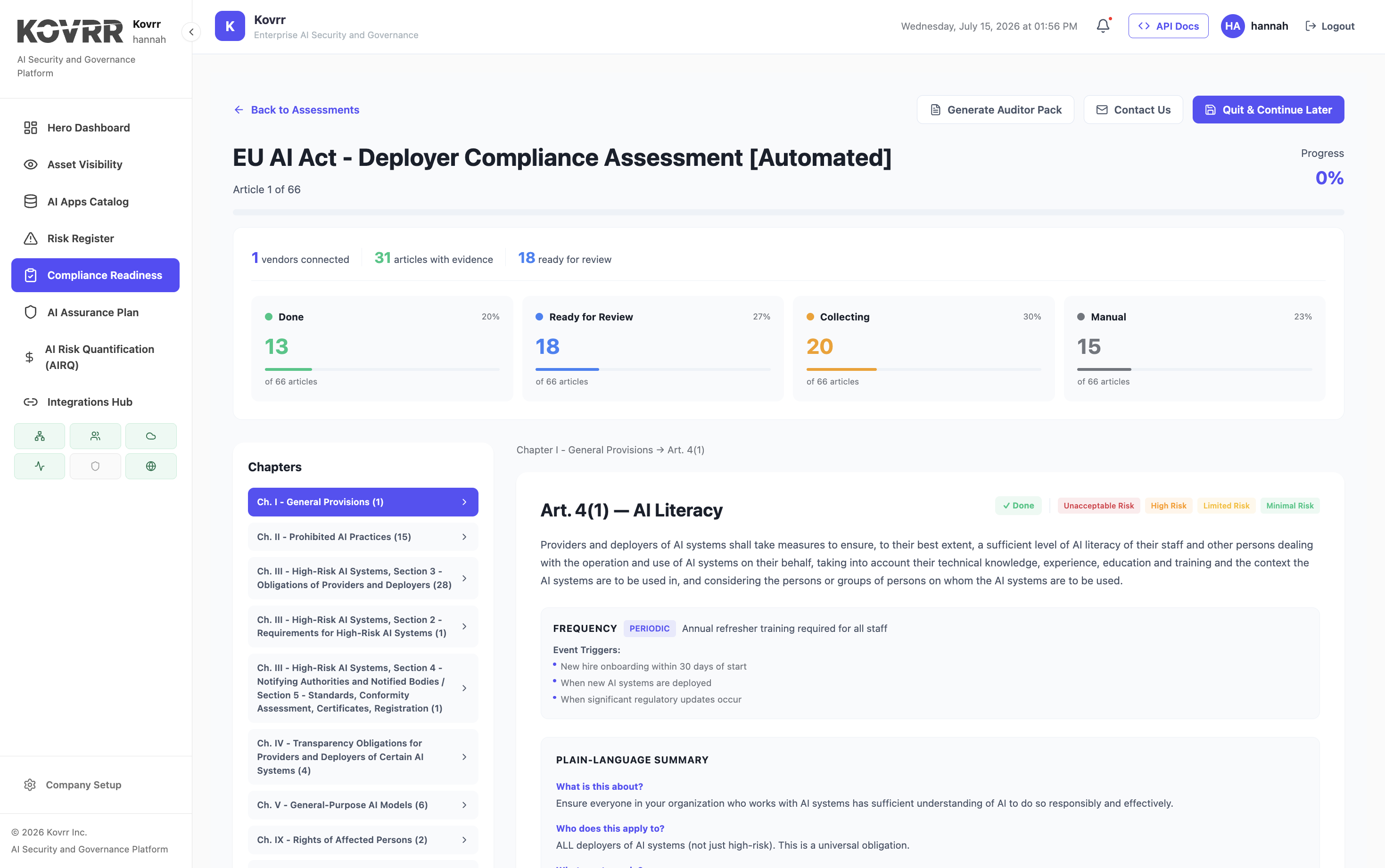
Technical Documentation
Annex IV expects a description of the intended purpose, version, commercial name and how the system interacts with hardware, software and external interfaces. Design and architecture detail follows, covering technical specifications, data flow logic, algorithms, optimization methods and hardware requirements. Validation and testing records complete the picture with accuracy, robustness and cybersecurity metrics alongside reproducible results.
Risk Management Records
Article 9 requires a continuous risk management system, documented across the full lifecycle rather than assessed once. Known and foreseeable risks must be recorded together with the mitigations applied and the residual risk accepted. Organizations already running a defined AI risk management process tend to find this the least disruptive requirement, because the records are a byproduct of work already happening.
Data Governance Records
Article 10 reaches into training, validation and testing datasets. Documentation covers data sources, collection methods, preparation steps such as labeling and filtering, and the examination of possible biases along with the measures taken to address them. Retrofitting these records onto a model trained two years ago is the single hardest item on the list, and the data requirements deserve attention well before a conformity assessment begins.
Logs, Registration and Retention
Article 12 requires high-risk systems to generate automatic logs across their lifetime, and providers must retain them for at least six months. Registration in the EU database precedes deployment. Conformity assessment produces either a notified body certificate or a documented self-assessment, followed by an EU declaration of conformity and CE marking. Post-market monitoring and serious incident reporting continue for the life of the system, which is where incident identification and management connects a compliance obligation to an operational one.
How Much of This Can Be Automated
Considerably more than most teams expect, though nowhere near all of it. Mapping obligations to existing GRC systems addresses the articles where evidence already exists somewhere in the organization. The remainder requires evidence no connected system holds, which is the part worth scoping early.
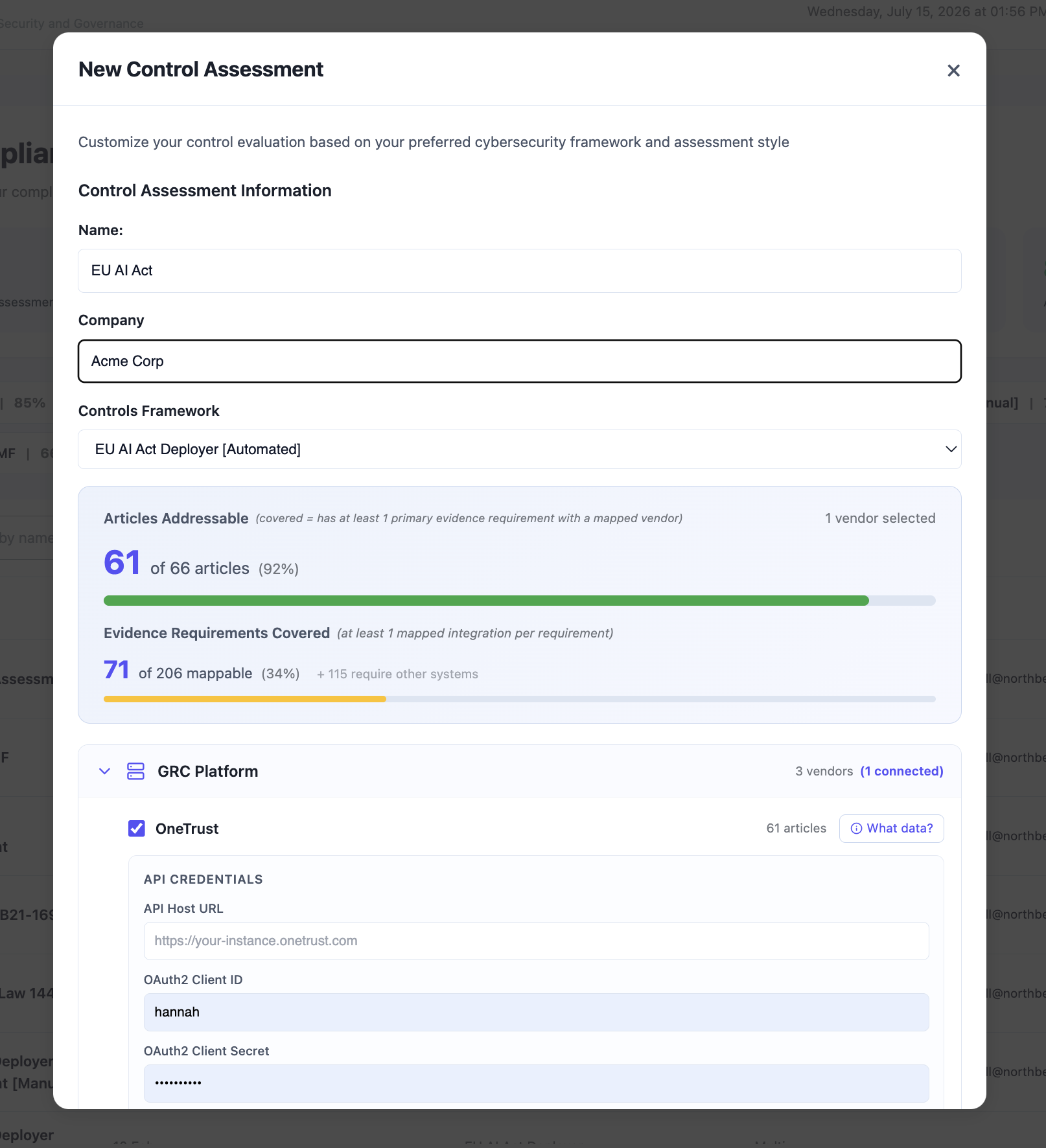
Coverage varies by which system is connected, so the figure is a starting position rather than a constant. An automated EU AI Act assessment that reads article by article also produces the auditor-facing output the conformity process expects, which removes the second pass most teams budget for. One organization moved from spreadsheets to audit-ready in weeks on that basis.
Sequencing the Work Against the Dates
Three horizons matter, and the work at each one differs in kind rather than degree. Transparency is a product change. Classification is an inventory exercise. High-risk documentation is a program.
- August 2, 2026, already in force: Confirm every customer-facing AI interaction discloses itself and every generated output is marked.
- December 2, 2026: Extend marking to legacy systems and confirm no prohibited practice exists anywhere in the estate.
- December 2, 2027: Complete classification, technical documentation, conformity assessment and registration for high-risk systems.
Classification Depends on Knowing What You Run
Classification cannot start without an inventory, and most enterprises discover their AI footprint is larger than recorded. Embedded features inside approved SaaS tools, models fine-tuned by individual teams, and unsanctioned assistants all fall inside scope while sitting outside any register. Building AI asset visibility and then surfacing shadow AI is the prerequisite step, not a parallel one.
Grandfathering Is Narrower Than It Sounds
Systems placed on the market before the new deadlines avoid full high-risk obligations until they undergo significant design changes. Ordinary model retraining, a new data source or an expanded use case can all qualify as significant, so treating grandfathering as permanent shelter tends to fail at the first material update.
What the Extension Is For
Sixteen additional months reads as relief and functions as a scoping window. The hardest requirements were never the paperwork itself, since drafting a document is tractable once the underlying evidence exists. Data lineage for models already in production, human oversight designed into interfaces rather than bolted alongside them, and conformity assessment scheduling with a notified body all take longer than the drafting they support.
Organizations treating December 2027 as a pause will meet it with the same problems, and organizations using the window to build operational AI governance rather than a document set will meet it with evidence already accumulating. The difference shows up in how emerging AI regulations land on a risk program, where the same records serve several frameworks at once.
The Same Evidence Serves Multiple Frameworks
Annex IV documentation overlaps substantially with NIST AI RMF and ISO 42001 expectations, so a single evidence base can satisfy several regimes. Mapping once and reporting many times is considerably cheaper than running parallel programs, and preparing across frameworks together avoids the duplication that makes AI compliance feel unbounded.
Two Dates Worth Putting in the Plan
August 2, 2026 has passed and its obligations are narrow.. December 2, 2027 is distant and broad. Treating the first as the whole obligation leaves high-risk work unstarted, and treating the second as the only deadline leaves transparency requirements unmet this month. Platforms such as Kovrr's AI Security and Governance Platform track obligations article by article against a live inventory, so classification, evidence collection and reporting run as one process instead of three.
To see which EU AI Act articles your current systems already satisfy and which still need evidence, book a demo mapped to your own AI inventory.

EU AI Act Compliance Roadmap FAQs
Speak to an ExpertWhat do enterprises need to do to comply with the EU AI Act?

Did the EU AI Act high-risk deadline change?
How do you classify an AI system by risk level?
What documentation is required for high-risk AI systems?
Who is responsible, the provider or the deployer?
What happens if a system was already deployed before the deadline?