
Hallucination
Hallucination is a failure mode of generative AI in which a model produces content that is plausible-sounding but factually incorrect, fabricated, or unsupported by any real source, presented with the same confidence as accurate output.
Why AI Hallucinations Happen
Generative AI models produce output by sampling from probability distributions learned during training. When the model does not have relevant information, or has conflicting information, it does not stop generating. It produces the most probable continuation given what it has learned, which can be entirely fabricated.
This is not a bug in a specific model. It is inherent to how current generative AI works. Techniques like retrieval-augmented generation (RAG) can reduce hallucinations by grounding output in retrieved sources, but do not eliminate them.
Why Hallucinations Are a Governance Concern
Hallucinated content that reaches customers or regulators can produce material harm. Legal citations that do not exist, product claims that are inaccurate, and technical guidance that contains fabricated details have all appeared in AI-generated content used by enterprises. The reputational and legal consequences can be significant.
Governance controls typically include output review requirements for high-stakes uses, source attribution requirements for factual claims, and appropriate use restrictions that prevent AI output from being treated as authoritative in contexts where it should not be.
Hallucination and Related Failure Modes
Hallucination is often confused with related failures. Model bias produces systematically skewed outputs. Model drift produces degrading performance over time. Hallucination specifically refers to the generation of confident-sounding fabrications, which is a distinct category with distinct controls.
Related Terms


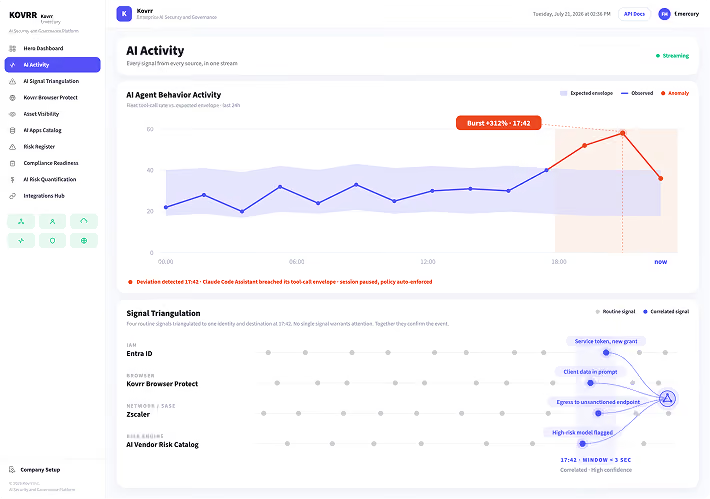
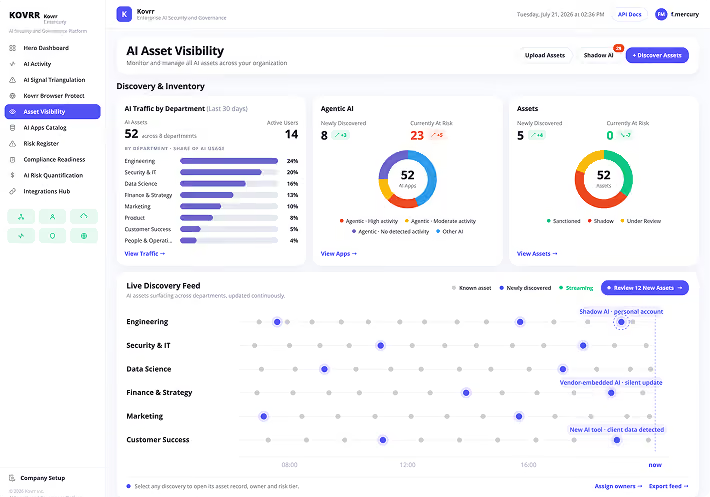
Full AI Visibility. Full Control. One Connected Platform.
Enterprise AI is expanding faster than most governance programs can track. Kovrr connects every AI signal across browser, endpoint, network, identity, and vendor systems into a single platform so security, governance, and risk teams work from the same evidence.