
AI Governance and AI Risk Management Frequently Asked Questions


Everything to Know About AI Governance and AI Risk Management
AI governance and risk management have quickly become essential pillars of responsible enterprise innovation. As organizations adopt AI across business functions, oversight structures and measurable safeguards are critical for maintaining compliance and trust. This FAQ addresses the most common questions about AI governance and risk management, helping you understand how to structure and strengthen your organization’s AI oversight program.
What’s included in an AI risk assessment report?
An AI risk assessment report covers model inventories, safeguard maturity, governance responsibilities, and identified exposures, usually benchmarked against NIST AI RMF and ISO/IEC 42001. Kovrr's assessment produces report-ready outputs structured for board discussion and regulatory review rather than for internal analysis alone.
What are the steps in conducting an AI risk assessment?
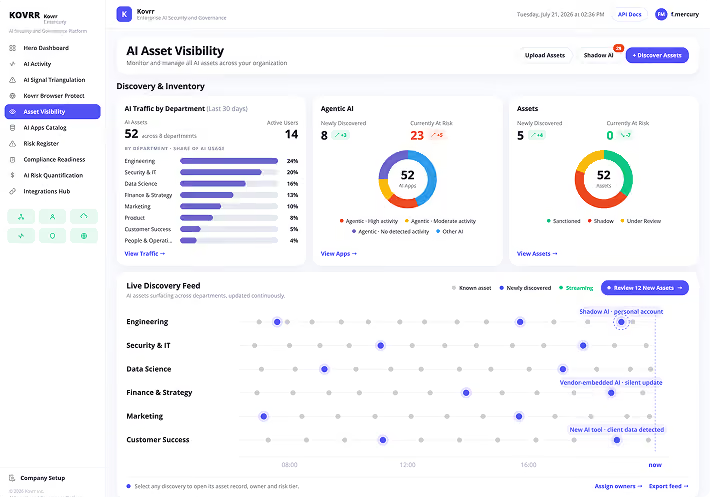
Cataloging models and data sources comes first, followed by evaluating safeguard maturity, governance accountability, and framework alignment. The cataloging step tends to take the longest, because the documented inventory and the actual one rarely match. Kovrr's AI asset visibility capability handles that discovery continuously, and the assessment then works from a current list rather than a stale one.
Who provides AI risk management services for enterprises?
Several firms offer AI oversight, mostly as advisory engagements that produce a report. The difference worth evaluating is whether the output is a point-in-time assessment or something that stays current, and whether it carries a financial figure. Kovrr combines governance structure, safeguard assessment, and financial modeling in one platform, with AI advisory services available where teams want support running the program.
What’s the best way to assess AI risk across multiple business units?
Consistency matters more than depth when AI use varies by department, because findings that are not comparable cannot be aggregated. Applying a standard framework across units keeps scoring and reporting aligned. Kovrr's AI governance capabilities support multi-entity evaluation, so maturity can be benchmarked across units and consolidated into one view. Finding the AI in each unit comes first, covered in how to identify and track AI use across business units.
How do organizations identify risks in their AI systems?
Risks surface through structured assessment of how data, models, and outputs interact, including model reliability, privacy controls, and operational dependencies. Dependencies are the most frequently missed, since a system can be well governed and still rely on a vendor that is not. Kovrr's AI risk assessment gives teams a systematic way to map exposure and document where oversight is thin.
What is AI risk management, and how is it different from cybersecurity risk?
AI risk management addresses exposures created by AI systems themselves, including data misuse, model bias, and regulatory non-compliance. Cybersecurity risk addresses protecting infrastructure and data from attack. The distinction matters because an AI system can cause serious harm while functioning exactly as designed, which no security control would flag. Kovrr's AI risk assessment capability evaluates the AI-specific safeguards traditional security tools do not cover.
Which frameworks guide responsible AI governance?
The NIST AI Risk Management Framework, ISO/IEC 42001, and the OECD AI Principles are the three most referenced. Each structures governance differently, and they define AI risk in meaningfully different terms, which is worth understanding before committing to one. Kovrr's AI risk assessment references all three so maturity can be benchmarked against whichever a regulator or customer asks about.
What are the biggest challenges in establishing AI oversight?
Fragmented accountability, no visibility into where models are used, and regulation that moves faster than the program. Underneath all three is the difficulty of connecting technical risk to business impact, which is what makes oversight hard to fund and hard to prioritize. Kovrr addresses that connection through assessment and quantification in a single structure.
How do you implement AI governance without slowing innovation?
Governance works best when it runs alongside deployment rather than gating it. Clear guidelines and automated assessment let teams move without waiting for review. Kovrr embeds oversight into normal workflows, so visibility into risk does not come at the cost of development pace, and evidence is produced as a byproduct rather than as a separate exercise.
Can AI governance help prevent compliance violations?
Yes, mostly by catching the conditions that lead to them. Enforcing data handling standards and documenting decisions creates a verifiable record, and the record is what turns an incident into a manageable finding rather than an enforcement problem. Kovrr's platform monitors compliance posture continuously and quantifies exposure where weaknesses appear.
How can companies create an effective AI governance framework?
An effective framework combines policy, accountability, and measurement. Define ownership for AI systems, set data-handling standards, and create a review process for new deployments, then measure whether any of it is working. Kovrr's AI risk assessment capability benchmarks safeguard maturity and shows where the framework needs reinforcement rather than where it looks complete.
What are the main goals of AI governance programs?
Fairness, reliability, transparency, and compliance, in service of understanding how AI affects operations and customers. The goal most often left out is measurability, without which none of the others can be demonstrated. Kovrr's AI governance capabilities map maturity, identify weak controls, and quantify what governance weaknesses could cost.
What are the best AI governance tools available right now?
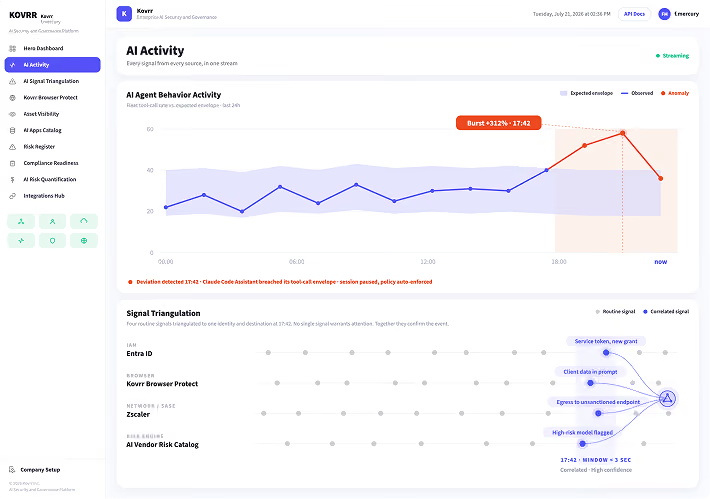
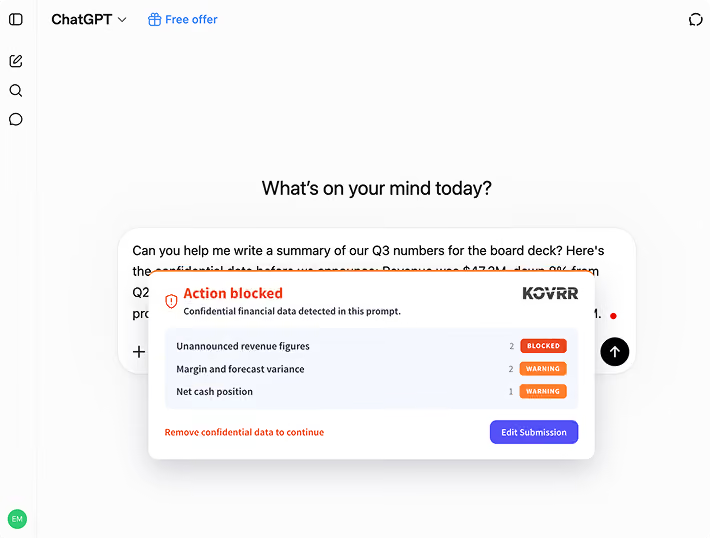
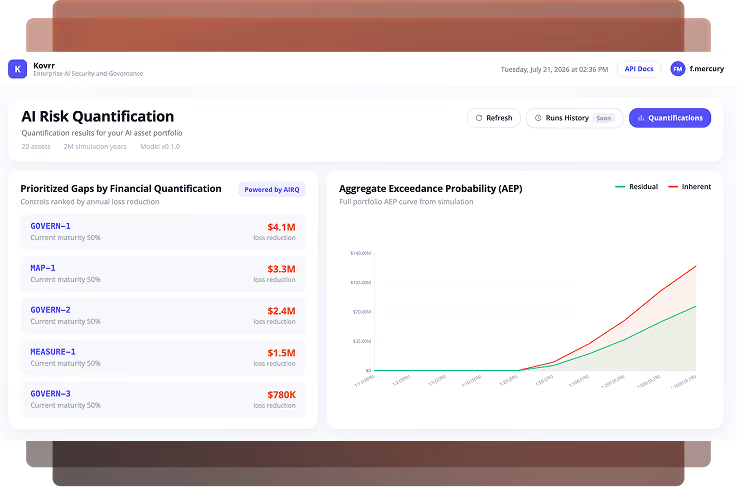
The criteria that separate tools are narrower than the category suggests. Coverage is the first: which surfaces a tool can actually see, including network, browser, endpoints, agents, identity, and cloud, and whether it reads them together or one at a time. The second is whether discovery connects to risk scoring, since an inventory that does not rank anything leaves prioritization to whoever shouts loudest. The third is whether evidence is produced automatically or assembled by hand before each audit. A detailed comparison of the platforms in this category covers how the major options differ. Kovrr's position is visibility and control first, with AI Risk Quantification (AIRQ) attaching a financial figure to what the inventory finds.
What is AI governance, and why does it matter for organizations?
AI governance is the structure that determines how AI is developed, deployed, and overseen. It defines who is accountable for each system, how decisions get documented, and how outcomes are measured. It matters because AI decisions are made at a volume and speed no manual review can keep up with, so accountability has to be designed in rather than applied afterward.
How can I tell if my organization has good AI governance practices?
Three signs. Policies exist and are consistently applied rather than consistently written. Accountability is documented, meaning someone can name the owner of any given system. And safeguard effectiveness is measured rather than assumed. Kovrr's AI governance capabilities provide those measurements, which is what lets an organization see progress instead of activity.
Who is responsible for AI governance within an enterprise?
Responsibility usually spans several roles: executive leadership approves policy, compliance monitors adherence, and technical teams implement controls. Some enterprises appoint a dedicated AI governance officer or committee, though the structure matters less than whether any individual system has a named owner. Who should be responsible depends on how organizations are actually resolving this. Kovrr supports these stakeholders by centralizing oversight data and linking governance activity to business outcomes.


